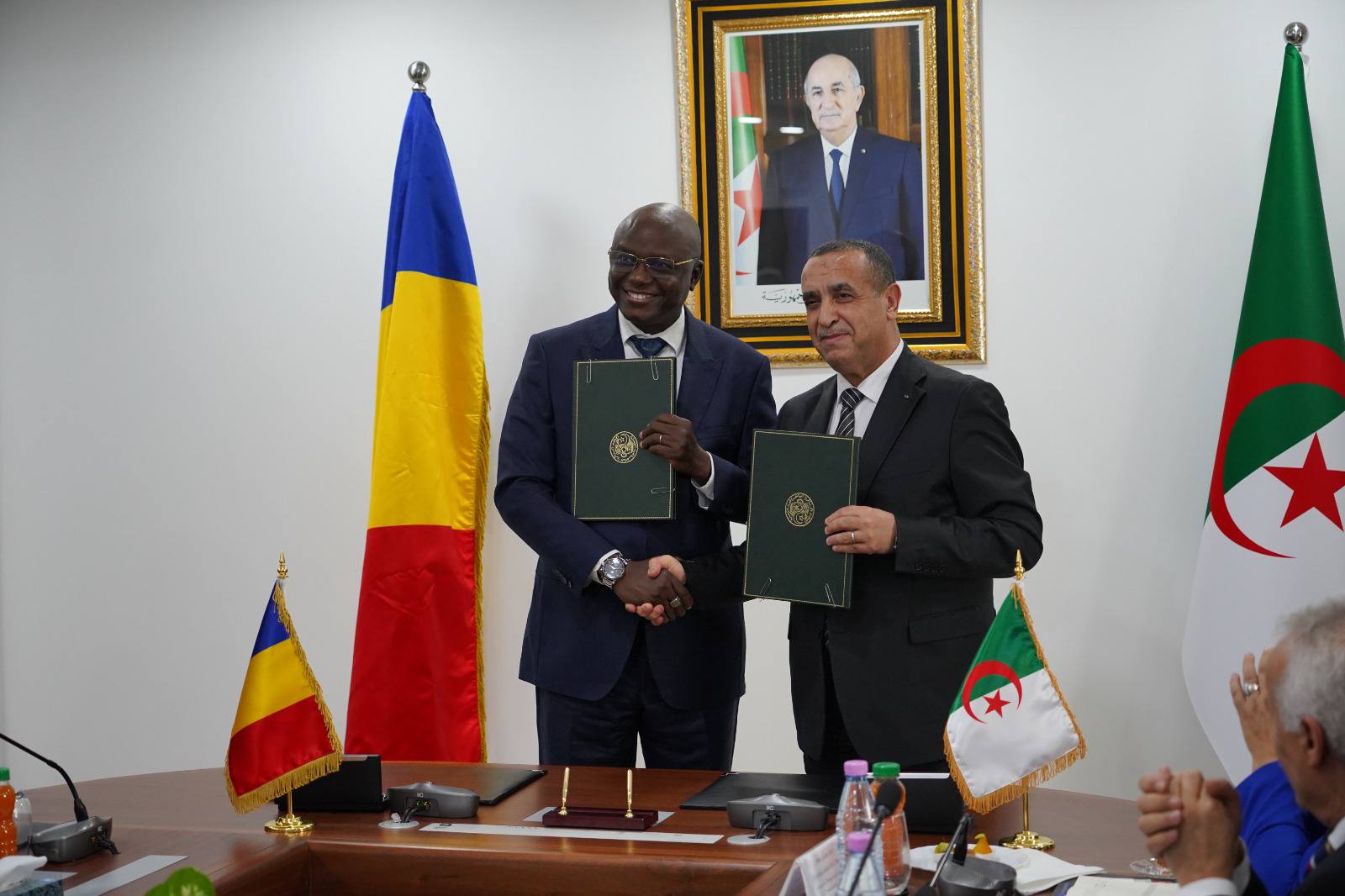
A significant agreement was formalized this Thursday in Algiers, marking a new chapter in cooperation between Algeria and Chad for the construction of a 40-megawatt (MW) power generation facility in N’Djamena.
The signing ceremony saw Algeria’s Minister of Energy and Renewable Energies, Mourad Adjal, and Chad’s Minister of Water and Energy, Passalé Kanabé Marcelin, affixing their signatures to the accord. This initiative underscores a commitment to bolster bilateral relations, aligning with the directives of Algerian President Abdelmadjid Tebboune, who champions support for African nations and the advancement of South-South cooperation.
technical study completed
This pivotal agreement followed extensive discussions between Minister Adjal and his Chadian counterpart, who was on a working visit to Algeria. Their exchanges focused on exploring avenues for bilateral cooperation in the energy sector, encompassing both conventional and renewable sources. The aim is to strengthen these ties through concrete projects spanning electricity production, transmission, and distribution, as well as the provision of essential electrical and gas equipment, alongside crucial training programs.
Minister Adjal confirmed the successful completion of the technical study for the power plant project. This milestone was achieved after technical teams from the Algerian Sonelgaz group visited Chad last week. He emphasized that both nations are now prepared to move forward with the export of necessary equipment, anticipating the imminent groundbreaking ceremony for the project. Furthermore, Adjal announced that Chadian technical teams are currently undergoing an intensive month-long training program at Sonelgaz academies in Algeria. These teams will be instrumental in operating the power plant once it becomes operational. The scope of bilateral cooperation is also set to extend to the rehabilitation of N’Djamena’s existing electricity grid.
Algeria, “a true benchmark”
From the Chadian perspective, Minister Passalé Kanabé Marcelin hailed the power plant agreement as a “historic milestone” for South-South cooperation and a crucial step in the evolving Algerian-Chadian relationship. He recalled that the foundations for robust cooperation between the two fraternal nations were laid during Chadian President Mahamat Idriss Déby Itno’s official visit to Algeria last April.
Marcelin conveyed his profound gratitude to President Tebboune for Algeria’s steadfast support and guidance in the energy domain. He acknowledged Algeria’s emergence as “a true benchmark” for numerous African countries, particularly in electricity provision, given its impressive production capabilities. Chad, he stated, is eager to leverage Algerian expertise, noting that 12 Chadian trainees are currently undergoing specialized training in Algeria for power plant operations, with future cohorts expected to benefit from similar programs.
a power plant “one hundred percent algerian”
Yazid Djellouli, President and CEO of Sonelgaz International, affirmed that the power plant in Chad will be “one hundred percent Algerian” in terms of its construction, equipment, and workforce. He assured that Chadian authorities would soon commence preparations for the designated site, moving in parallel with the transfer of equipment and the official launch of construction activities.
Djellouli elaborated on Sonelgaz International’s strategic objective to expand its footprint across Africa. Since its establishment last March, the company has received numerous inquiries from various African nations regarding energy and related infrastructure projects. Complementing this, Saleh Ben Haliki, Director General of Tchadienne d’électricité (TchadElec), lauded the power plant initiative as one of the initial tangible outcomes of the “new relations” between Algeria and Chad in the energy sector. He reiterated Chad’s strong desire to benefit from Algerian expertise, recognizing Algeria’s transformation into “a true benchmark” for electricity coverage across the continent.