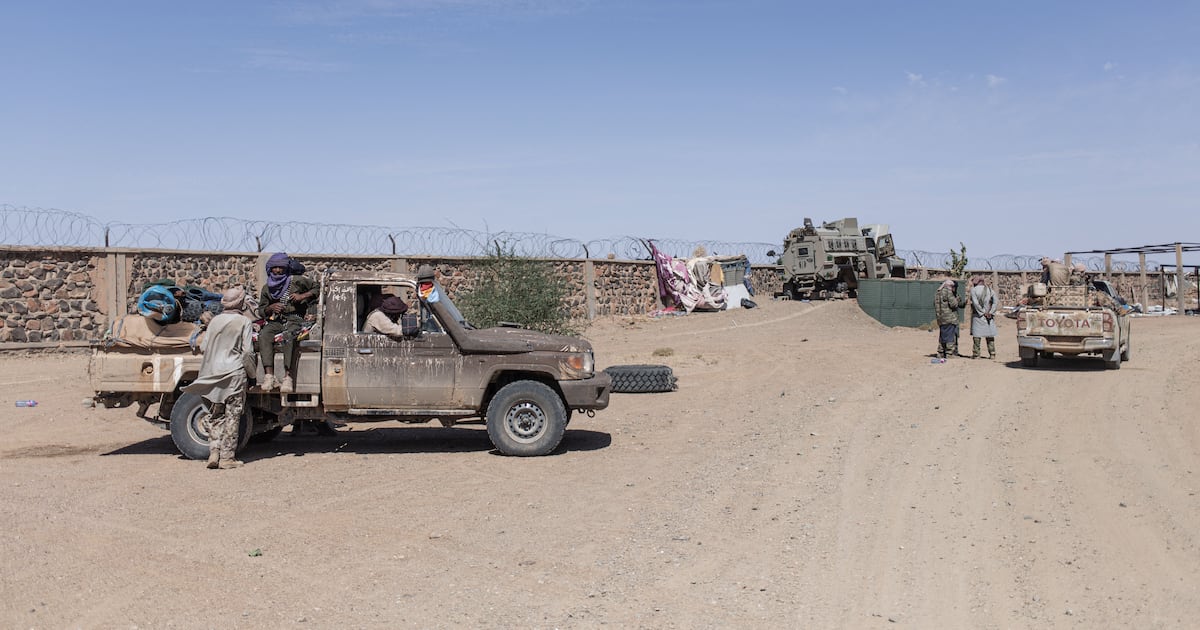
Following the coordinated assaults on April 25 and 26 targeting key Malian cities such as Bamako, Kati, Gao, Sévaré, and Kidal, a previously unspoken question has re-emerged within Mali’s security discussions: should dialogue be initiated with jihadist factions? Given the extensive nature of this joint offensive, spearheaded by the Al-Qaïda-aligned Jnim (Jamaat Nusrat al-Islam wal-Muslimin) and the Tuareg rebels of the Front de libération de l’Azawad (FLA), a growing consensus among analysts and experts suggests that a purely military approach is proving inadequate.
Across Mali, from its northern reaches to the south, the scale and speed of this offensive have been unparalleled. Armed entities launched multiple synchronized attacks against military installations and state symbols in at least six urban centers, reaching as far as the outskirts of Bamako. This marked the first time the Jnim and the FLA visibly collaborated. Established in November 2024 following the dissolution of the Cadre stratégique permanent (CSP), the FLA advocates for self-determination in Azawad, a significant northern Malian territory.
These recent assaults starkly revealed the Malian government’s susceptibility. Neither Assimi Goïta’s junta nor its Africa Corps allies from Russia appear capable of halting the armed groups’ advance. Regional media and diplomatic circles are now more openly discussing the prospect of talks with the Jnim, amidst increasing pressure on Bamako and a deepening regional quagmire. Despite this, the junta publicly dismisses any notion of negotiation, maintaining a firm stance against “any dialogue with terrorist armed groups” and adhering to a strictly military strategy, even as the security landscape rapidly deteriorates.
Since late April, however, the regime has faced relentless pressure. Violence in the central regions of the country is escalating dramatically. Just recently, villages in the Bankass area, including Kouroude and Dougara, came under attack. Reports from local and security sources indicate a combined death toll ranging from 70 to 80 fatalities from the Wednesday and Friday assaults.
Unprecedented Alliance: A Critical Warning
The Jnim remains the primary driver of jihadist activity across the Sahel, impacting Mali, Burkina Faso, and Niger significantly. For the military juntas forming the Alliance des États du Sahel (AES), the situation is becoming increasingly dire. Despite pledges to restore security upon taking power, they are struggling to control an ever-expanding threat. In Mali, for nearly a year, attacks have been drawing closer to the capital with alarming consistency.
« Starting in July 2025, jihadists initiated attacks in western Mali, targeting gold mining and industrial sites. They subsequently focused on the Bamako-Dakar corridor, effectively choking the capital, » notes Alain Antil, director of the Ifri’s Sub-Saharan Africa Center. Héni Nsaibia of Acled observes, « What is striking this time is not merely the scale of the operation, but also the intentional selection of targets. Kati and Bamako represent the very core of the regime. »
The demise of Defense Minister Sadio Camara in Kati dealt a significant blow to the authorities. Concurrently, the recapture of Kidal in late 2023, once hailed as a major triumph, now stands as a considerable strategic setback.
The Strategy of Asphyxiation
Even prior to this latest offensive, various experts had noted a shift in Jnim’s tactical approach. Alain Antil had previously explained, « There is an intent to establish a more potent power dynamic, not only through security pressure but also to compel Malian authorities into negotiations. »
The jihadist group now aims to replicate nationally the tactics it has refined locally: economic blockades, gradual encirclement of urban centers, and applying pressure on vital logistical arteries. The researcher emphasizes, « The Jnim is attempting to sustain an economic blockade around Bamako. »
Abdel Nasser Ould Ethmane Elyessa views this strategy as a long-term endeavor: « They have opted to undermine the government from within, favoring a strategy of attrition and exploiting vulnerabilities within the military system. » He further notes, « The Jnim no longer insists on the implementation of Sharia law as a prerequisite for peace and now expresses openness to negotiation. »
Within this complex environment, the ongoing rivalry with the État islamique au Grand Sahara (EIGS) introduces another layer of instability, as both groups vie to expand their territorial control and influence.
A Taboo Option Gains Ground
Officially, Sahelian regimes reject any notion of dialogue. Alain Antil remarks, « For the leaders of the AES, political negotiation is not on the table. The rhetoric remains martial, with military response presented as the sole viable option. »
However, the reality on the ground is considerably more intricate. Atrocities committed by state forces and their allies have severely eroded public trust. Between January 2024 and March 2025, approximately 1,500 civilians were killed by Malian governmental forces and their Russian partners, a figure nearly five times higher than those attributed to the Jnim, according to GI-TOC data. Such violence fuels public resentment and inadvertently aids jihadist recruitment efforts.
States must commit to a courageous compromise.
Abdel Nasser Ould Ethmane Elyessa, Sahel researcher
Confronted with this deadlock, a growing number of specialists advocate for a fundamental shift in approach. Alain Antil of the Ifri asserts, « A purely military option is a dead end against the jihadist phenomenon in the Sahel. It must be paired with political negotiations. » While acknowledging their inherent violence, certain grievances articulated by jihadist groups—such as corruption, demands for justice, and access to resources—could potentially serve as starting points for dialogue.
Abdel Nasser Ould Ethmane Elyessa expands on this, stating, « States must embrace a brave compromise. The concept would involve integrating jihadists into the political framework to expose their limitations. » However, he establishes clear red lines: « The principles of gender equality and the secular nature of the state are non-negotiable. »
As jihadist offensives continue their advance, the concept of negotiation is transforming from a radical notion into a pragmatic political consideration. For many Malian experts, the central question is no longer whether to engage in dialogue, but rather how much longer Bamako can realistically avoid it.