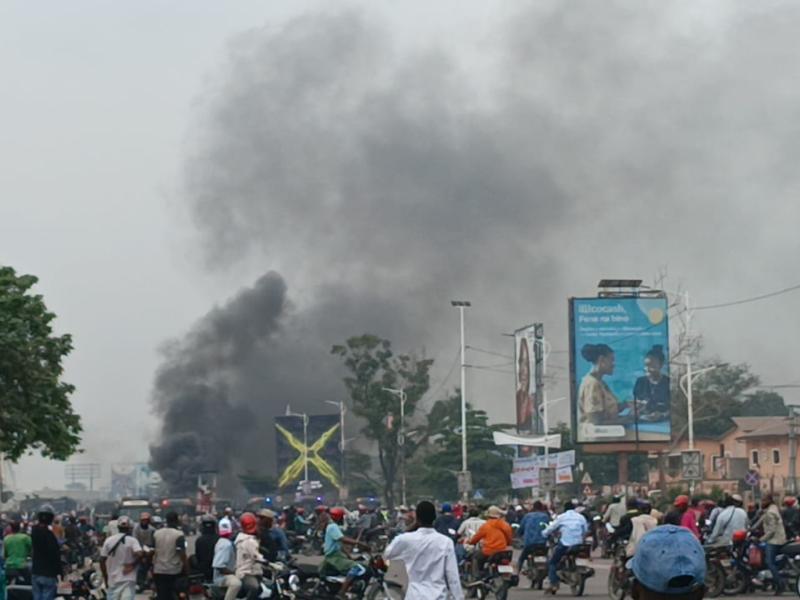
DRC political tensions escalate as Kabuya and Mbata clash over C64 march
- Politics
Tensions within the Democratic Republic of Congo’s ruling coalition have reached a new peak as prominent figures Augustin Kabuya and André Mbata engage in a public feud over the upcoming C64 march scheduled for July 22 in Kinshasa. The march, organized by the Coalition for Article 64, will demand President Félix Tshisekedi’s resignation, accusing him of constitutional betrayal following revelations about his plans to amend the 2006 constitution.
Opposing strategies spark conflict
While the opposition prepares to take to the streets, André Mbata, a constitutional law professor and member of the Sacred Union of the Nation (USN) platform, has called on all USN members—including political parties, associations, and individuals—to participate in nationwide protests against what he describes as an “illegal coup” aimed at undermining the Congolese people’s sovereignty. Speaking from Yaoundé, Cameroon, where he is on an official mission, Mbata urged supporters to mobilize not only in Kinshasa but also in all 25 provincial capitals and the diaspora.
In stark contrast, Augustin Kabuya, Secretary-General of the ruling Union for Democracy and Social Progress (UDPS) party and a key member of the USN presidium, has issued a directive urging UDPS members to ignore the opposition’s march entirely. In a terse statement released on July 13, Kabuya declared that “no march is planned for that date” and cautioned against using routes designated for the opposition’s demonstration. His directive, which many interpreted as an attempt to demobilize supporters, has drawn sharp criticism from Mbata.
Mbata swiftly countered Kabuya’s stance, dismissing it as politically misguided and legally untenable. In a scathing response, he emphasized that the USN, comprising over 900 parties and associations, cannot be reduced to the position of a single component. “A premature and clumsy statement made by the leader of a party or association within the USN only reflects their personal opinion,” Mbata argued. He went on to accuse Kabuya of failing to uphold the platform’s principles, particularly as the opposition prepares to march against what Mbata calls “individuals with malicious intent who disregard the Constitution.”
Mbata concluded by asserting that USN members should disregard any messages not issued by the platform’s Permanent Secretary, whom he identifies as the official spokesperson. This public rebuke underscores the deepening divisions within the ruling coalition, which has already faced internal strife in the past.
Shadows of past conflicts
The rift between Kabuya and Mbata is not without precedent. In 2024, Mbata publicly distanced himself from Kabuya during a dispute with Déo Bizibu, then Kabuya’s deputy at the UDPS. More recently, their differences resurfaced during the April gubernatorial elections in Sankuru province, where Mbata openly opposed Kabuya’s candidate, instead backing Jules Lodi Emongo, who went on to win the election. Following this setback, Kabuya publicly accused Mbata of undermining the party’s authority and instructed UDPS members to cease financial contributions to him.
As the July 22 march approaches, the clash between Kabuya and Mbata highlights the growing instability within the Sacred Union of the Nation. With less than two years remaining in President Tshisekedi’s second and final term, these internal divisions risk further destabilizing the political landscape of the DRC.
Related Posts
Germany’s world cup exit: a historic shootout defeat for the Mannschaft
Germany – Paraguay: “one of the worst days for german football”… how the Mannschaft was once again embarrassed Deutsche not…

Life-saving ambulance strengthens healthcare in Oicha, North Kivu
Alain Akpadji, the UNFPA Representative, recently delivered a fully equipped, medicalized ambulance to the Oicha General Referral Hospital, specifically for…
Thousands of displaced Dogon return to central Mali under strict conditions
Thousands of displaced Dogon return to central Mali under strict conditions Mahamadou Kane Several thousand displaced residents from the Bankass…