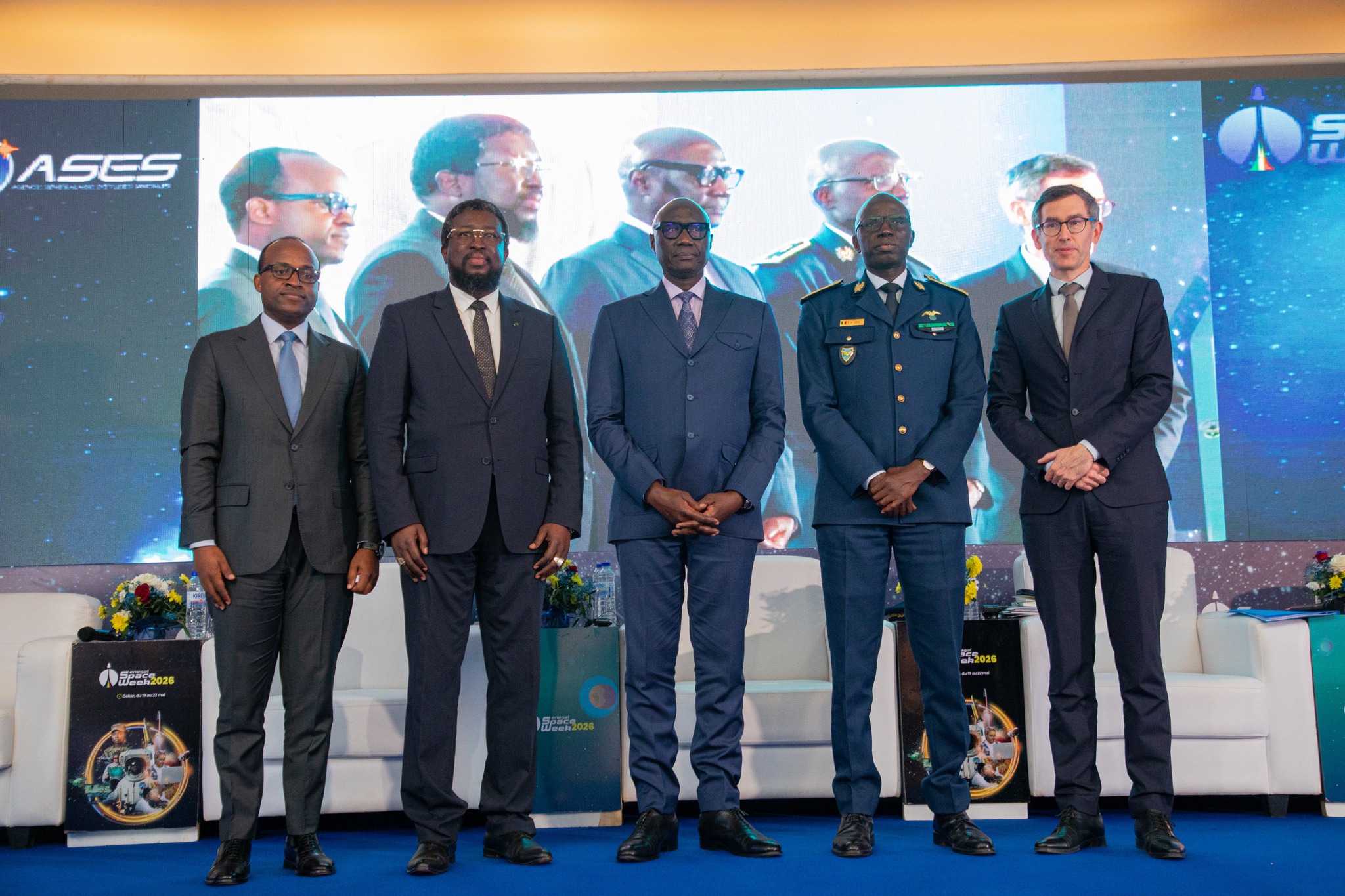
Dakar is positioning itself as a rising hub in Africa’s space and technology sectors. The second edition of Sénégal Space Week, held under the high patronage of President Bassirou Diomaye Faye, underscores the country’s commitment to advancing its technological sovereignty through satellite innovation, artificial intelligence, and geospatial intelligence.
This year’s event, organized by the Agence Sénégalaise d’Études Spatiales (ASES), focuses on leveraging space technologies to enhance national security, defense, and territorial governance. With the theme “Space for Security and Defense: Geointelligence and Applications for Territorial Safeguarding,” the conference aims to solidify Sénégal’s role in Africa’s evolving space ecosystem.
Space technology as a pillar of national sovereignty
The Minister of Armed Forces, Biram Diop, emphasized that the global power dynamic is increasingly shaped by technological capabilities, particularly in space and data systems, rather than traditional military domains. He highlighted the critical role of space-based tools in border surveillance, cybersecurity, strategic intelligence, maritime security, counterterrorism, and disaster prevention.
“Mastery of space capabilities is no longer optional—it is a necessity for nations seeking true sovereignty,” stated the Air Force General during his keynote address.
Structuring Sénégal’s space strategy around geointelligence
Maram Kaïré, Director General of ASES, outlined a comprehensive vision for Sénégal’s space program. He stressed the importance of integrating satellite data, artificial intelligence, and geographic information systems to strengthen analytical capacities, foresight, and public decision-making. Kaïré also highlighted ongoing collaborations with defense and security forces to develop geointelligence frameworks as a strategic asset for national security.
Building the infrastructure for a space-powered future
Beyond policy declarations, Sénégal is actively developing the physical and institutional foundations for its space ambitions. Key initiatives include the construction of the country’s first astronomy and astrophysics observatory in Khombole, with groundbreaking ceremonies held in late 2025. Additional projects involve satellite data reception and processing stations, high-performance computing platforms, innovation hubs, and future microsatellite assembly and testing facilities.
These efforts are designed to nurture a domestic scientific and technological industry centered on space exploration and innovation.
Diplomatic engagement to amplify Sénégal’s influence
The ASES is pursuing an active space diplomacy strategy, forging partnerships with international agencies, research institutions, and global organizations. According to Kaïré, these alliances aim to facilitate technology transfers, attract high-tech investments, and position Sénégal as a credible and respected voice in international space governance debates.
Investing in human capital for long-term success
Sénégal’s leadership recognizes that sustainable progress in space technology hinges on a skilled workforce. Priorities include engineering education, STEM development, public awareness campaigns, youth mentorship, and university specialization in aerospace and AI fields.
“No space ambition can succeed without substantial investment in human capital,” affirmed the ASES Director General.
By fostering local expertise and innovation, the country seeks to embed its technological sovereignty within the global landscape of high-tech industries, where data, AI, and satellite systems are reshaping economic and geopolitical power structures.