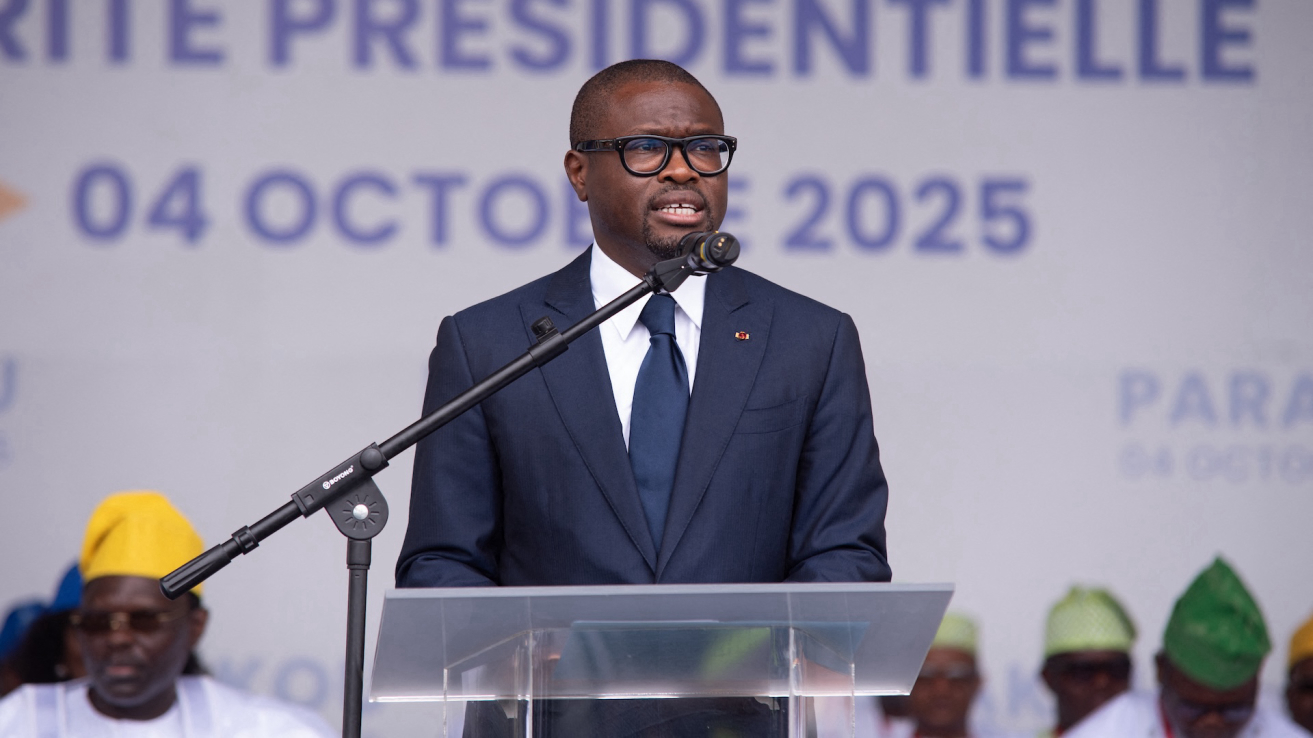
Romuald Wadagni takes office under heavy pressure at Bénin’s helm
Romuald Wadagni secured victory in Bénin’s presidential election on April 12, winning 94.27 % of the vote against challenger Paul Hounkpè, who conceded defeat and urged national unity and respect for republican values. The Constitutional Court certified a turnout of 63.57 %, a sharp rise from the 50.17 % recorded in 2021.
Democratic continuity amid regional instability
This marks Bénin’s fifth peaceful democratic transition since the 1990 National Conference. In an era where neighboring countries frequently extend presidential mandates, outgoing President Patrice Talon’s decision to step down after two terms has bolstered the country’s institutional stability.
The election proceeded smoothly, though isolated irregularities—including allegations of ballot stuffing—were reported. Investigations are underway to determine accountability. The Electoral Commission, Constitutional Court, and international observer missions concluded that these incidents did not undermine the election’s credibility. The Court invalidated 34,596 votes nationwide due to irregularities.
A weakened opposition faces uncertain future
Paul Hounkpè posed no real challenge to the ruling party’s candidate. His party, Forces Cauris pour un Bénin émergent, underperformed in the January 2026 legislative and local elections, as well as the 2021 presidential vote, securing just 4.78 %, 6.65 %, and 11.37 % of the vote respectively.
The opposition remains fractured after former President Boni Yayi stepped down as leader of Les Démocrates in March 2026, triggering internal strife and defections. Without reform to the 15 % sponsorship rule introduced in the 2024 electoral code revision, the opposition may remain sidelined until at least the 2040 election.
Economic architect inherits growth but persistent poverty
Wadagni, who served as Finance Minister for a decade under Talon, is credited with steering Bénin’s economic turnaround. Under his guidance, annual GDP growth surged from 1.8 % in 2015 to around 8 % by 2025. Yet despite this progress, over 40 % of Béninois still live below the poverty line.
The new administration’s top priority is translating economic growth into inclusive development. Wadagni’s 2026–2033 agenda prioritizes three pillars: universal social well-being, a diversified and competitive economy, and national cohesion and security.
Political pluralism and regional cooperation on the agenda
Restoring political pluralism and institutional balance will be critical. The 2025 constitutional reforms, which tightened electoral participation rules, reduced civic space and restricted opposition engagement. A constitutional clause allows for a “pact of republican responsibility” between the government and political parties under Senate mediation, but its implementation risks stifling debate rather than fostering consensus.
The new president must also revitalize regional cooperation amid persistent security threats. Terrorist attacks continue in northern Bénin, and relations with Burkina Faso and Niger remain strained despite improved ties with Nigeria following its support during last year’s coup attempt.
Wadagni has signaled a conciliatory regional approach, acknowledging that Bénin cannot tackle multi-faceted security challenges alone. However, meaningful cooperation hinges on political will from Niamey and Ouagadougou. Without renewed collaboration, the porous borders and W-Arly-Pendjari complex will remain havens for armed groups, destabilizing all three nations.
Institutional reforms and the shadow of Talon
The November 2025 constitutional changes introduced a powerful Senate with authority to review and request second readings of National Assembly legislation. Speculation persists that Talon may be appointed to lead the Senate, potentially creating a dual-executive structure that could strain governance.
As Wadagni prepares to implement institutionalized citizen participation and public accountability dialogues, the government must quickly engage in national dialogue to assess contested reforms, address gaps, and build broad-based consensus while upholding democracy and the rule of law.
The December 7 coup attempt underscored the fragility of Bénin’s democratic gains. For the opposition to regain relevance, it must reinvent itself as a credible alternative and effective counterbalance. The coming seven years will test whether Bénin can balance growth, inclusion, and stability—or risk backsliding into instability.