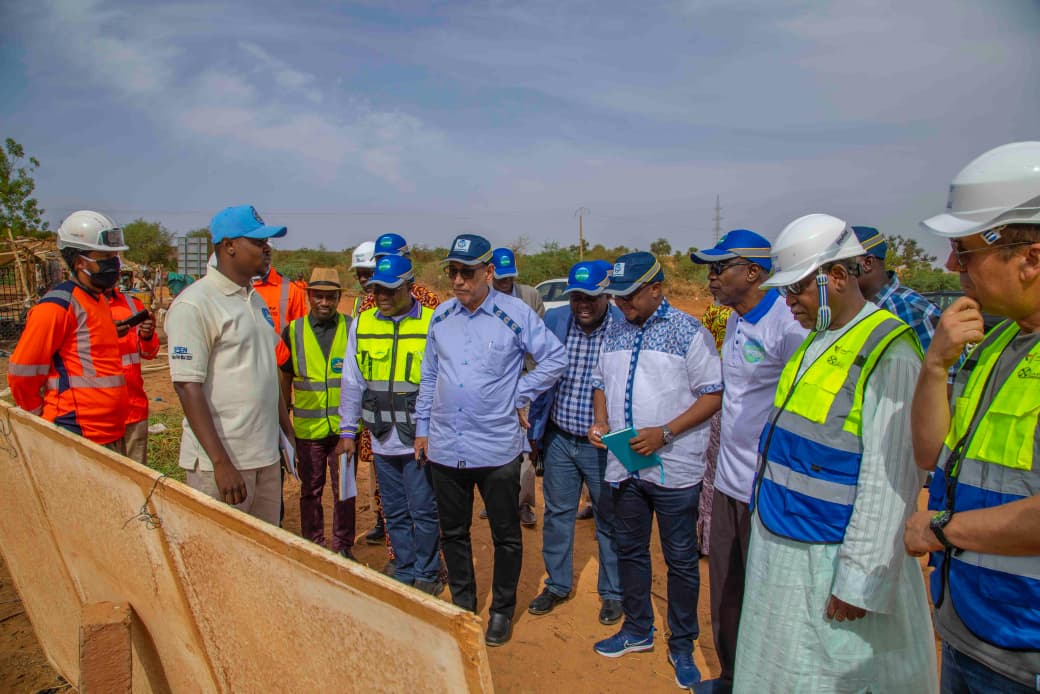
The Integrated Platform for Water Security in Niger (PISEN) has achieved a significant milestone with a joint inspection of Niamey’s third drinking water treatment and production plant by national and international stakeholders. Led by PISEN National Coordinator Zibo Zakara and World Bank Project Manager Mohamed Nanzoul, alongside SPEN officials, the delegation assessed progress at critical construction sites, including the water intake facility, the treatment plant itself, and the future reservoir locations.
This ambitious project, launched under Niamey’s 2017 Urban and Semi-Urban Water Master Plan, aims to deliver 250,000 cubic meters of clean water daily across three development phases. The initial phase will provide 100,000 m³/day, followed by two additional phases of 75,000 m³/day each. The ultimate goal is to dramatically improve water access in Niamey’s urban and peripheral neighborhoods, with PISEN serving as the coordinating body, supported by the World Bank and implemented by SPEN as the lead contractor.
Critical infrastructure taking shape across Niamey
Technical teams confirmed that raw water will be transported to the treatment facility via an elevated pipeline to the Yawari plateau, where two 2,500 m³ reservoirs are under construction. These reservoirs will serve as distribution hubs for surrounding neighborhoods, ensuring reliable water supply to areas currently facing shortages.
Zibo Zakara emphasized that the first phase of 100,000 m³/day will secure Niamey’s water supply through 2035. The project encompasses ten distinct construction packages, with provisions for future expansions of the river water treatment system. While acknowledging earlier delays, he highlighted the current acceleration in activities, particularly at the water intake site and Yawari plateau, where heavy machinery and local labor are actively engaged.
“The project has truly gained momentum,” Zakara noted. “Workers on packages six and seven are excavating foundations, and local subcontractors are employing significant manpower, directly benefiting community members.”
World Bank praises project’s social and economic impact
World Bank Project Manager Mohamed Nanzoul praised the construction progress, reaffirming the institution’s commitment to supporting Niger’s government in improving citizens’ quality of life through sustainable water infrastructure.
Project Manager Haladou Laouali Amani provided further details about the construction timeline, reporting that site mobilization and setup are complete. Topographic and geotechnical studies have been finalized, and the project’s scale promises transformative benefits for Niamey residents. “This is a landmark initiative,” he stated. “It represents one of the most substantial investments ever made in potable water capacity here. Approximately 45,000 social connections will be established, ensuring widespread access.”