An unprecedented assault on Niamey’s international hub
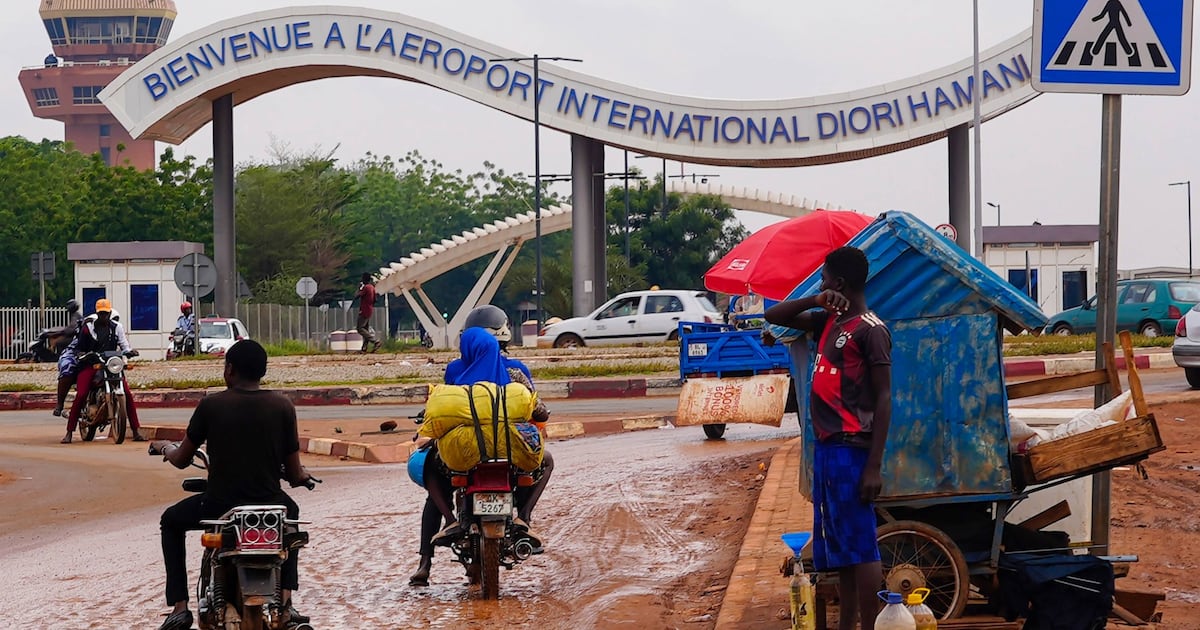
The night of January 28 to 29 marked a dark chapter in Niger’s modern history when sustained gunfire and explosions rocked the Diori Hamani International Airport in Niamey. What makes this incident exceptional is that the capital itself became the target of an assault later claimed by the Islamic State in the Sahel (EIS) through its AMAQ propaganda outlet.
Nigerien authorities reported that the attack lasted approximately one hour before being repelled through an air-land counteroffensive. Official figures—though unverifiable by independent sources—indicate 20 attackers killed, 11 captured, and four soldiers injured. On February 2, Russia’s Foreign Ministry confirmed the involvement of Africa Corps personnel, a unit under the Russian Ministry of Defense, in securing the airport alongside Nigerien forces.
Russian partnership praised by Niger’s military leadership
General Abdourahamane Tiani, leader of Niger’s junta, publicly commended the professionalism of Russian partners deployed in their designated security sector around the airport perimeter. This area hosts the critical Air Base 101, a cornerstone of Niger’s military infrastructure.
Propaganda in motion: EIS releases chilling footage
On February 2, the Islamic State in the Sahel escalated its psychological warfare by releasing a video allegedly filmed during the attack. The AMAQ-branded footage depicts dozens of armed militants, some on motorcycles, advancing through the airport’s restricted military zone.
The visuals show attackers approaching hangars, opening fire, and setting fires. Two small aircraft and a helicopter appear damaged—equipment matching part of the Nigerien air force’s arsenal used against jihadist groups. Satellite imagery taken after the assault confirms scorched areas near the runway.
The video then shifts to the airport’s civilian section, where militants film commercial planes bearing the liveries of Asky Airlines and Air Côte d’Ivoire. While Nigerien authorities acknowledged damage to three civilian aircraft, the Defense Ministry mentioned damaged equipment, including a stock of munitions that caught fire—without further details.
Niamey emerges as a new jihadist battleground
While Niger has faced a decade of violence from the Support Group for Islam and Muslims (JNIM)—an Al-Qaeda affiliate—and the EIS in the country’s west and southeast, direct attacks on the capital remain rare. Just days before the airport assault, the JNIM claimed responsibility for destroying a military vehicle east of Niamey, signaling growing pressure on the central government.
This surge in jihadist activity coincides with Niger’s military regime overhauling its security partnerships. Since the July 26, 2023 coup, Niamey has strengthened ties with Moscow while distancing itself from Western allies. Following the forced departure of French troops in late 2023, the United States withdrew most of its military presence in 2024, though diplomatic channels remain open.
Diplomatic tensions flare amid accusations
In a fiery speech, General Tiani accused France, Benin, and Côte d’Ivoire of sponsoring the attack—a claim swiftly condemned by Abidjan and Cotonou. Côte d’Ivoire summoned Niger’s ambassador, denouncing the remarks as grave and warning of potential bilateral fallout.
Meanwhile, nearly 300 Italian troops stationed in Niger as part of the Italian Support Mission in Niger (MISIN) were present at the site. Italian Defense Minister Guido Crosetto reassured that his forces played no role in the fighting, emphasizing their absolute priority on security.
A high-stakes target with regional implications
The airport’s significance extends beyond symbolism. It serves as an air base, headquarters for the joint force of Niger, Mali, and Burkina Faso, and stores a substantial uranium concentrate shipment. This stockpile, central to a dispute with the French firm Orano, could be transferred to Russia, though Niamey has yet to finalize logistics for its removal.
Despite the attack, commercial flights resumed the following day. Life in surrounding neighborhoods quickly returned to normal, but the event signals a turning point. By striking the capital’s logistical and military core, the EIS demonstrated its disruptive capabilities, while Russia’s involvement underscores Niger’s shifting security alignment—a shift that risks fueling further regional tensions.