
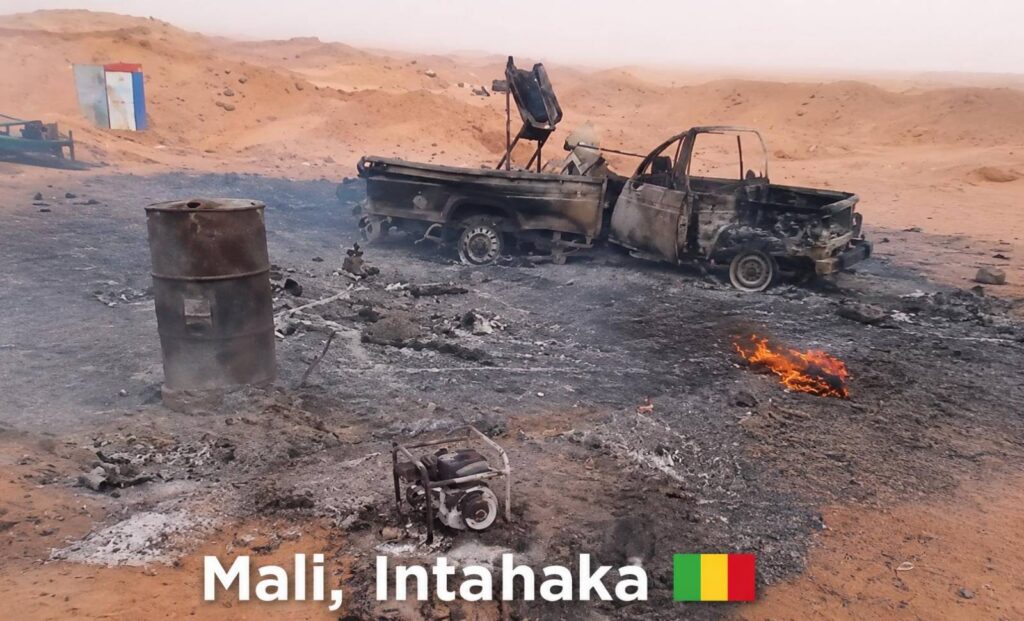
A Malian Armed Forces (FAMa) drone tragically struck a vehicle belonging to the GATIA armed movement in the Intahaka mining area, close to Gao, on the morning of May 18. This latest incident, which resulted in fatalities, underscores a profound strategic misstep by the ruling military junta. As Mali grapples with escalating assaults from both rebel factions and terrorist groups, advanced technologies, intended to bolster security, appear to be exacerbating the turmoil, pushing local communities into unprecedented economic and humanitarian distress.
Intahaka’s tragic misfire: a system breakdown
The news, which broke at dawn this Monday, sent shockwaves across northern Mali. Multiple reliable local sources confirm that a Malian army drone strike obliterated a pickup truck associated with the Tuareg Imghad Self-Defense Group and Allies (GATIA). Initial reports indicate several dead and critically wounded among the militia members, who have paradoxically fought alongside Bamako for years to counter instability.
Initially portrayed by official channels as a «neutralization of terrorists» by official propaganda, this operation quickly unraveled as a tragic blunder. This glaring lack of operational coordination on the ground exposes deep technical deficiencies and a severe deficit in foresight within an army seemingly waging war blindly, under the watchful, yet seemingly impotent, gaze of its Russian Africa Corps partners.
Technological illusion versus ground realities
For several months, the military junta led by Colonel Assimi Goïta has championed its «drone-centric» strategy as a miraculous solution for reclaiming national territory. However, the situation on the ground tells a different story. Far from stabilizing the nation, these aerial vehicles are increasingly responsible for dramatic targeting errors, frequently striking civilians, as seen in the recent tragedy in San, and now, regrettably, its own tactical allies.
While Bamako flounders in its technological miscalculations, the threat itself intensifies. The Permanent Strategic Framework, now rebranded as the Azawad Liberation Front (FLA), alongside the jihadists of the Group for the Support of Islam and Muslims (JNIM), are conducting offensives of unprecedented scale. The de facto alliance of these groups has routed government forces in several critical areas, demonstrating the junta’s asymmetric strategy is utterly ineffective against mobile insurgents who now also possess jamming technologies and kamikaze drones.
Intahaka’s bleeding gold: an economic lifeline choked
The choice of location for this grave error is not coincidental. The Intahaka site hosts the largest artisanal gold mine in the Gao region. A vital economic artery for northern Mali, this mining zone is embroiled in a fierce struggle for control among the state, various armed groups, and smuggling networks.
The persistent instability has a devastating economic toll on the local economy. Gold panning activities, which sustain thousands of families, are constantly disrupted by clashes and indiscriminate firing. «On ne sait plus où fuir. Déjà que les routes sont bloquées par les terroristes et que les prix des denrées ont triplé à Gao, si même le ciel dirigé par Bamako nous bombarde, c’est la fin», confided a local resident from the area, speaking anonymously. For the civilian population, the presence of the army and its aerial assets has become synonymous with terror rather than liberation.
The Intahaka incident serves as a stark symptom of a deeper malaise: the political and military deadlock into which the junta has plunged Mali. By abandoning peace accords and relying exclusively on a military response disconnected from human realities, Bamako is alienating its remaining on-the-ground allies, such as the GATIA.
Today, as the northern and central regions increasingly slip from state control, the slogan of «restoring national sovereignty» rings tragically hollow. Should the Malian military leadership continue to conflate war rhetoric with strategic efficacy, it risks not only mistakenly eliminating its own allies but also jeopardizing the very future of an entire nation.
You may also like
Le carnet de Malian relance l’enquête sur la migration clandestine au Sénégal
Mamadi Doumbouya de retour à Conakry après une visite d’État en Côte d’Ivoire
Elversberg vs Bayern Munich: kick-off time, tv channel and team news
Gabon : l’association Force ouvre un espace de propositions pour la rentrée
Dakar 2026 : Diomaye Faye confie la flamme olympique à la jeunesse sénégalaise