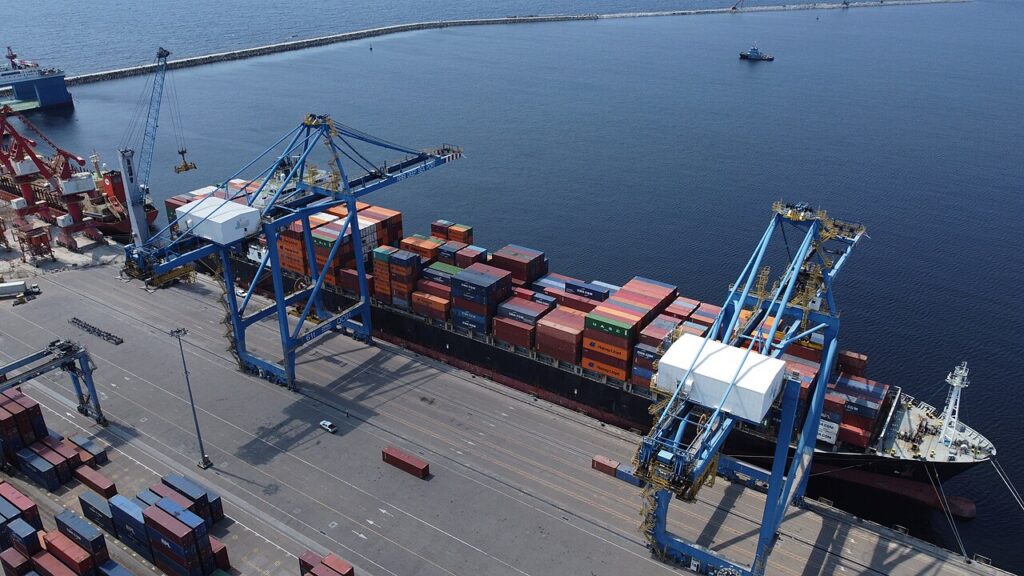
Once a remote fishing village with dirt tracks and scattered homes, Mboro on the edge of Kribi in southern Cameroon now hosts one of Central Africa’s most advanced deep-water ports, reshaping daily life and economic prospects across the region.
That transformation has not stayed confined to the coastline. It has rippled through household incomes, career paths, freight routes and industrial investment, altering how thousands of Cameroonians work, earn and move goods.
For decades, Cameroon had planned a deep-water port to ease pressure on Douala, the country’s main harbour, whose shallow estuary cannot accommodate large vessels. Those plans became reality with the completion of the first two phases of the Kribi deep-water port.
A city rebuilt around opportunity
Gu Gaobai was among the first Chinese engineers to arrive in 2011 with China Harbour Engineering Company (CHEC), the firm tasked with building the port.
“When we headed to the project site, we struggled along narrow dirt tracks. At the chosen spot, we saw only a small sandy beach and a few reefs. Back then, those reefs were the only markers for where the future port would stand,” recalled Gu, now CHEC’s general manager of projects in Cameroon.
The change is unmistakable along the roads leading to the port. A narrow trail has become a dual-carriageway with a central pedestrian strip. New buildings, shops and public facilities have sprung up as economic activity expanded. For Jean-Kalvin Assembe, a 50-year-old local resident, those shifts reach into everyday life. “I am happy and fulfilled in this city,” he said.
The influx of workers and businesses has created more opportunities for residents and helped support household incomes. “Even small neighbourhood shops now have customers. It really brings positive change,” he noted.
Apartment blocks, hospitals, universities and shopping centres now dot Kribi. Streetlights illuminate roads once plunged into darkness, while the port area stays brightly lit after nightfall.
Truck drivers are also among those who have benefited from the port’s growth. Long queues of lorries form daily in the port zone.
“The port gave us the chance to discover the region,” said Yaya Aboubakar, 68, a veteran driver who has crisscrossed four Central African countries. “Kribi made things easier for us. The service is fast too.”
“Many clients and experts who know China often say Kribi is Cameroon’s Shenzhen, a ‘city of the future’,” Gu said.
An industrial hub with regional reach
As the port expanded, so did its industrial zone.
Patrick Mpila Ayissi, head of infrastructure at the Kribi Port Industrial Zone, said investment has accelerated since operations began in 2018. “Since 2018, industrial operators have invested nearly 400 billion CFA francs (about $700 million), and 93 occupancy permits have been issued, while 18 companies are already operational,” he stated.
The ambition has grown from an initial 455-hectare logistics zone to an integrated industrial area of 4,000 hectares, he added.
According to Ayissi, the zone is expected to attract nearly $900 million in investment and create 50,000 direct jobs, with up to 150,000 direct and indirect jobs in total over the next 15 years. The port has also become a strategic platform for Central Africa, serving markets in neighbouring countries.
“Container traffic has quadrupled since 2018, exceeding 555,000 TEUs in 2025, while total cargo volume surpassed 12.7 million tonnes in 2024,” Ayissi said.
Trade already flows from Kribi to Gabon, the Central African Republic, Chad, Congo and Equatorial Guinea, he noted, adding that the port’s regional connections have been strengthened by shipping lines such as MSC.
To support the growing logistics network, CHEC also built the Kribi-Lolabé road. “This road links the Kribi deep-water port to major cities in the country, easing the movement of people and goods, and thereby contributing to Cameroon’s industrialisation,” explained Emmanuel Nganou Djoumessi, Cameroon’s minister of public works.
Skills that change lives
The port’s impact is also visible in the career trajectories of local workers. In 2013, Ngatugirius Ndenya left his welding job in Yaoundé to join CHEC in Kribi. “When I arrived here in 2013, the early days were very hard for me,” said the 53-year-old. CHEC adopted a method of pairing Cameroonian workers with experienced Chinese colleagues, allowing them to gain hands-on experience before taking on certain tasks themselves.
“Before coming here, I was just a platform welder. But now I can do everything in welding,” Ndenya explained. “The young people who came here were not technicians, but today they are.”
For some workers, the port has transformed their living conditions. “When I arrived here, I had absolutely nothing. I had left a job where I earned maybe 100,000 CFA francs a month,” said Armand Guehoada, now in charge of commercial affairs at CHEC. “After a while, I was able to buy a vehicle. Today, I am on my third. I can easily provide for my family,” he added.
“Over the past 15 years, we have trained a large number of local professionals in port construction and large-project engineering. Many of those who worked on the port are now contributing to the development of the nearby industrial zone,” Gu stressed.
This year marks the 55th anniversary of diplomatic relations between China and Cameroon, while the Kribi deep-water port celebrates 15 years since construction began.
“Kribi remains a visible symbol of cooperation between Cameroon and China. Its development has relied from the outset on concessional financing from Chinese institutions, which shows a partnership truly built for the long term,” said Patrick Mpila Ayissi.
For Patrice Melom, general manager of the Kribi Port Authority, the port’s development has opened new horizons for the city and the country.
“The future of Kribi port is promising, with concrete results and extremely positive prospects. It is now up to us to mobilise all our energies to turn this infrastructure into a genuine engine of sustainable growth, serving national prosperity and sub-regional integration,” he said.
You may also like
Benin’s growing security network: what new cooperation with Algeria means for citizens and the economy
Mali war crimes report: the human and economic cost of impunity for families in Ségou, Mopti and Tombouctou
Mali’s fuel import loan: how the 8 billion CFA BOAD deal hits households, businesses and the wider economy
RAFFINOR-BF: the concrete impact of Burkina Faso’s gold refinery on citizens and the national economy
Niger’s competitive dialogue reform: how a 2022 decree left businesses and taxpayers footing the bill