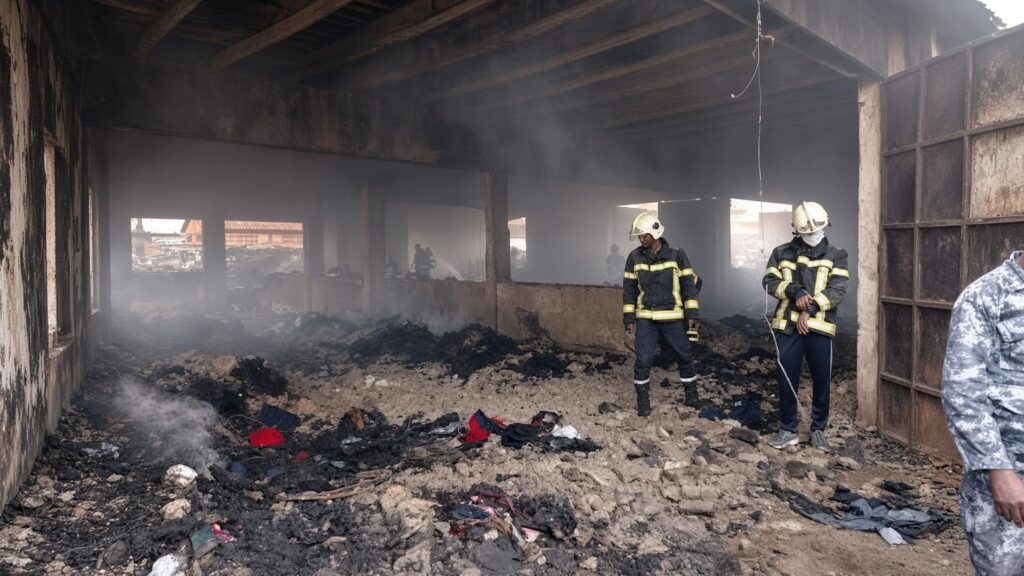
In the dead of night, the main building of Anié’s grand market was consumed by flames, reduced to ash while traders could only watch helplessly. While no lives were lost—a small mercy—the material toll is staggering: hundreds of families have been ruined overnight, their goods, their stock, and their savings gone up in smoke. The economic heart of the Plateaux region has been torn out, and the consequences will be felt for months, if not years.
But beyond the immediate shock and the suffering of the victims, this fire is not a simple misfortune. It is a glaring symptom of state neglect and a chronic lack of foresight that have become hallmarks of governance in Lomé.
An infrastructure stuck in another era
How can we explain that in 2026, a market of such strategic importance has no modern fire safety system, no working water points, and no clear access routes for emergency services? The answer lies in the political record of the current leadership.
Since coming to power in 2005, Faure Gnassingbé’s regime has shown itself incapable of sustainably modernising Togo’s local infrastructure. More than sixty years after his father, the late Gnassingbé Eyadéma, took power, the current executive continues to operate on structures built in the last century, without any substantial investment to adapt them to contemporary demographic and economic realities. The result is a network of markets and public spaces that are accidents waiting to happen.
The gap between ’emerging Togo’ rhetoric and daily reality
While official speeches endlessly tout major projects, digitalisation, and foreign investment, the situation on the ground remains dramatically archaic. The contrast is not just jarring—it is dangerous.
- No prevention culture: Most of the country’s major markets—from Lomé to Kara, and now Anié—remain logistical powder kegs, lacking compliant electrical standards and risk prevention plans. Traders work in constant fear of the next disaster.
- Under-equipped emergency services: Firefighters, often alerted late or hampered by a lack of suitable equipment in the regions, can do little more than witness the scale of the damage. Their inability to respond effectively turns manageable incidents into catastrophes.
- Living off past glories: The current regime coasts on the security reputation and political foundations of its predecessor, without building a modern public policy to protect citizens and their property. The result is a state that reacts to crises instead of preventing them.
The cost of inaction: a cycle of ruin
The consequences of this fire extend far beyond the charred remains of the market. For the hundreds of traders who lost everything, it means no income, no savings, and no safety net. Families who were already struggling to make ends meet are now pushed into destitution. The local economy, which relied on the market as a hub for goods and services, will suffer a severe blow, with ripple effects across the entire Plateaux region.
After the historic fires that destroyed major markets in Lomé and Kara in previous years, the tragedy of Anié proves that no lessons have been learned. The Togolese state cannot limit itself to sending ministerial delegations to distribute food or promise symbolic aid after each catastrophe. That is not a policy—it is a bandage on a wound that requires surgery.
The true responsibility of a government is to protect its citizens before disaster strikes. By allowing informal sector actors to work in vulnerable, outdated infrastructure, the regime reveals the limits of a worn-out political model, more concerned with its own perpetuation than with the safety and well-being of the Togolese people. The fire at Anié is not just a tragedy—it is a verdict on a system that has failed those it claims to serve.