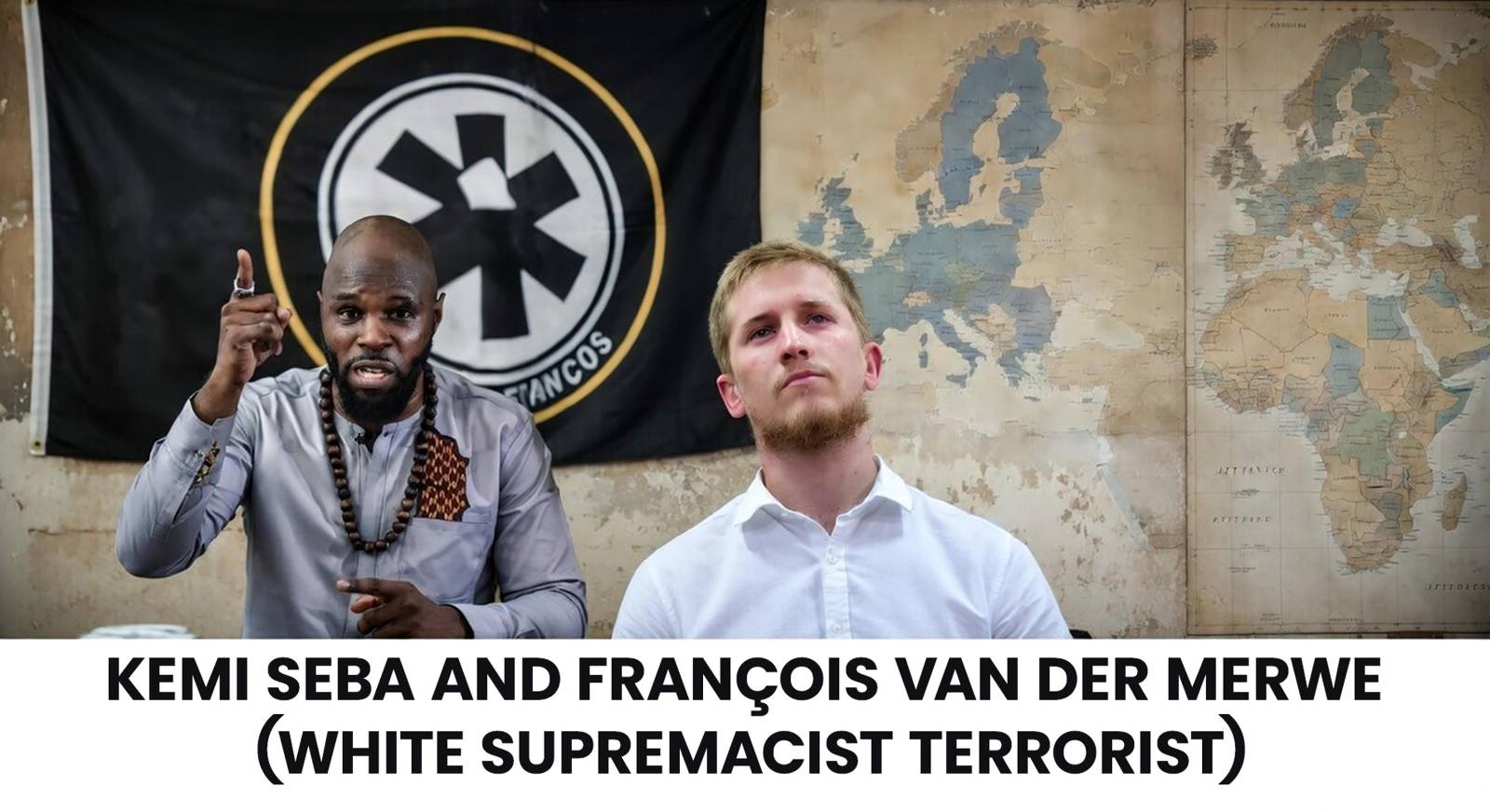
Some arrests are merely unexpected, while others serve as a profound revelation. When Kemi Seba was detained in South Africa on Wednesday, April 15, the circumstances did more than just stop his journey; they exposed a disturbing alliance and a controversial financial transaction that challenges his entire public image.
Who is François van der Merwe?
At the center of this scandal is François van der Merwe, a 26-year-old born in Pretoria. He serves as the head of the Bittereinders, a group officially classified as a terrorist entity by South African authorities. To grasp the severity of this connection, one must look at the ideology driving the movement and its historical roots.
The name “Bittereinders” refers back to the final, fanatical stage of the Second Boer War, where a faction of fighters refused to surrender to British forces, viewing peace as a civilisational betrayal. Van der Merwe has revived this label for the modern era, adopting its mission as a programmatic goal rather than just a symbolic tribute.
The vision of a racially exclusive Volkstaat
The contemporary Bittereinders movement gained momentum following the 2020 protests in Senekal. Van der Merwe positioned his group to fill a void for young Afrikaners who view Black political leadership as a fundamental threat to their culture. Their goal is unambiguous: the creation of a Volkstaat.
This proposed sovereign state would be racially exclusive, carved out of South African land, and would deny citizenship to Black South Africans. It is a modern echo of the most extreme Afrikaner nationalist demands from the early 1990s, reminiscent of the violent tactics used by groups like the AWB to destabilize the country’s first democratic elections. Van der Merwe represents the generational continuation of this fringe ideology.
Paramilitary training and criminal history
Since 2021, Van der Merwe has been a vocal critic of the ANC and EFF, characterizing the post-Apartheid constitutional order as an “occupation.” His organization doesn’t just protest; it conducts paramilitary-style tactical training at security academies, which they openly document and share. Van der Merwe himself has a history of legal trouble, including a 2023 arrest for assault and a 2024 arrest for inciting violence during courthouse demonstrations in Groblersdal.
The illegal crossing and the 250,000 rand payment
The most shocking revelation from the Hawks—South Africa’s elite police unit specializing in organized crime—is the alleged financial link between Seba and Van der Merwe. It is reported that Van der Merwe acted as an intermediary, receiving approximately 250,000 rands (over 13,000 euros) to facilitate an illegal crossing of the Limpopo River for Kemi Seba and his son into Zimbabwe.
Under South African counter-terrorism legislation, providing funds to a designated terrorist leader is a major felony, regardless of the stated reason for the payment. By handing over this significant sum, Seba has moved beyond mere association into the realm of criminal financing of an extremist group.
A narrative in collapse
For years, Kemi Seba has marketed himself as a champion of Black sovereignty and a fierce opponent of Western supremacy. He built a massive following across francophone Africa by speaking about dignity and the fight against systems of oppression. However, his decision to fund a man who advocates for a return to Apartheid-style segregation creates a massive credibility gap.
The activist who claimed to fight for African liberation is now accused of bankrolling a movement that views Black democratic rights as an aberration to be corrected. Seba now faces a complex legal battle involving charges of illegal immigration, conspiracy, and the potential financing of terrorism. Beyond the courtroom, he faces a historical reckoning: the collapse of the very narrative that gave him his public legitimacy.