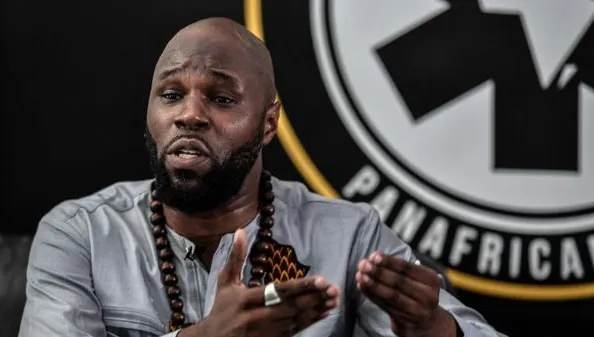
Kémi Séba, a fiery pan-African activist and social media sensation from Bénin, has become a polarizing figure across Francophone Africa. With over a million Facebook followers and viral YouTube content, his anti-Western rhetoric resonates with thousands who attend his rallies. Recently, France revoked his citizenship, a move that has intensified debates about his influence and allegiances.
From panafricanist to controversial figure
Born in Strasbourg, France, to Béninois parents, Kémi Séba—whose birth name is Stellio Gilles Robert Capo Chichi—rose to prominence as a radical voice in Africa’s digital sphere. His online presence is marked by fierce criticism of former colonial powers, particularly France, and institutions like the Françafrique and the CFA franc, which he labels as tools of economic domination.
His activism has drawn both fervent supporters and harsh critics. Convicted of inciting racial hatred in 2006, Séba was also the leader of the now-dissolved Tribu Ka, a Black supremacist and antisemitic group. Despite this controversial past, he rebranded himself as a modern revolutionary, positioning himself as a champion of African sovereignty.
a star turned alleged kremlin ally
Kémi Séba’s global reach extends far beyond Africa. Through his NGO Urgence Panafricaines, he has organized conferences across continents, from Brazil to Iran, with stops in Russia and Venezuela. His appearances often draw large crowds, including at the Russia-Africa Summit in Saint Petersburg, hosted by Vladimir Putin.
His alignment with Moscow’s interests has raised eyebrows in Western capitals. According to Jeune Afrique, Evgueni Prigojine—the late founder of the Wagner Group—directly funded and directed some of Séba’s activities. The Wagner Group, known for mercenary operations and resource extraction in Africa, has been instrumental in expanding Russian influence on the continent.
accusations of pro-russian propaganda in africa
French authorities have accused Kémi Séba of being a “conduit for Russian propaganda” and a tool of a foreign power stoking anti-French sentiment. In 2023, the president of the French National Assembly’s Defense Committee publicly labeled him as such, citing his vocal support for African nations pivoting toward Moscow after severing ties with Paris.
His reactions to recent political shifts in Africa underscore his stance: following coups in Niger, Mali, and Burkina Faso, he celebrated each upheaval, declaring, “More countries will join this movement—we’re working hard on it.” His rhetoric consistently aligns with narratives that favor Russian-backed regimes over Western-aligned governments.
revocation of french citizenship and online reaction
The French government’s decision to strip Kémi Séba of his citizenship has sparked mixed reactions. On social media, he celebrated the move, tweeting in French: “No more French nationality—glory to God. I am freed from this burden.” His supporters hail him as a symbol of defiance against neocolonialism, while detractors see him as a pawn in a geopolitical game orchestrated by the Kremlin.
Whether viewed as a revolutionary or a Russian proxy, Kémi Séba remains a defining voice in Africa’s evolving political and digital landscape, embodying the continent’s shifting alliances and rising anti-Western sentiment.