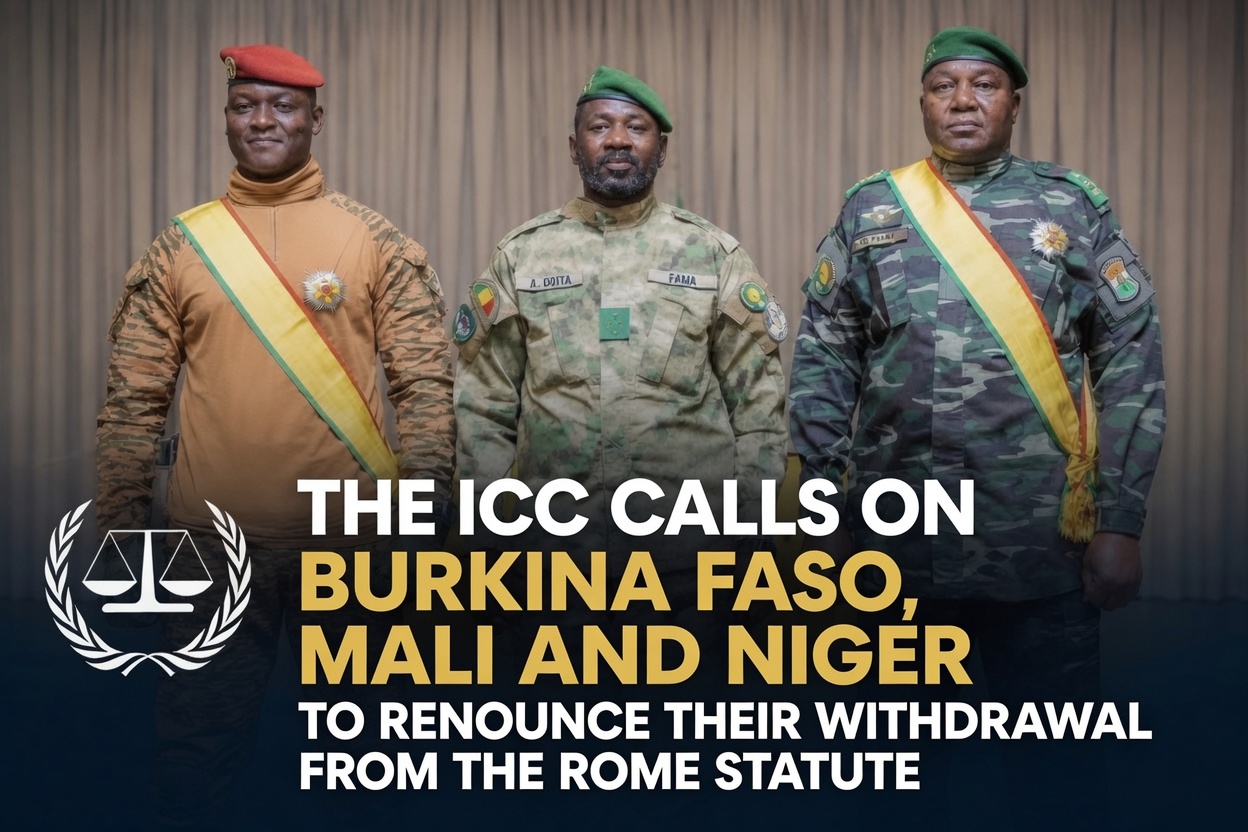
The International Criminal Court (ICC) has issued a formal appeal to Burkina Faso, Mali, and Niger, urging them to reconsider their withdrawal from the Rome Statute, the foundational treaty of the global judicial body. This move follows a period of shifting political and diplomatic alignments within the Alliance of Sahel States (AES).
For the ICC, the continued participation of these nations remains crucial to sustaining efforts aimed at combating impunity. The court stresses that its mandate is to investigate and prosecute alleged perpetrators of war crimes, crimes against humanity, genocide, and, in specific instances, acts of aggression—particularly when national jurisdictions are unable or unwilling to act.
The potential departure of Burkina Faso, Mali, and Niger has sparked significant debate among international observers. Many warn that such a decision could undermine international judicial cooperation and create obstacles in investigating severe crimes committed in a region plagued by armed conflict and widespread violence against civilians.
In response, officials from the three countries emphasize the principle of national sovereignty. They argue that domestic legal systems should take precedence in handling cases arising within their borders. These governments have repeatedly criticized what they describe as an inconsistent or politically motivated approach within international justice mechanisms.
Beyond legal considerations, the issue underscores a fundamental tension between state sovereignty and the necessity of a robust international justice system capable of addressing the most heinous crimes when local avenues fail.
The ICC’s intervention highlights the critical choices facing Burkina Faso, Mali, and Niger. Their final decision will not only shape their relations with global institutions but also impact judicial cooperation, victim protection, and their perceived commitment to fighting impunity across the Sahel.