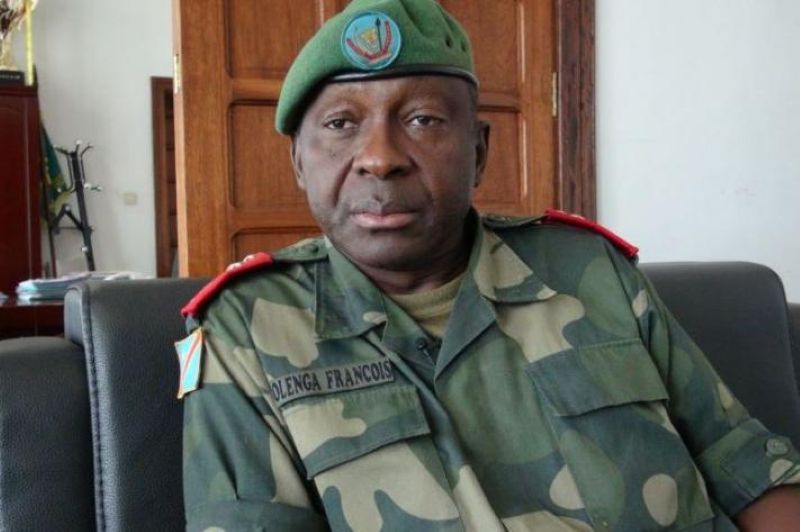

General Olenga’s delisting from US sanctions: reactions, debate and what lies ahead for the DRC
The removal of retired four-star General François Olenga from the United States sanctions list has triggered a wave of reactions across the Democratic Republic of Congo, reopening debates on sovereignty, international justice and the country’s place in global diplomacy. The decision, confirmed by the US Treasury Department through its Office of Foreign Assets Control (OFAC), not only allows the general to engage freely with American citizens and entities, but also clears the way for his Safari Club complex to welcome US visitors—a significant turn after more than nine years of restrictions.
“The United States Department of the Treasury has officially notified me of the OFAC decision to remove General François Olenga Tete and Safari Club from the American sanctions list,” announced his lawyer, Aimé Kilolo Musamba, in a statement dated September 23 and sent to our editorial team this Friday, September 25.
“This decision marks the culmination of more than nine years of work, efforts and advocacy, which led me several times to Washington to defend this case before American institutions. I have always maintained that the elements of the case did not justify keeping these sanctions against my client. Today, this long procedure has come to an end,” wrote Me Aimé Kilolo in the document, while expressing his conviction that an African lawyer can mount a defense at the highest international level, confront the complex legal mechanisms of major powers and make his client’s arguments heard.
For Me Kilolo, this experience should also benefit all Congolese. He argues that the DRC must emerge from its lethargy regarding international sanctions. Faced with international crimes committed particularly in the east of the country, he believes, it cannot continue to wait for individual and financial sanctions to come almost exclusively from the United States or the European Union.
“Our country, the DRC, must equip itself with a national legislative framework allowing its own institutions to adopt, in compliance with the rule of law and the rights of the defense, targeted sanctions against individuals and entities involved in international crimes committed on its territory. Sovereignty is also the capacity of a state to implement itself the legal instruments necessary for the defense of its population and its fundamental interests. Law has no borders when the defense is carried with competence, constancy and determination. But international justice must not be a responsibility that Congo abandons to others,” observed the lawyer from Brussels, where he is staying.
As a reminder, while he was in charge of the close protection of former President Joseph Kabila, General François was placed on Washington’s financial blacklist in June 2017. His assets were frozen and he was himself banned from traveling to the United States.
The American administration accused him of obstructing the democratic process in the country, thus plunging it into crisis since Joseph Kabila remained in power after his mandate expired in December 2016.
“Under his control, the Republican Guard allegedly ‘harassed political opponents’, carried out ‘arbitrary’ arrests and executions, and hindered the work of UN observers,” detailed the US Treasury in a statement.
Since then, François Olenga had seen not only his potential assets in the United States frozen, but also could not establish business relationships with American entities or individuals. The measure had also hit his prestigious tourist complex Safari Beach, located in N’sele.

À ne pas rater
À la une
You may also like
Iran’s Hormuz gambit: the world reacts as a seven-day clock starts ticking
Burkina Faso’s public debt debate intensifies as borrowing surpasses 8,700 billion FCFA
Benin’s police investigation overhaul: the fallout, the debate and what comes next
Benin-Algeria defense pact: the fallout, the debate and what comes next
Burkina Faso’s 80 % NGO rule: the debate, the fallout, and what comes next