DRC president unveils inclusive national dialogue with religious leaders
Kinshasa — President Félix Tshisekedi has announced the launch of a comprehensive national inclusive dialogue, placing its facilitation in the hands of the country’s leading religious institutions. The historic announcement follows a high-level meeting at the Cité de l’Union africaine in Kinshasa, where the president outlined his vision for a peaceful, republican process rooted in constitutional principles.
Dialogue to strengthen national cohesion
The initiative aims to foster national cohesion and consolidate peace across the Democratic Republic of the Congo (DRC), as outlined in a statement from the presidency. It emphasizes the importance of respecting existing institutions and the Constitution throughout the dialogue process.
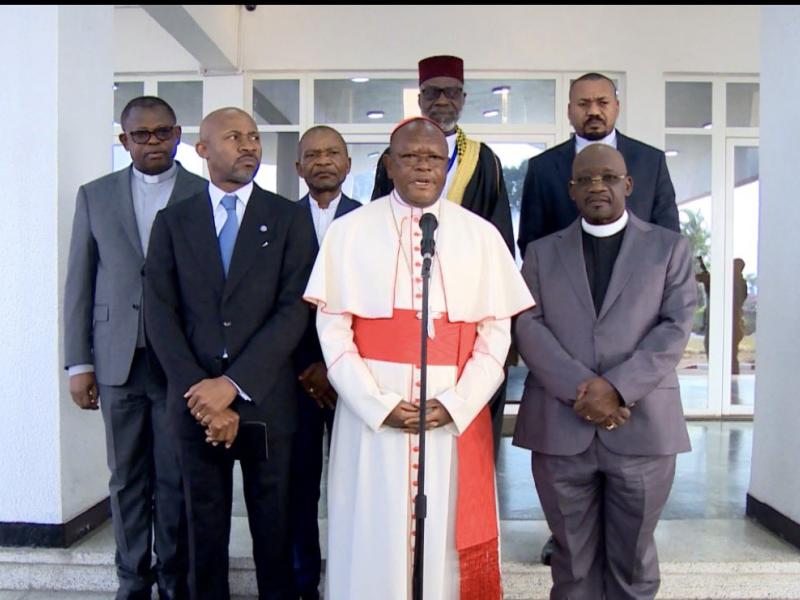
Cardinal Fridolin Ambongo, Archbishop of Kinshasa and spokesperson for the religious delegation, expressed strong support for the president’s initiative. He stated, “We welcome this bold step and extend our deepest gratitude to the head of state.”
The cardinal highlighted that the dialogue is a continuation of President Tshisekedi’s commitment to peace, national unity, and the strengthening of the country’s social fabric. He emphasized that the process will prioritize unity among all Congolese citizens, regardless of political affiliation or regional background.
Religious leaders commit to facilitation
The religious delegation, representing a broad spectrum of faiths, has accepted the mission entrusted to them by the president. Cardinal Ambongo affirmed their dedication, stating, “We will carry this forward as a sacred duty, calling on both the ruling majority and the opposition to actively participate.”
The delegation includes prominent religious figures such as:
- Mgr André Bokundoa — Representative of the Church of Christ in Congo
- Archbishop Ejiba Yamampia — Church of Revival in Congo
- Sheikh Abdallah Mangala — Muslim Community
- Mgr Donatien Nshole — Spokesperson for the Catholic Church
- Pastor Éric Senga — Spokesperson for the Church of Christ in Congo
According to ecclesiastical sources, a detailed roadmap for the dialogue will be published in the coming days, outlining its structure, objectives, and timeline.
Addressing regional tensions and political divides
The announcement comes amid ongoing regional tensions and deep political divisions within the DRC. Cardinal Ambongo underscored the urgency of national unity, particularly in response to the ongoing conflict in the eastern provinces, which he attributed to external interference. He stressed that “our nation must stand united to face these challenges.”
While the Rwandan government has repeatedly denied supporting the M23 rebel group, Kinshasa and multiple United Nations expert reports have accused Rwanda of providing military backing to the movement, which controls significant territories in North Kivu and South Kivu provinces.
Next steps and political expectations
The contours of the dialogue remain to be defined, including its start date, format, participants, agenda, and guarantees for all stakeholders. Political factions hold divergent views, with some opposition groups demanding the release of political prisoners, an end to what they describe as politically motivated prosecutions, and the restoration of public freedoms before engaging in discussions.
Earlier this month, President Tshisekedi reaffirmed his openness to dialogue but cautioned that it must not be used as a tool to undermine constitutional institutions or overturn the popular will expressed through elections.
The president’s announcement follows a series of consultations involving political leaders, religious figures, and regional stakeholders, aimed at addressing the country’s political and security crises.