
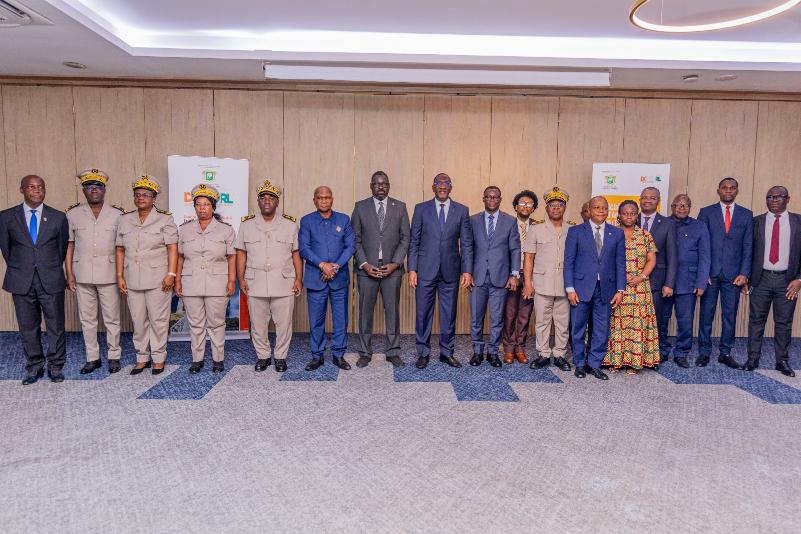
The Minister of Planning and Development, Dr. Souleymane DiarraSSouba, led a pivotal national workshop in Abidjan to finalize the study of the National Territorial Development Framework (SNAT CI-2045). The gathering brought together leaders from Ivorian institutions, prefects, local governments, technical and financial partners, alongside public administrations, the private sector, civil society, academics, experts, and media representatives.
This milestone paves the way for the adoption of Côte d’Ivoire’s first-ever national territorial planning reference. The SNAT CI-2045 will equip the government with a robust framework to guide public and private investments sustainably, enhance the efficiency of state actions, and promote balanced regional development across the country.
Under the leadership of President Alassane Ouattara, the Ivorian government continues to strengthen its strategic planning mechanisms. These efforts aim to support the country’s economic, social, and environmental transformations, with territorial planning playing a central role in balancing investments, unlocking regional potential, and aligning development policies.
The SNAT CI-2045 serves as the long-term spatial development blueprint, structuring where public and private investments are directed. It harmonizes state actions with those of local authorities and development stakeholders by assigning each region a tailored development role.
« The National Development Plan (PND) 2026–2030 sets medium-term priorities and investments for national growth. The SNAT CI-2045 translates these into territorial strategies for the long haul and will underpin future National Development Plans. Together, these frameworks ensure coherent public action across the entire country. Our ministry’s duty is to secure each region’s rightful place in this national vision, » explained Dr. Souleymane DiarraSSouba.
The validated framework emerges from a multi-level, participatory, and evidence-based consultation process. Built on a thorough analysis of the national territory, it addresses key challenges: bridging regional disparities, managing urban expansion, boosting local competitiveness, strengthening governance, protecting natural resources, and deepening regional integration.
The SNAT envisions a Côte d’Ivoire where all territories are resilient, competitive, and share in shared prosperity. It rests on five strategic pillars: balanced territorial growth, efficient urban-rural networks, stronger local governance, a high-performing and inclusive economy, and accelerated climate transition.
Following the workshop, the draft framework will be submitted to the government, then to Parliament for adoption into law. Once enacted, Côte d’Ivoire will possess its first national territorial planning reference, steering state-led investments toward high-impact areas and fostering balanced nationwide development.
You may also like
Why Niger’s soldiers are walking away from Tiani’s army
Behind the sovereignty talk, AES states owe 7,727 billion CFA francs on the regional market
Benin back to school: classes reopen nationwide on 14 september 2026
Sonidep’s 2026 loss: how Niger’s cheap fuel policy is draining the state oil company
Texforces-BF: a textile plant built on Burkina Faso’s retirement savings