
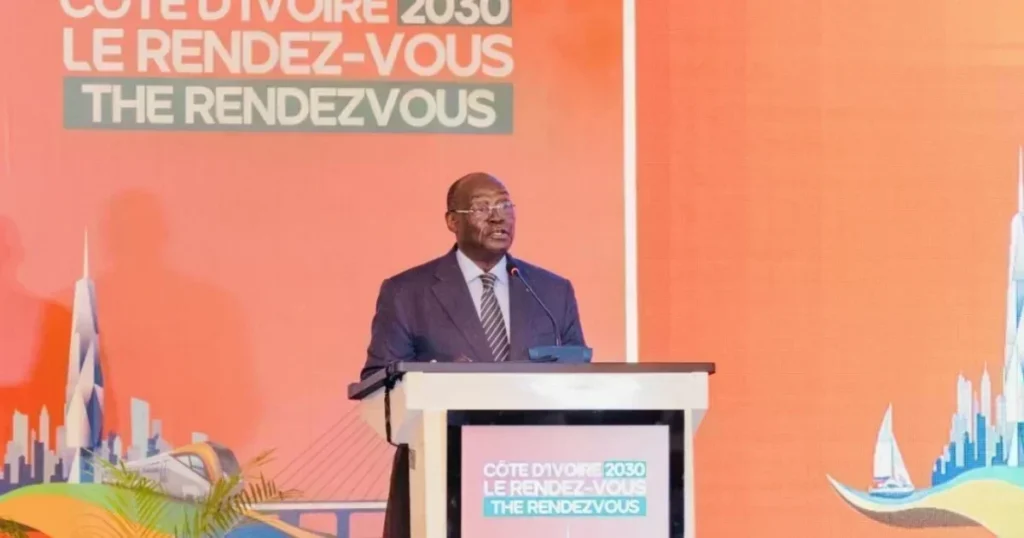
With a robust economic performance and renewed political stability, Côte d’Ivoire has surpassed all expectations by securing over $80 billion in international funding for its National Development Plan (PND) 2026-2030. This unprecedented financial commitment underscores the country’s growing appeal to global investors and marks a significant milestone in its post-crisis recovery.
An economic turnaround attracting global confidence
Since emerging from a decade of political and military turmoil in the early 2000s, Côte d’Ivoire has transformed into one of West Africa’s most dynamic economies. Annual growth averaging 6.5% over recent years reflects this resurgence, positioning the country as a prime destination for foreign capital.
This momentum was on full display during a high-profile investment forum in Abidjan, where government officials and over 500 public and private investors converged to discuss funding for the PND. The plan outlines transformative initiatives including security enhancements, agricultural modernization—accounting for 20% of GDP—support for national champions, and major infrastructure projects like a planned high-speed rail network.
Financial commitments far exceed original projections
Originally targeting around $20 billion in public funding, Côte d’Ivoire has dramatically exceeded this goal. International partners, including the World Bank, African Development Bank (AfDB), and European Union, have pledged more than $80 billion in support—a fourfold increase over initial expectations.
Minister of Planning Souleymane Diarrassouba highlighted the significance of these commitments, noting that “our economic indicators are nearly all positive.” He added that over 70% of the PND’s total financing—exceeding $147 billion—is expected to come from the private sector, with the remaining contributions from the Ivorian state.
The comprehensive financing package brings the PND’s total investment to approximately $209 billion. This follows a February bond issuance where Côte d’Ivoire raised $1.3 billion on international markets at exceptionally favorable rates for an emerging economy. Earlier, the International Monetary Fund (IMF) also approved nearly $833 million in disbursements under multiple assistance programs, citing the country’s resilient economy.
While acknowledging an expected slight slowdown in growth to 6% in 2026 (down from 6.5% in 2025) and a projected inflation rate of 3.3% this year, officials remain optimistic about the nation’s economic trajectory. Côte d’Ivoire’s traditional agricultural base is increasingly diversifying into mining, gas, and oil sectors, further strengthening its economic foundation.
You may also like
Mali: at least 80 soldiers killed in deadly assault on Dioura camp
Côte d’Ivoire : le Burida redistribue 795,4 millions FCFA à 5 435 créateurs
Paris FC vs Lyon: kick-off time and TV channel for the Ligue 1 clash
Niger: does Tiani’s purge expose hidden fractures at the top?
Everest Finance dévoile Sama Naffa, une épargne à petits pas au Sénégal