Capturing France’s turmoil: a strategic question for Sahel juntas
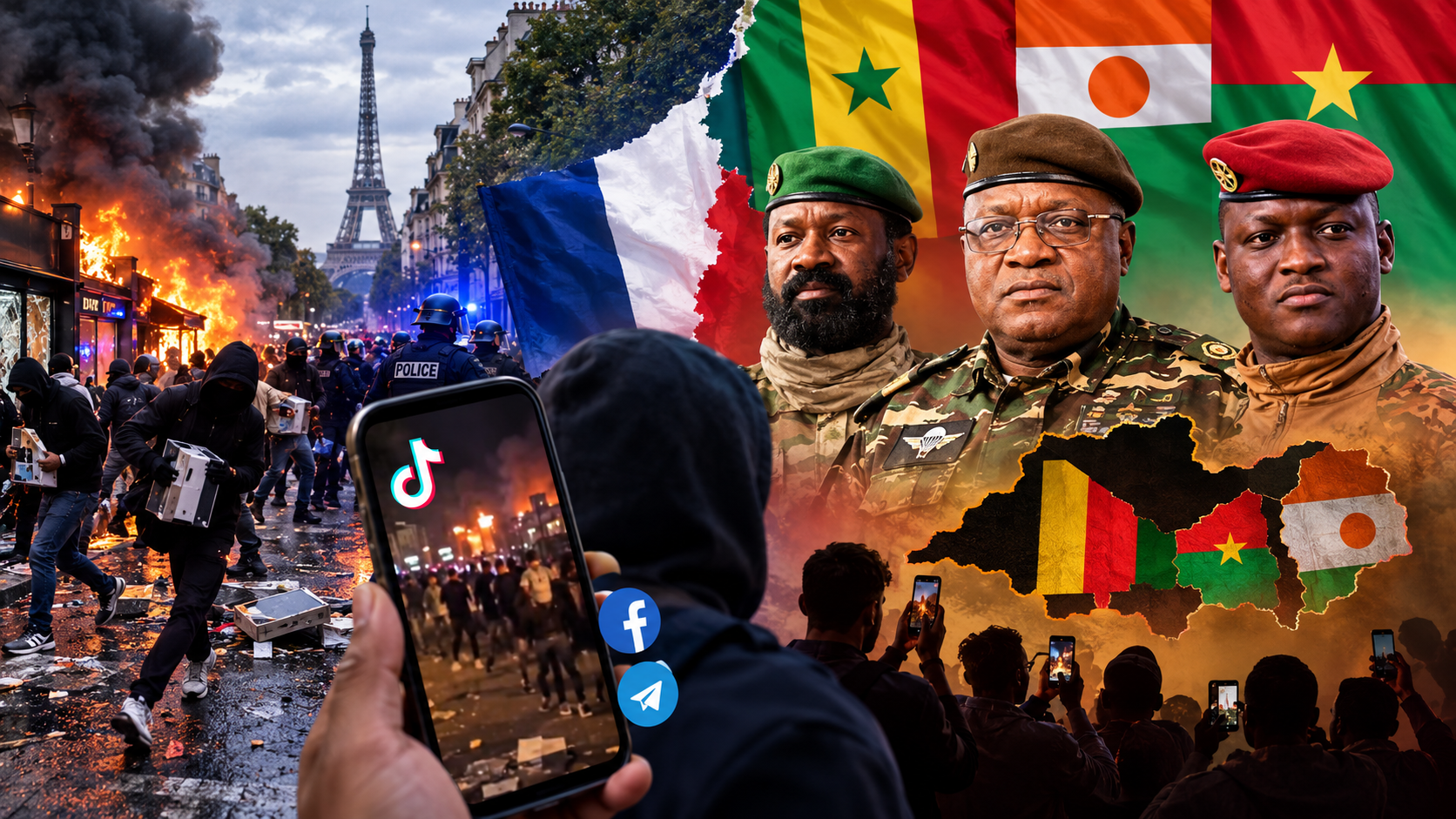
The recent urban unrest in France is not merely a domestic crisis. It has ignited political discussions across the Sahel region, particularly in Mali, Burkina Faso, and Niger, where relations with Paris have sharply deteriorated under military-led governments. Images of looting, vandalism, and clashes with law enforcement are being swiftly disseminated on platforms such as TikTok, Facebook, and Telegram to fuel anti-France rhetoric. But could this moment serve as a calculated political tool for Sahel juntas?
Propaganda as a weapon: turning French disorder into a narrative advantage
For supporters of the Alliance of Sahel States (AES), these scenes present an opportunity to challenge France’s credibility on democracy, security, and the rule of law. The argument follows a familiar line: if France cannot maintain order domestically, how can it criticize governments in the Sahel for their own governance challenges? The intent is clear erode France’s moral authority and reinforce a narrative of political revanche against its colonial past. Yet, behind this strategic communication battle, a critical question lingers: what are the legal consequences for those involved?
Individual accountability in the spotlight
Investigators probing the unrest have identified participation by individuals from AES member states, some of whom may have been in France illegally. If their involvement in looting, destruction, or violence is confirmed, they will face French justice like any other alleged offender. This is not about nationality it is about accountability under the law. For those in irregular situations, additional administrative consequences may also arise, provided due process is followed.
What cannot be overlooked is that foreign status does not exempt individuals from complying with French law. Even if judicial proceedings reveal that some Malians, Burkinabè, or Nigeriens were involved in the disturbances, their nationality does not shield them from legal consequences. Justice must be blind to origin only facts and evidence should determine outcomes.
Media manipulation: when images obscure the truth
In digital spaces aligned with the AES agenda, footage of the unrest is being framed as proof of France’s systemic collapse. Yet, a single video of a looted store or a confrontation with police does not validate claims of national failure. Such narratives often rely on misleading captions, recycled footage, or isolated incidents blown out of proportion. To substantiate allegations of a coordinated campaign, concrete links between accounts, consistent messaging, and verifiable patterns of misinformation must be established not assumed.
Previous fact-checking efforts have exposed misleading content circulating in pro-AES online environments. While these findings do not conclusively prove a centralized propaganda operation, they underscore the need for caution. Journalistic rigor requires more than surface-level impressions; it demands thorough verification before drawing conclusions about coordinated influence.
The ethical dilemma: justice versus political narrative
The situation raises a fundamental dilemma: if foreign nationals are implicated in illegal acts in France, the appropriate response lies with its judicial institutions not with online commentators or propagandists. Responsibility must be assessed individually, based on evidence and legal standards, not national origin.
Equally problematic is the selective use of images by politicians and media outlets. Those who condemn external criticism of Sahel regimes must also acknowledge individual responsibility when citizens of those countries are accused of breaking the law abroad. This is not a collective judgment against all Malians, Burkinabè, or Nigeriens in France. The vast majority live law-abiding lives and should not be tarnished by the actions of a few. Yet, where evidence exists, accountability must prevail irrespective of nationality.
Diplomatic tensions framed by domestic strife
Since France severed ties with Sahelian military governments, the confrontation has extended beyond embassies and into the digital sphere. Accounts of French instability are being leveraged to reinforce a narrative of Western decline, while the actual performance of Sahel juntas in governance, security, and public welfare remains subject to scrutiny based on verifiable outcomes.
The urban unrest in France does not, in itself, signal the collapse of the nation. Nor does it affirm the success of Sahel juntas. Should investigations confirm involvement by certain AES nationals in criminal acts, those individuals must face consequences not as a reflection of their country of origin, but as a matter of justice. France’s judicial system exists to investigate, adjudicate, and enforce the law. Its findings, not social media assertions, should guide public understanding of these events.
By Daniel Mbami — Journalist