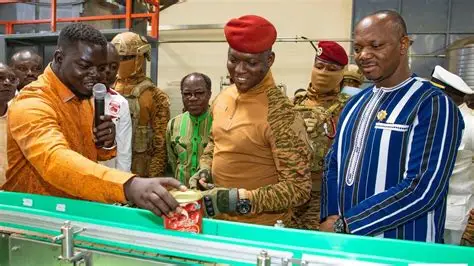
The captain Ibrahim Traoré has recently intensified his efforts, inaugurating factories and touring industrial sites across Burkina Faso. From tomato processing plants to gold refineries, the transitional government’s communication machine is working overtime to project an image of national progress. Yet, beyond the carefully staged media appearances, the harsh realities of a nation grappling with deepening security and economic crises refuse to be ignored.
Public relations campaigns overshadow systemic challenges
In a familiar pattern for governments seeking legitimacy, Burkina Faso’s leadership has adopted the strategy of “grand projects” to convey resilience. In major cities like Ouagadougou and Bobo-Dioulasso, the captain presents himself as the architect of economic revival. The narrative emphasizes self-sufficiency, local job creation, and economic sovereignty, positioning every groundbreaking ceremony as a triumph over foreign influence. Critics, however, argue that these staged events resemble desperate attempts to mask structural weaknesses rather than evidence of a coherent development strategy.
Industrial ventures shrouded in secrecy and suspicion
Closer examination of these so-called industrial successes reveals troubling inconsistencies. While ribbon-cutting ceremonies dominate headlines, critical details—such as precise funding sources, long-term production viability, and operational transparency—remain conspicuously absent. Whispers of financial misconduct have also surfaced, particularly regarding the allocation of funds earmarked for both national security and industrial development. With traditional private enterprises struggling under heavy fiscal burdens and escalating insecurity, the rise of new enterprises linked to power circles raises serious questions about procurement fairness and accountability.
The widening chasm between rhetoric and reality
Amidst the celebratory fanfare of industrial progress, the daily lives of ordinary Burkinabè continue to deteriorate. The cost of essential goods—including rice, cooking oil, and millet—has spiraled out of control, placing unbearable strain on vulnerable households. The humanitarian toll is equally devastating: over two million internally displaced persons languish in precarious conditions, many trapped in areas under terrorist blockade and dependent on unreliable aid deliveries. Meanwhile, the informal economy, the backbone of Burkina Faso’s economic activity, is in freefall due to persistent power outages, road insecurity, and disrupted trade routes.
Propaganda as a temporary facade
The stark contrast is undeniable: on one side, polished media productions showcasing gleaming machinery and a resolute leader; on the other, families struggling to afford school fees and soldiers battling in extreme conditions. The narrative of a “thriving Burkina Faso” is, for now, a carefully constructed illusion designed to stifle dissent and sustain hope. Yet, propaganda has its limits—it cannot feed a nation when fields lie fallow and newly inaugurated factories churn out only television images. The captain’s gamble on perception carries significant risk: by prioritizing image over substance, he risks severing the already fragile connection between leadership and citizenry. Industrialization remains a worthy goal, but one that cannot be built on shifting sands. Without genuine financial transparency and effective territorial security, presidential appearances will remain mere illusions in the Saharan landscape.