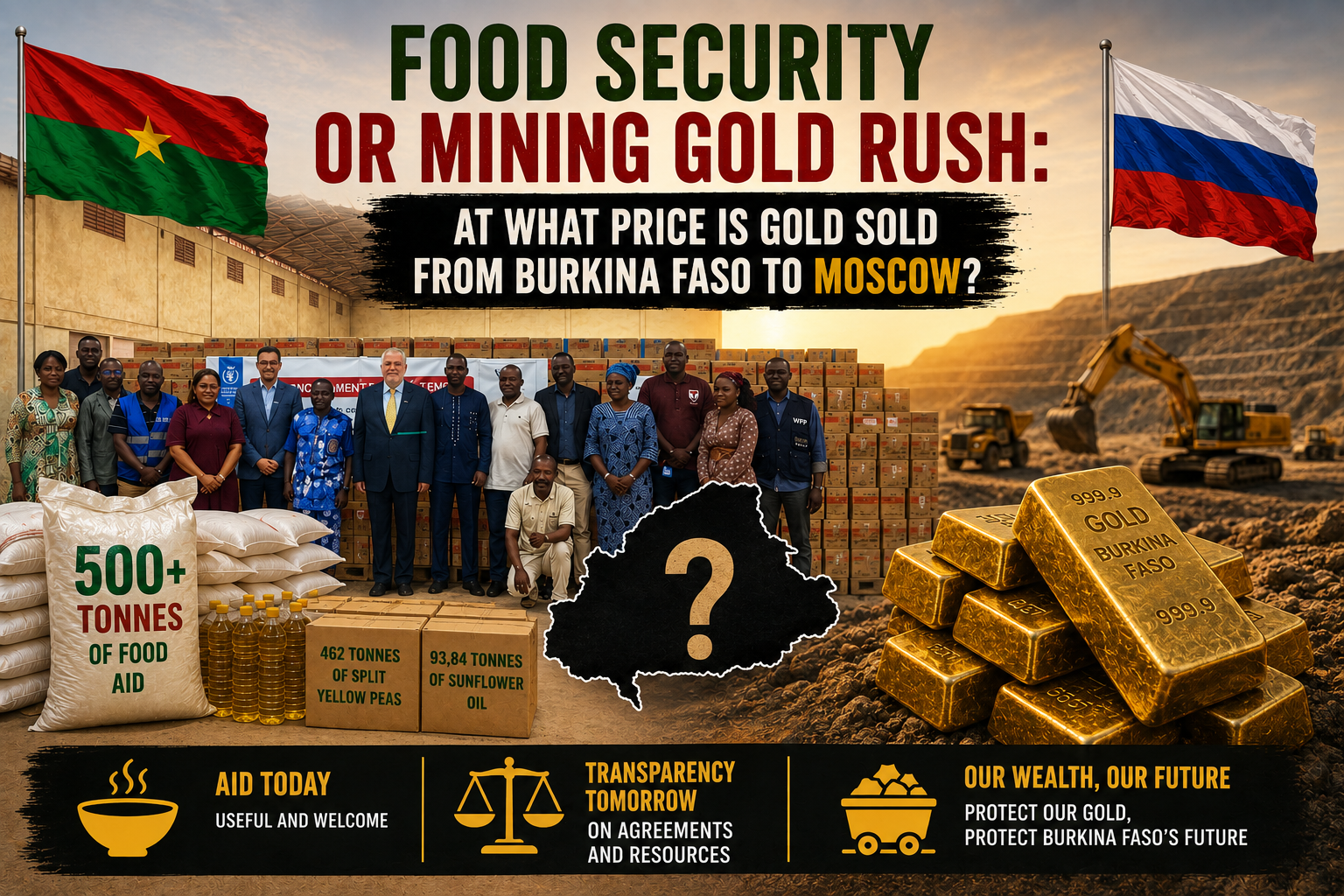
An official announcement from the Russian diplomatic mission in Ouagadougou confirmed the delivery of over 500 tonnes of humanitarian food assistance to Burkina Faso, valued at approximately $942,500. The cargo notably included 462 tonnes of yellow split peas and 93.84 tonnes of sunflower oil. This gesture was presented as a demonstration of fraternal solidarity amidst a particularly challenging humanitarian and security landscape.
However, beyond this humanitarian operation, a critical inquiry arises: what truly defines the evolving partnership between Ouagadougou and Moscow? While vital, food aid should not preclude public examination of the economic, mining, and strategic dimensions underpinning the rapprochement between these nations.
In contemporary geopolitics, states primarily advance their own interests. Assistance can serve both humanitarian and diplomatic objectives without necessarily signifying pure altruism. This fundamental principle underscores the imperative for Burkinabè citizens to demand transparency regarding agreements forged on behalf of their country.
The illusion of cost-free assistance
The provision of hundreds of tonnes of foodstuffs undeniably offers relief to populations grappling with severe food insecurity. Yet, it would be imprudent to portray this operation as conclusive evidence of an equitable partnership.
Burkina Faso possesses substantial mineral wealth, with gold forming the cornerstone of its extractive economy. Consequently, the pivotal question is not whether to accept or decline food aid, but rather what the nation yields, what it acquires, and under what specific conditions.
A dispassionate analysis of the equation is warranted: on one side, a nation abundant in mineral resources; on the other, external partners possessing considerable financial, military, commercial, and technological capabilities. Between these two entities lie agreements whose principal provisions must be accessible to the populace.
Indeed, a few hundred tonnes of provisions cannot equate to the potential value of mineral resources exploited over many years. Episodic aid must never serve as a diversion from the strategic significance of national assets.
The core inquiry should thus revolve around value creation: Is Burkina Faso sufficiently processing its resources domestically? Is it securing an equitable share of revenues? Are mining contracts publicly accessible? Are oversight mechanisms robust enough? Do proceeds genuinely contribute to infrastructure, education, health, and security?
Gold must not become the invisible currency of alliances
Gold represents far more than a mere commodity. It constitutes a strategic asset, a repository of value, and a potential wellspring for financing national development.
Consequently, any significant redirection of gold exploitation, commercialization, or export channels merits rigorous examination. Burkinabè citizens are entitled to inquire about the destination of their gold, its purchasers, its price, the contractual terms, and the degree of state oversight involved.
The issue is not the engagement of a foreign partner in purchasing Burkinabè gold, as international commerce is a standard practice. The concern arises if an imbalanced relationship takes root, wherein the nation’s strategic resources are exchanged for immediate advantages without a comprehensive long-term vision.
A tonne of food is consumed and vanishes. An extracted mineral resource, however, is irrecoverable. This fundamental distinction ought to inform all economic partnership policies.
From French yoke to Russian snare: the illusion of liberation
The predicament is both political and psychological in nature.
The widespread condemnation of the former colonial power, France, taps into deeply rooted popular resentment. Critiques concerning historical patterns of domination, economic dependencies, and past diplomatic choices are entirely valid subjects for discussion.
Yet, severing an old dependency does not automatically confer sovereignty.
Substituting Paris with Moscow, Beijing, Ankara, or any other capital would only constitute genuine sovereignty if Ouagadougou maintains full command over its decisions, resources, and national interests.
Therefore, sovereignty should not be gauged by the quantity of foreign flags removed from ceremonies or the number of new partners welcomed into the country. Instead, it is primarily measured by a state’s capacity to negotiate from a position of strength, safeguard its resources, and demonstrate accountability to its populace.
A new dependency can be more difficult to identify
Modern dependency does not invariably manifest as foreign administration or a discernible colonial presence.
It can emerge through mining contracts, military hardware, financial arrangements, infrastructure projects, foreign enterprises, export markets, or preferential access to strategic resources.
For this reason, Burkina Faso must assiduously avoid replacing one form of dependency with another.
An equitable partnership should empower the nation to diversify its alliances without becoming beholden to a single entity. It should also bolster national capacities rather than perpetually transferring control of strategic sectors to foreign actors.
Food aid must not become a political argument
It is also imperative to differentiate between humanitarian solidarity and diplomatic propaganda.
Populations suffering from hunger require sustenance, irrespective of its source. It would therefore be unjust to diminish the utility of this aid for its beneficiaries.
Nevertheless, a consignment of split peas and oil should not serve to stifle public discourse on the management of natural resources.
Food aid addresses an immediate crisis; mining policy commits future generations.
To conflate these two distinct aspects would be precisely the hazard.
The Burkinabè citizen should be able to acknowledge received assistance while simultaneously demanding greater transparency regarding contracts, concessions, exports, and mining revenues. There is no inherent contradiction in thanking a partner for aid and simultaneously seeking accountability for its economic interests.
Sovereignty begins with transparency
If the transitional government genuinely seeks to demonstrate Burkina Faso’s mastery of its own destiny, it must permit its new partnerships to undergo public scrutiny.
What are the specific mining agreements concluded with foreign enterprises? What are the fiscal terms? What proportion accrues to the state? How many local employment opportunities are generated? What industrial transformation occurs domestically? What oversight exists over exports? Where are the revenues invested?
These inquiries, far more than political rhetoric, will serve to gauge the veracity of economic sovereignty.
The people of Burkina Faso do not necessarily seek to exist without foreign partners. Rather, they primarily demand that foreign partnerships never be established to the detriment of their long-term interests.
Opening eyes to avoid losing everything
Therefore, Burkinabè citizens must not allow themselves to be swayed solely by consignments of oil, split peas, or the symbolic imagery of a newfound international fraternity.
While food aid may be welcome, it must never become the political leverage used to justify opacity surrounding national resources.
Genuine independence does not entail merely swapping one dominant partner for another. It resides in the capacity to engage with all parties without becoming subservient to any.
Burkina Faso possesses resources capable of funding its development for decades. The crucial question, therefore, is whether these riches will be harnessed to construct schools, hospitals, roads, generate employment, and foster a productive economy, or if they will simply serve as the invisible quid pro quo for new geopolitical alliances.
West Africa requires partners, not a new master.
The fundamental distinction between the two lies in the capacity of African states to safeguard their interests, negotiate equitable agreements, and uphold accountability to their citizens.
Before celebrating each foreign consignment as a diplomatic triumph, it is essential to pose the fundamental question: what is the true cost of this burgeoning proximity with Moscow, and who will bear the ultimate burden once the provisions have been consumed, but the nation’s gold has departed its shores?