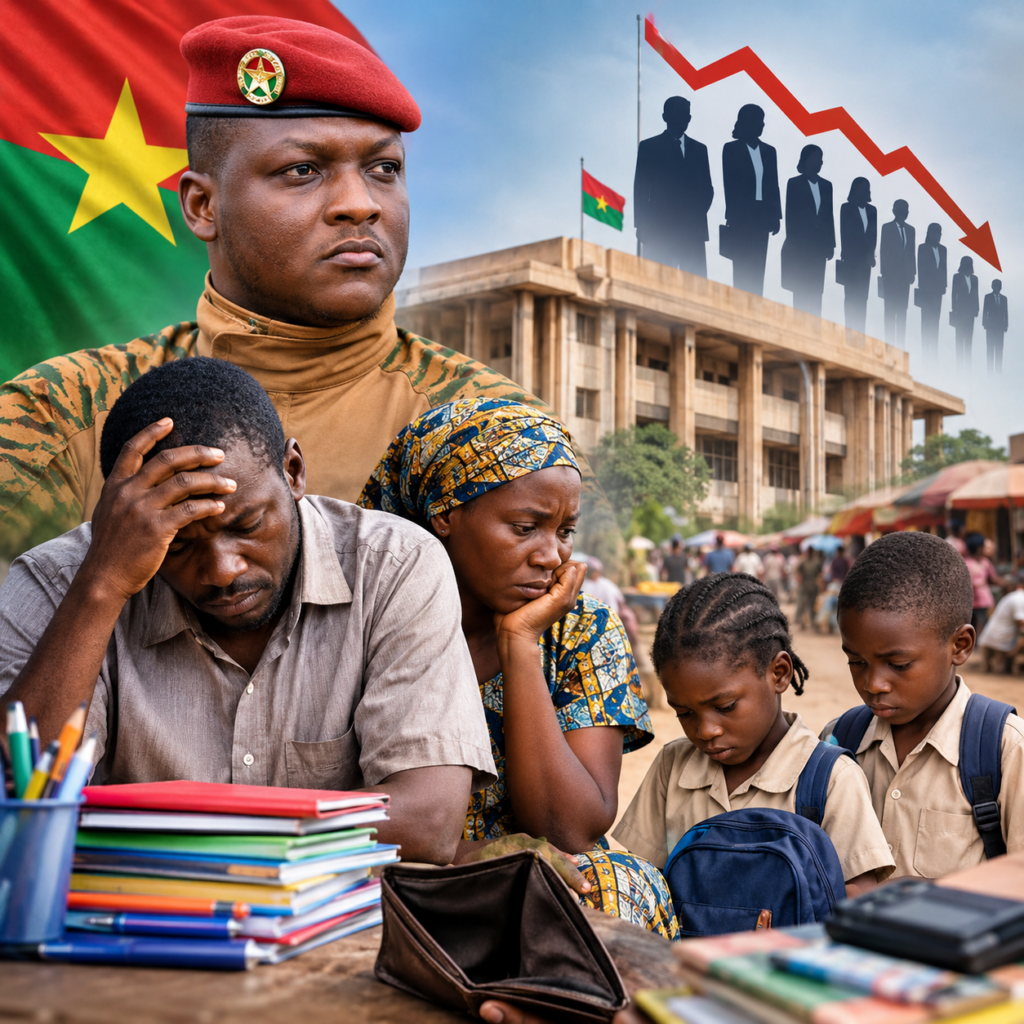
A declining public workforce and its immediate social repercussions
As Burkina Faso prepares for the new school year, a troubling social reality confronts numerous families across the nation. Official figures reveal that the number of salaried state civil servants has declined from 204,310 in 2021 to 202,393 in 2025, representing a reduction of 1,917 agents over a four-year period.
A detailed breakdown of the 2025 workforce
The composition of the 2025 civil service roster is as follows:
- 140,438 men;
- 61,955 women.
Beyond these statistics lie households. A public employee is not merely an administrative post; they often serve as the primary breadwinner for a family, covering school fees, housing, food, and daily expenses.
The social dimension of a shrinking payroll
This is precisely what lends the reduction in staff numbers a profound social dimension. At a time when Burkinabe families are grappling with back-to-school costs, any decrease in regular income can swiftly lead to painful trade-offs: tuition, supplies, food, or healthcare.
Since Ibrahim Traoré assumed power, official discourse has consistently emphasized sovereignty, national mobilization, and the transformation of Burkina Faso. Yet behind the grand speeches and economic announcements, the central question remains the daily reality of households: how many families today truly possess a stable income to meet their obligations?
Documenting the causes and weighing the consequences
The decline in civil service numbers alone does not permit the assertion that all affected agents have been “laid off,” nor does it mechanically attribute each departure to a personal decision by Ibrahim Traoré. The exact causes of this trend require documentation: retirements, recruitments, non-renewals, administrative restructurings, or other civil service management measures.
However, the social debate cannot be sidestepped.
When a household loses its primary income, the repercussions extend far beyond the administration. They reverberate in classrooms, markets, and homes. Each public job eliminated or left unfilled can have a much broader economic impact when it constitutes a family’s main source of revenue.
A critical juncture: the school year and household survival
As the school year begins, this reality takes on particular urgency. For some parents, the priority is no longer merely preparing their children for a new academic year but finding the means to finance it.
The true challenge for Burkinabe authorities is therefore to demonstrate that state management choices do not result in further weakening of households.
For behind civil service statistics are families who live, consume, educate their children, and strive to preserve their future.
You may also like
Libya-Cameroon air link plan: how Yaoundé and Tripoli are reacting, and what could follow
Silmossin fallout: Burkina Faso’s security debate moves beyond slogans
Chad’s UN warning on Ennedi-East strikes: global reactions and what happens next
General Olenga’s delisting from US sanctions: reactions, debate and what lies ahead for the DRC
Iran’s Hormuz gambit: the world reacts as a seven-day clock starts ticking