Educational reform sparks debate over cultural influence and geopolitical alignment
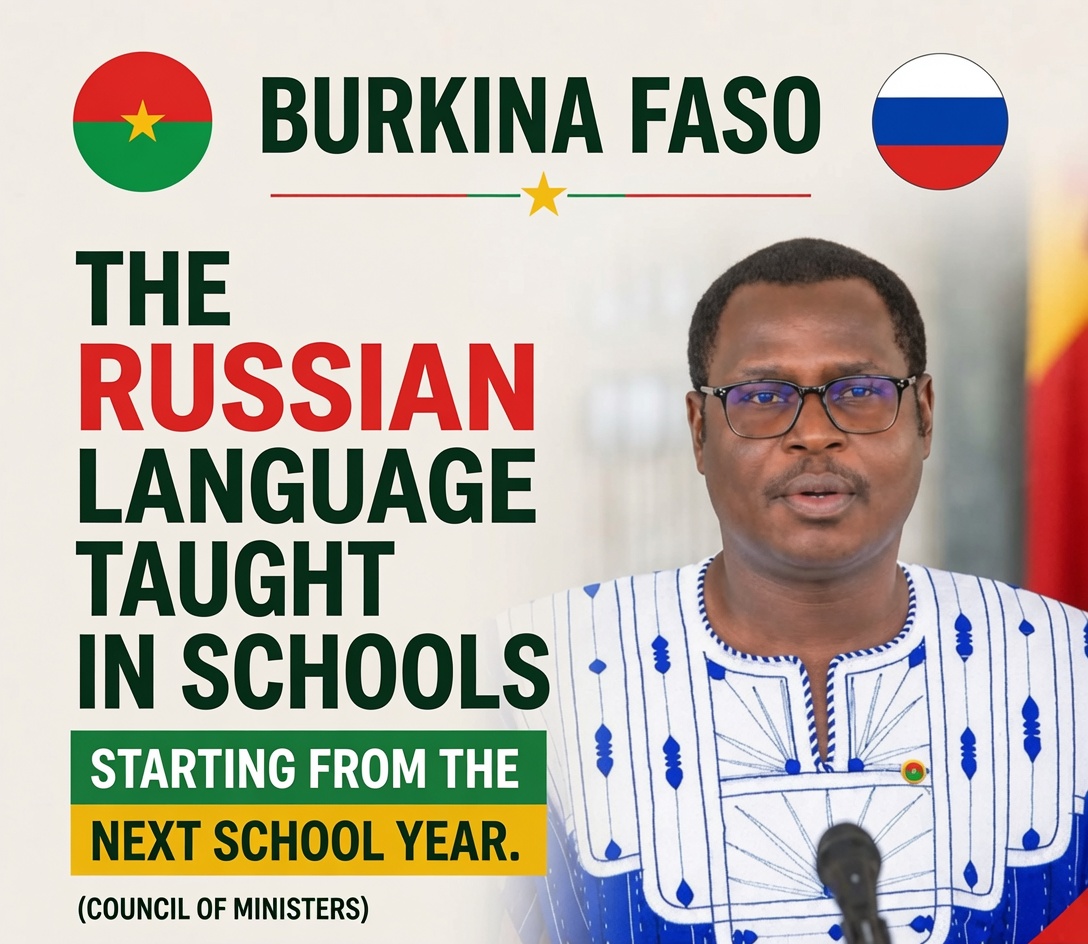
The transitional government of Burkina Faso has taken a decisive step in reshaping the nation’s strategic partnerships by introducing Russian language instruction in public schools starting next academic year. While officials frame the initiative as a forward-thinking move to expand Burkina Faso’s global engagement, the decision has ignited fierce debate about its underlying motives and long-term implications.
An official narrative of opportunity
The administration justifies the measure as a pragmatic response to a rapidly evolving world. By equipping students with Russian language skills, authorities argue, Burkina Faso can strengthen future commercial, technological, and academic exchanges with Eurasia. The move aligns with the country’s growing reliance on Moscow, particularly in security cooperation, where Russian forces and private military contractors have become central to counterterrorism efforts. For the government, embedding Russian in the national curriculum is seen as cementing a partnership deemed essential for state survival in the face of escalating jihadist threats.
Shadows of influence: a modern form of dependency?
Critics, however, warn that the decision may represent more than just an educational pivot. They question whether this is merely the latest move in a broader geopolitical realignment that risks replacing one form of foreign influence with another. While Burkina Faso seeks to break free from historical ties to former colonial powers, the rapid expansion of Russian involvement—now reaching into classrooms—raises concerns about the emergence of a new, subtler form of tutelage. Replacing colonial patronage with a new dependency, they argue, does little to restore true sovereignty.
The introduction of Russian in schools is not viewed as an isolated policy. Rather, it is seen as part of a deliberate strategy to cultivate influence through soft power—a tool Moscow has historically used to shape the worldviews of future generations. By normalizing the Russian language and culture in Burkina Faso’s education system, the Kremlin may be laying the groundwork for a lasting ideological alignment, ensuring that a segment of the population becomes more receptive to Russian narratives, media, and political messaging.
Historical parallels and asymmetrical power dynamics
Opponents draw uncomfortable parallels with Cold War-era practices, when Soviet authorities imposed Russian language education in Eastern Bloc countries. In those cases, linguistic assimilation served as a mechanism for political control and ideological uniformity. Observers caution that a similar pattern may be unfolding in Burkina Faso, where the state’s vulnerability—amplified by its reliance on Russian military support—creates an environment of unequal leverage. In this context, making Russian a mandatory subject may appear less like a balanced partnership and more like a concession extracted by a powerful benefactor.
Equally troubling is the potential cultural cost. Burkina Faso is home to a rich tapestry of indigenous languages, many of which struggle for recognition and funding within the national curriculum. Prioritizing a foreign language over local linguistic heritage raises questions about the government’s commitment to decolonizing education. Rather than fostering intellectual emancipation, critics argue, this policy may simply shift the axis of dependence from one foreign power to another.
A strategic gamble with uncertain outcomes
As Burkina Faso deepens its ties with Russia across military, mining, and now educational sectors, the nation stands at a crossroads. The long-term consequences of embedding a foreign language so deeply into its national identity remain unclear. Will this move empower the next generation with new opportunities, or will it entrench a new form of foreign control disguised as cooperation? The answer may depend on whether Burkina Faso can navigate this geopolitical pivot with caution—or whether it risks surrendering its hard-won independence in exchange for immediate security gains.
The future of the country now rests on the ability of its people to scrutinize such decisions and demand policies that serve national sovereignty, not foreign interests.