
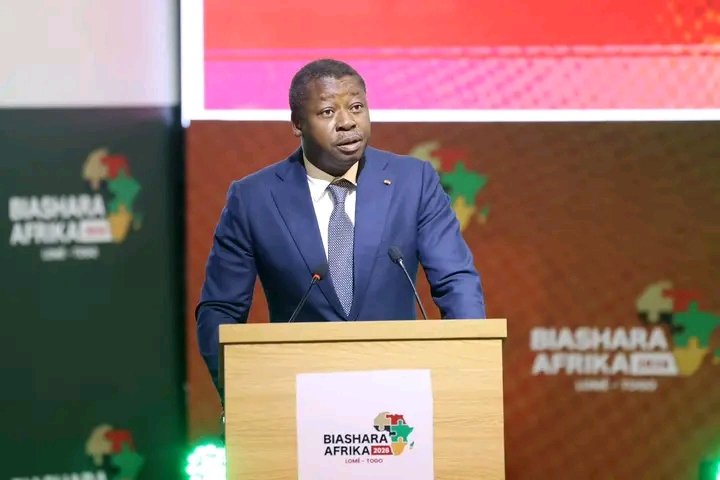
The third edition of the Biashara Afrika forum has kicked off in Lomé, bringing together continental leaders, investors, and private sector representatives to address trade, investment, and economic partnerships across Africa. This year’s event, running since May 18, 2026, serves as a pivotal platform for advancing Africa’s economic integration ambitions.
Addressing the gathering, Faure Essozimna Gnassingbé, President of the Togolese Council, delivered a keynote speech emphasizing the urgent need to shift Africa’s economic integration agenda from political declarations to tangible outcomes. Speaking before an audience of heads of state, ministers, and business leaders, he underscored that “the era of vision must now give way to an era of action.”
honoring past leadership and accelerating the AfCFTA
Gnassingbé paid tribute to Mahamadou Issoufou, a key figure in championing the African Continental Free Trade Area (AfCFTA), highlighting his role in driving the continent’s economic integration efforts. The Togolese leader stressed that mere agreements and policy frameworks are no longer sufficient—what Africa needs now is robust infrastructure, streamlined logistics corridors, and modern payment systems to facilitate seamless intra-African trade.
He also highlighted persistent challenges such as non-tariff barriers, cumbersome border procedures, and high logistics costs, which continue to impede trade within the continent. “The time for declarations is over. We must now focus on operationalizing the AfCFTA,” he asserted.
biashara afrika 2026: a platform for action, not just dialogue
For Gnassingbé, Biashara Afrika 2026 must transcend traditional forums and serve as a dynamic platform for solutions, partnerships, and the practical implementation of Africa’s integration goals. He called on participants to use the event to forge meaningful collaborations that can drive economic growth across the continent.
The forum’s significance is further amplified by the current global economic landscape, marked by geopolitical tensions, rising protectionism, and shifting international supply chains. In this context, the AfCFTA emerges as a strategic tool for Africa to assert its economic sovereignty and reduce vulnerability to external shocks.
building a sovereign and competitive african economy
Gnassingbé argued that no single African nation can effectively defend its economic interests in isolation, particularly in a fragmented global economy. He positioned the AfCFTA as more than a trade agreement—it is a cornerstone for achieving continental economic sovereignty. The ultimate goal, he explained, is to boost local production, strengthen industrial capacities, and enhance Africa’s bargaining power in the global market.
He lamented the persistent trend of African countries exporting raw materials while importing high-value processed goods. “Africa must move beyond the export of raw resources and build competitive industries that add value locally,” he stated. The AfCFTA, in his view, offers a pathway to overcome the limitations of fragmented national markets and foster the growth of robust, continent-wide industries.
empowering africa’s private sector and youth
The Togolese leader also emphasized the critical role of the private sector, particularly small and medium-sized enterprises (SMEs), women entrepreneurs, and young people, in driving sustainable integration. He warned that economic integration efforts will only succeed if they translate into tangible benefits for ordinary Africans—through job creation, entrepreneurship, and access to regional markets.
“Integration cannot be a privilege reserved for elites or large corporations,” he declared. “It must be inclusive, empowering every African to participate in and benefit from the continent’s economic growth.”
Togo’s commitment to regional connectivity
Concluding his address, Gnassingbé reaffirmed Togo’s unwavering commitment to Africa’s integration agenda. Leveraging its strategic geographic location, well-developed logistics infrastructure, and regional connectivity, Togo is positioning itself as a key player in shaping the future of the AfCFTA market.
He expressed optimism that Biashara Afrika 2026 would catalyze new partnerships and inject fresh momentum into the continent’s economic transformation. The forum, he believes, holds the potential to unlock new opportunities and set Africa on a path toward sustainable and inclusive growth.
You may also like
Niger: the silence at the top of the state fuels questions after the August mutiny
Le carnet de Malian relance l’enquête sur la migration clandestine au Sénégal
Mamadi Doumbouya de retour à Conakry après une visite d’État en Côte d’Ivoire
Elversberg vs Bayern Munich: kick-off time, tv channel and team news
Gabon : l’association Force ouvre un espace de propositions pour la rentrée