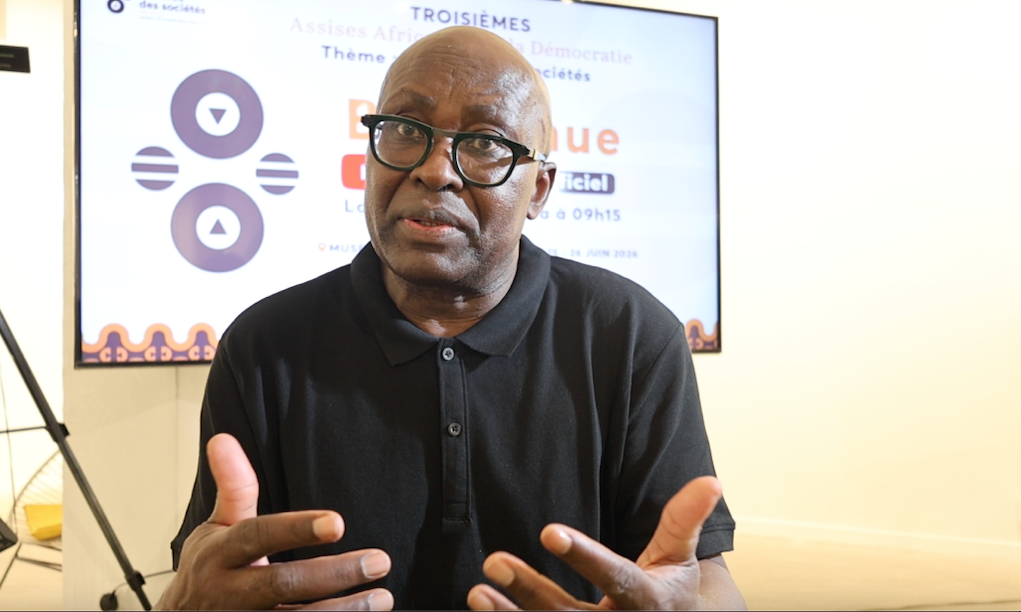
The Cameroonian philosopher Achille Mbembe does not mince words when dissecting Africa’s political landscape. Speaking at the third edition of the African Democracy Forum held at Dakar’s Theodore Monod Museum, he dismantled persistent myths about governance on the continent, declaring that true democracy has never actually taken root in most African nations.
Democracy in Africa: a myth or a misunderstood concept?
Mbembe, president of the Foundation for Innovation in Democracy, argues that what is often described as a “crisis of democracy” in Africa is, in fact, a misdiagnosis. “There can be no crisis of democracy where it has never truly existed,” he asserts. According to him, many African countries have only implemented a superficial form of multiparty systems—what he terms administrative multipartism—where elections are held but often contested and lack genuine democratic substance.
“The idea of a ‘tropical democracy’ is meaningless,” Mbembe states emphatically. He rejects this colonial-era construct, which was designed to brand African governance as inherently inferior. Instead, he advocates for an endogenous democratization process, rooted in Africa’s unique political, social, and cultural traditions rather than imported models.
The influence of financial capitalism on African politics
This year’s Democracy Forum, themed “The Strength of Societies”, places citizens at the heart of governance rather than states. Mbembe highlights how speculative financial capitalism has weakened democratic institutions worldwide, including in Africa. He warns that the concentration of economic power undermines genuine democratic participation, making the forum’s focus on societal resilience all the more critical.
Monetary sovereignty: beyond the CFA franc debate
On economic sovereignty, Mbembe goes further than the CFA franc controversy. “Africa needs a real African currency,” he declares. He draws a sharp contrast between West and Central Africa, attributing the dynamism of West African civil societies to their more active engagement in political processes. In contrast, Central African nations—Cameroon, Chad, Equatorial Guinea, Congo-Brazzaville, and the Central African Republic—remain trapped in what he describes as “postcolonial dark regimes,” resistant to any emancipatory change.
Reparations and historical justice: an unrepairable loss
Mbembe also addressed the irreparable nature of the crimes committed during the transatlantic and trans-Saharan slave trades. “There are things that cannot be repaired because their value is beyond measure,” he explains. “Yet this only strengthens the case for reparations. The more irreparable the loss, the more urgent the demand for justice.”
However, he cautions that discussions on reparations must also confront the complicity of certain African elites in these historical atrocities. “We cannot ignore Africa’s own responsibility,” he states. “Africans were not merely victims—we were also perpetrators in these centuries-long processes. This dual role must be part of the broader conversation on justice, reconciliation, and universal accountability.”
A call for endogenous democracy and historical reckoning
Through his sharp critique, Mbembe challenges Africans to reclaim their political narratives, reject imported models that do not align with their realities, and confront the legacies of colonialism and slavery with honesty. His reflections offer a roadmap for rethinking democracy, sovereignty, and justice—one that prioritizes Africa’s own resources, memories, and aspirations.