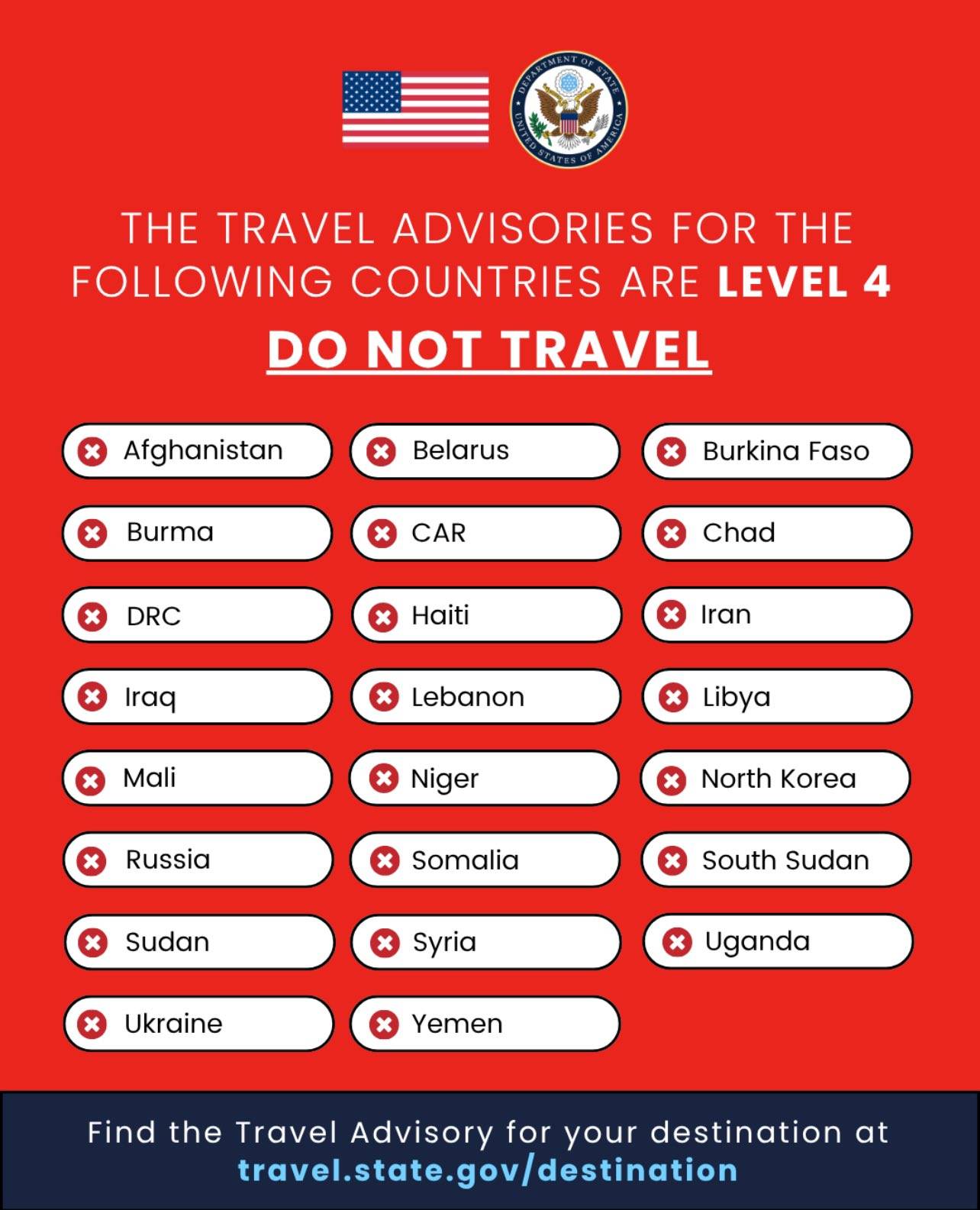
The United States Department of State has once again issued its most severe travel advisory, classifying 23 countries—including three in the Sahel region—as Level 4: Do Not Travel. Among the newly listed nations are some of the most volatile regions globally, with the Alliance of Sahel States (AES)—comprising Burkina Faso, Mali, and Niger—standing out as critical hotspots. The classification reflects a dramatic escalation in security threats, driven by entrenched terrorism and the collapse of state authority in vast peripheral areas.
Why the US warns against travel to the Sahel
The Department of State’s four-tier travel advisory system serves as a stark warning for American citizens, with Level 4 representing the highest possible alert. For the AES countries, this means a near-total absence of consular or emergency support from US missions on the ground. The withdrawal of non-essential diplomatic staff has left these nations effectively isolated, leaving travelers vulnerable to kidnapping, armed attacks, or hostage situations with little to no external intervention.
The decision underscores a broader geopolitical reality: parts of West Africa have slipped beyond the control of central governments, creating a breeding ground for extremist networks that thrive in the power vacuum. The US government’s assessment highlights not only the immediate risks to foreigners but also the systemic collapse of security infrastructure in these regions.
The AES countries in the crosshairs of terrorism
Burkina Faso: A nation under siege
Burkina Faso has become the epicenter of jihadist violence in the Sahel, with armed groups seizing control of vast swathes of territory. Dozens of towns face total blockades, cutting off food, medical supplies, and communication. Military convoys and outposts are frequently ambushed, forcing civilians into internal displacement. The humanitarian crisis deepens as extremist factions expand their reach, exploiting poverty and weak governance to recruit disillusioned youth.
Mali: From rebellion to regional chaos
Mali’s security landscape has deteriorated sharply following the withdrawal of the UN peacekeeping mission (MINUSMA) and renewed clashes between government forces and northern rebel factions. Terrorist groups have exploited this power vacuum, escalating attacks from their traditional strongholds in the north toward the capital, Bamako. What was once considered a relatively stable urban center now faces growing threats, signaling a dangerous shift in the conflict’s dynamics.
Niger: Triple-front insecurity
Niger bears the brunt of cross-border threats, particularly in the volatile “three-border” region shared with Mali and Burkina Faso, as well as the Lake Chad basin, where Boko Haram and the Islamic State’s West Africa Province (ISWAP) remain active. Despite efforts to reorganize its armed forces, Niger struggles with endemic insecurity, compounded by strained diplomatic relations that hinder coordinated regional responses.
A global snapshot of instability
The US advisory extends beyond the Sahel, encompassing other high-risk zones such as the war-torn regions of eastern Democratic Republic of the Congo, where armed factions like the M23 continue to terrorize civilians, and Russia, where geopolitical tensions and arbitrary detentions pose grave dangers. Neighboring Chad also remains under scrutiny due to its proximity to Sudan’s civil war and the persistent threat of cross-border terrorism.
Economic and humanitarian fallout
The Level 4 classification carries severe consequences beyond travel restrictions. For the AES countries, already grappling with economic fragility, the warning acts as a deterrent for foreign investment. Multinational corporations face prohibitive insurance costs, forcing them to freeze or abandon critical infrastructure and resource development projects. Meanwhile, NGOs confront rigid security protocols that severely limit their ability to deliver life-saving aid to populations in dire need of food, healthcare, and education.
The path forward: Beyond military solutions
The US’s latest advisory underscores the failure of a decade-long stabilization strategy in the Sahel. Despite political upheavals and shifting alliances in Bamako, Ouagadougou, and Niamey, insecurity has only worsened, with civilians bearing the heaviest burden. Military interventions alone have proven insufficient; lasting stability will require addressing the root causes of the crisis—governance failures, socioeconomic inequality, and the absence of essential services. Until these challenges are met head-on, the Sahel’s map of peril is unlikely to change.