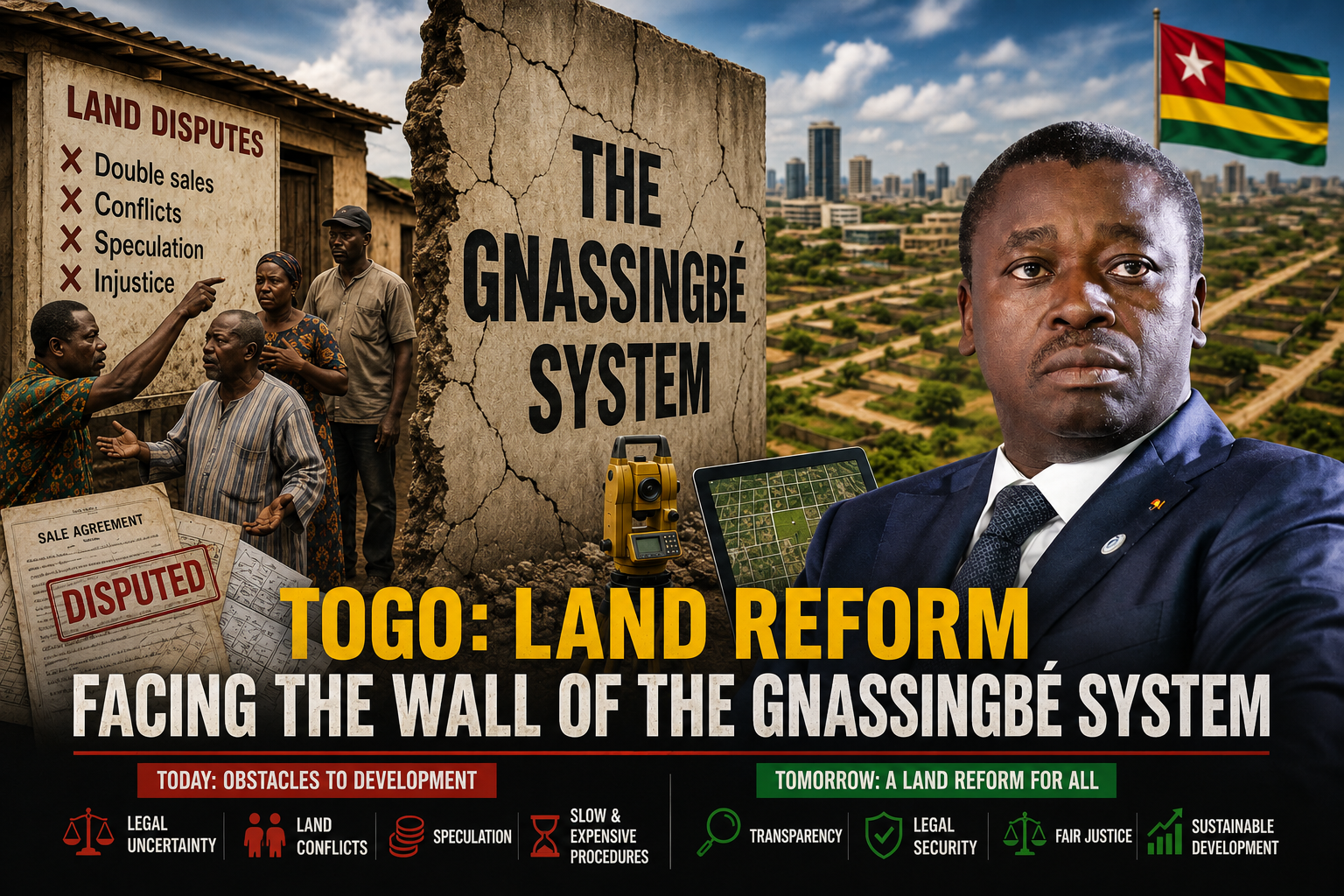
For over six decades, Togo has grappled with a fragmented and inconsistent approach to land administration, prompting the government to embark on a bold new initiative. The stated objective is to position the land sector as a pivotal driver of economic growth. However, the gap between policy aspirations and operational realities remains substantial. Analysts caution that without addressing entrenched systemic weaknesses, this reform effort could meet the same fate as its predecessors—ambitious in rhetoric but failing in execution.
Central to this predicament is the persistent issue of land disputes, which continue to plague communities across the country. These conflicts frequently stem from overlapping land sales, ambiguous ownership claims, flawed documentation, and pervasive lack of transparency in transactions. How can sustainable development be advanced when property rights are consistently undermined by legal ambiguities? A land certificate or sales contract often fails to reassure a buyer, as the same parcel may be subject to competing claims. This fundamental insecurity discourages investment, depletes household capital, and transforms land acquisition into a high-stakes gamble.
Administrative bottlenecks and systemic inefficiencies
The convoluted nature of land-related administrative processes further exacerbates the problem. For individuals and enterprises alike, obtaining land information and completing formalities can be a protracted, costly, and opaque endeavor. Unequal access to land data and procedural opacity unfairly privilege those with political connections, financial means, or insider knowledge. A meaningful reform must transcend the mere issuance of land titles; it should prioritize clear, accessible records that allow citizens to trace the full history of any parcel before making a purchase.
The judiciary, too, bears a heavy burden. A land dispute that drags on for years does not merely stall administrative progress; it can destabilize families, disrupt inheritance, render land economically unviable, and obstruct critical development initiatives. Court rulings must be delivered promptly, fairly, and impartially, free from external influence based on social standing, political clout, or financial capacity. Without a robust, independent, and well-resourced land justice system, administrative reforms will yield only superficial and unsustainable improvements.
Political trade-offs and entrenched interests
The path to reform is further complicated by entrenched political dynamics. At the local level, land governance involves a complex web of actors—traditional landowners, kinship groups, surveyors, local officials, and community leaders. When some stakeholders maintain close ties to powerful political or commercial networks, conflicts of interest and systemic favoritism become pervasive. A credible overhaul must actively dismantle these opaque practices rather than perpetuating them under a new guise.
Speculative pressures also intensify the challenge, particularly in urban and peri-urban areas where land values are rising rapidly. In such environments, unchecked real estate demand can lead to predatory land grabbing, duplicate sales, and manipulation of parcel records. Disadvantaged communities often bear the brunt of these practices, as they lack the resources to navigate a market skewed in favor of wealthier actors. Land thereby shifts from being a shared heritage to a speculative asset controlled by a privileged few.
The social dimensions of land disputes are equally profound. Conflicts frequently erupt within families, between neighboring communities, or across generations over inherited property. As long as customary rights remain poorly integrated with formal legal systems, such tensions will recur. An effective reform must therefore incorporate mechanisms for mediation, early conflict resolution, and public education on legal rights and procedures.
Digital transformation and the imperative of transparency
Digital tools hold promise, but they cannot be treated as a panacea. A reliable, centralized, and regularly updated land registry could substantially reduce the risks of duplicate sales and streamline pre-transaction verifications. Yet automation alone cannot resolve systemic fraud if underlying datasets are incomplete, susceptible to tampering, or available only to a select few. True progress requires not just technological modernization, but a fundamental commitment to data integrity and equitable access.
Transparency must extend beyond systems to the actors who manage them. Who allocates parcels? On what basis? Who oversees transactions? How are infractions addressed, and what protections exist for citizens challenging administrative decisions? Until these questions are answered with clarity, skepticism will persist, and each new reform effort will be met with justified doubt.
Economically, the stakes are undeniable. Secure land tenure empowers individuals to invest, enables businesses to expand, aids financial institutions in assessing collateral, and allows the government to plan infrastructure with confidence. Conversely, land insecurity stifles capital, delays projects, and perpetuates an economy rooted in uncertainty. This is not merely a matter for individual landowners—it shapes the nation’s ability to attract and retain investment.
The real challenge facing Togo is not whether it can introduce another land reform, but whether it possesses the political will to embrace the profound administrative, judicial, and social transformations necessary for lasting change. Meaningful progress will demand unwavering transparency, rigorous enforcement against fraud, faster dispute resolution, stronger oversight of public administration, and robust protections for vulnerable populations.
Without a resolute commitment to dismantling entrenched networks of influence, upholding the rule of law, and ensuring equitable access to justice, any new legislation or reform body risks becoming little more than a superficial gesture. So long as partisan or privileged interests continue to eclipse the principles of fairness and transparency, land will remain a source of division rather than the engine of prosperity envisioned.