
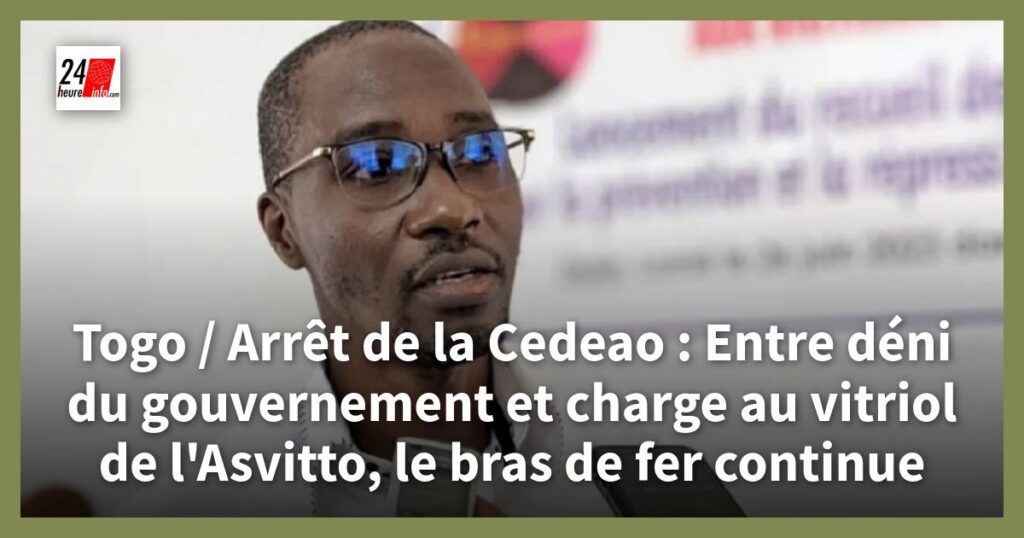
Togo’s constitutional clash: government defies ECOWAS while activists demand justice
Tensions are escalating in Lomé following the Economic Community of West African States (ECOWAS) Court’s ruling against Togo’s constitutional amendments. While authorities dismiss the decision as legally irrelevant, civil society groups are accusing the government of undermining regional justice.
Lomé’s legal counterattack against the regional court
The Togolese government has firmly rejected the ECOWAS Court’s authority to assess domestic constitutional changes. Officials argue that the ruling body “lacks jurisdiction to oversee internal constitutional matters or judge sovereign national powers”, effectively nullifying the court’s decision within national borders.
ASVITTO’s fierce response: “state-backed gangsterism”
The Association of Victims of Torture in Togo (ASVITTO) has launched a scathing rebuttal, calling the government’s stance a “denial of reality”. In a strongly worded statement, the group condemned what it describes as a constitutional coup, warning that those behind the amendments are “trapped in their own anxiety, awaiting their inevitable downfall”.
“Their long-standing pattern of ignoring ECOWAS rulings speaks volumes about their disregard for regional commitments,” ASVITTO declared, highlighting the government’s history of non-compliance with court orders.
The association points to the continued detention of political prisoners in Lomé as proof of the regime’s defiance, despite multiple regional court orders demanding their immediate release.
Crisis escalates: activists urge ECOWAS to intervene
ASVITTO is intensifying pressure on regional bodies, demanding that ECOWAS “administer the necessary remedy to cure Togo’s institutional pathology” and enforce Judgment No. ECW/CCJ/JUD/01/26.
The landmark ruling, issued in January, declared Togo’s 2024 constitutional reforms incompatible with the African Charter on Democracy, Elections, and Governance. The NGO’s message is unequivocal: “This form of state-backed gangsterism must end in our subregion.”
Political deadlock leaves detainees in limbo
The standoff between Lomé and civil society mirrors a broader crisis: one side clinging to legal technicalities, the other demanding accountability. Meanwhile, political prisoners remain incarcerated, their fate hanging in the balance as diplomatic and legal battles rage on.
You may also like
Why Niger’s soldiers are walking away from Tiani’s army
Behind the sovereignty talk, AES states owe 7,727 billion CFA francs on the regional market
Benin back to school: classes reopen nationwide on 14 september 2026
Sonidep’s 2026 loss: how Niger’s cheap fuel policy is draining the state oil company
Texforces-BF: a textile plant built on Burkina Faso’s retirement savings