
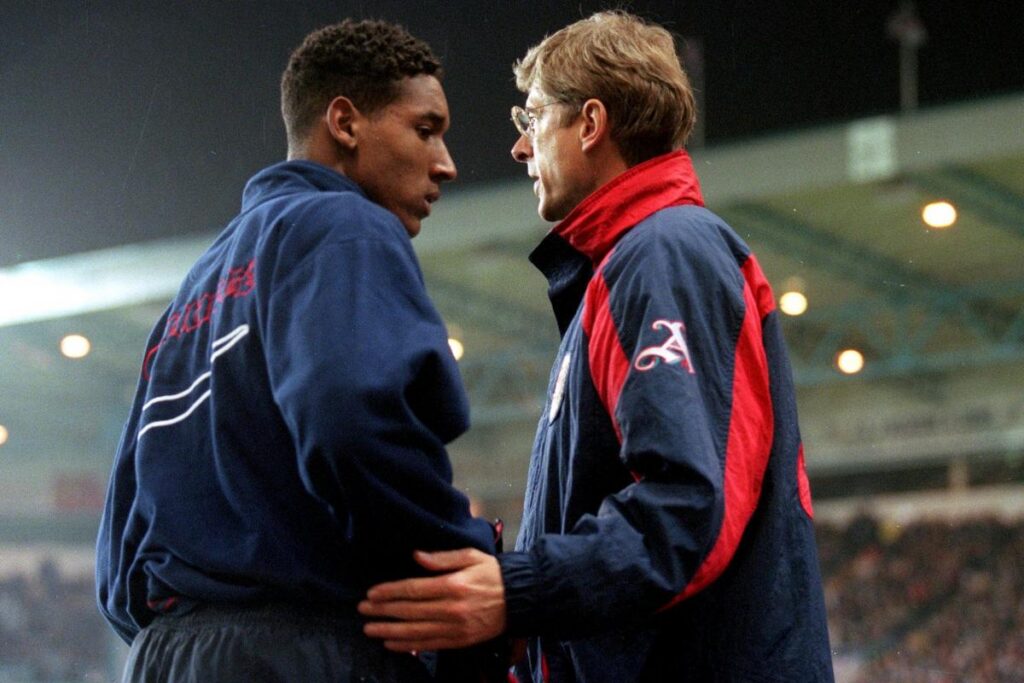
In February 1997, a 17-year-old Nicolas Anelka made headlines when he left Paris Saint-Germain for Arsenal in a move that became one of the most controversial transfers in French football history. The young striker, trained at Clairefontaine, had barely begun his professional journey when he chose to challenge his club’s authority and pursue a career abroad.
From Paris to London: a teenager’s bold decision
Anelka had joined PSG’s youth academy in 1996, making his first team debut just weeks later. By September 1996, he had already earned praise from coach Ricardo, who called him a “joker” after a standout performance against Lens. Yet despite his early promise, the teenager grew frustrated with limited playing time and club decisions that he felt showed a lack of confidence in young talent.
Frustrated by the arrival of veteran striker Cyrille Pouget on loan, Anelka decided to take control of his future. In January 1997, he visited Arsenal’s facilities and met with manager Arsène Wenger, who was impressed by his potential. On January 13, Arsenal’s vice-president David Dein sent a fax to PSG claiming the club would contact Anelka once his amateur contract expired in June. The very next day, the teenager and his father signed a six-year deal with the Gunners, set to begin on July 1.
A legal and media storm
PSG reacted furiously. The club suspended Anelka, excluded him from the first team, and threatened to send him on loan to Servette FC. Club president Michel Denisot accused the player of “rude and disrespectful behavior,” while French football authorities, including the LNF and FFF, argued that Anelka was not free to leave since he was still under contract as an amateur.
The debate escalated into a legal battle, with PSG even threatening to block Anelka’s transfer by refusing to grant him an international clearance. However, Anelka and Arsenal stood firm, arguing that the European Union’s Bosman ruling—passed in 1995—allowed players to move freely at the end of their contracts. FIFA secretary-general Sepp Blatter weighed in, stating that French clubs should accept the reality of young players seeking opportunities abroad.
After weeks of tension, PSG and Arsenal finally reached an agreement. The Parisian club received 5 million francs (approximately €1.19 million in today’s terms) in compensation, while Anelka secured a new life in England with a monthly salary of 500,000 francs (about €119,000), a staggering increase from his previous earnings.
Anelka’s legacy: triumph and controversy
Though his time at Arsenal got off to a slow start—he made just four appearances in his first season—Anelka soon became a key player for the club. In 1998–99, he became the first non-British player to win the Premier League Young Player of the Year award. Yet his career in London would be short-lived. In 1999, he left for Real Madrid in a transfer worth 220 million francs (€51.6 million), marking another dramatic chapter in his journey.
Years later, Denisot reflected on the episode with a mix of resignation and respect. “It wasn’t a pleasant moment for either club, but everyone had the right to do what they did,” he admitted. “Anelka was a special talent, and we wanted the best for him. In the end, he chose to go—and that’s football.”
You may also like
Monaco vs Marseille: where to watch the big ligue 1 clash live
Suivez Lille – PSG : Où Regarder, Compos et Cotes
Eintracht Frankfurt (f) and Paris-SG (f) clash in champions league qualifier
Fenerbahçe and Lyon clash in Champions League qualifier
Crystal palace signs israeli winger from union saint-gilloise for €24.5m