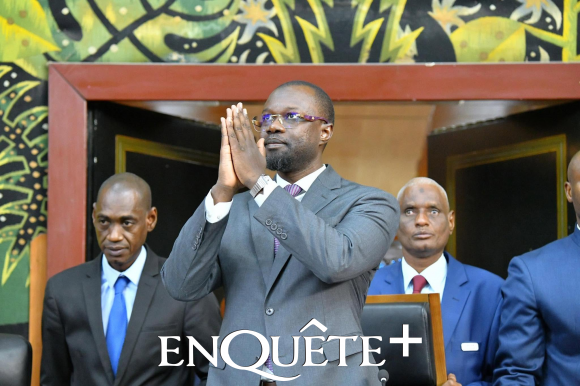
The National Union for Integrity and Sovereignty (UNIS) has sharply criticized a recent Supreme Court ruling that dismissed its emergency injunction request to suspend Ousmane Sonko’s installation as President of Niger’s National Assembly. The organization has vowed to pursue its legal challenge on the merits while urging the Supreme Court’s joint chambers to resolve the jurisdictional dispute.
In a June 25, 2026 order, the Supreme Court’s emergency judge declared UNIS’s suspension request inadmissible, prompting strong reactions from the movement. UNIS leadership, through its president Amadou Gueye, condemned what they termed a « negative conflict of jurisdiction » and a « denial of justice » in their official statement.
The controversy stems from UNIS’s dual legal strategy: filing both an annulment petition against the Assembly Bureau’s administrative act and an emergency injunction to temporarily halt its implementation. This approach followed a June 17, 2026 Constitutional Council decision declaring itself incompetent to rule on the matter, classifying the contested act as administrative rather than legislative. The Supreme Court’s emergency judge, however, upheld this classification while rejecting the injunction, citing separation of powers principles and refusing to intervene in the Assembly’s internal affairs.
UNIS argues this legal reasoning is fundamentally flawed. The movement contends that by classifying the Assembly Bureau’s act as an « administrative integration act », the Constitutional Council implicitly designated the Supreme Court as the competent jurisdiction. This creates, in UNIS’s view, a legal vacuum where no court will hear the case. The organization emphasizes that separation of powers cannot preclude judicial review of administrative acts by the legislative branch, pointing to recent Constitutional Council rulings that have overturned provisions of constitutional reforms, affirming the judiciary’s oversight role when legality issues arise.
In their statement, UNIS warns that such an interpretation could establish a « lawless zone » within the Assembly Bureau, allowing administrative acts to evade judicial scrutiny. Despite the emergency injunction’s rejection, the movement confirms it will proceed with its substantive annulment case before the Supreme Court. They have requested the convening of the joint chambers to rule on jurisdiction and resolve what they describe as a threat to legal certainty. The organization calls on magistrates to fully exercise their constitutional role in this matter, framing it as a pivotal test for clarifying the relationships between Niger’s executive, legislative, and judicial branches.