
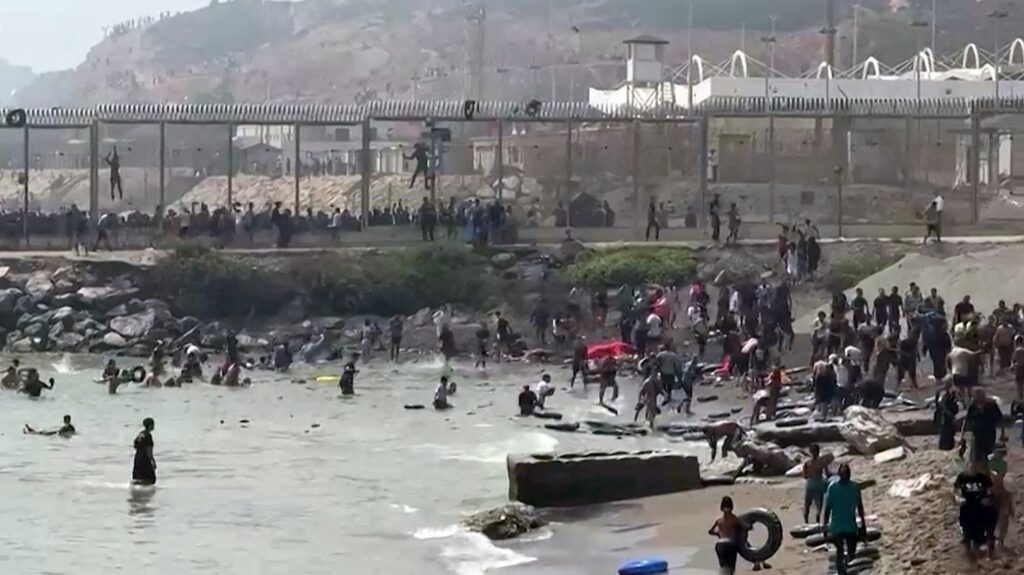
Massive migrant influx at Ceuta sparks political tensions between Spain and Morocco
In just 24 hours, nearly 60,000 migrants illegally crossed into the Spanish enclave of Ceuta, a 20 km² territory bordering Morocco with 85,000 residents. Madrid now suspects Rabat of using migration flows as political leverage following Spain’s recent rapprochement with Algeria.
:quality(50)/2026/07/31/6a6ca763e2f9541974903.jpg)
Thousands of Moroccans reached the autonomous city of Ceuta by swimming just days after Spanish Prime Minister Pedro Sanchez’s visit to Algeria. This mirrors the 2021 incident when nearly 9,000 people entered the country after Spain hosted the leader of the Polisario Front, an independence movement opposing Morocco.
Chaos at the Ceuta-Castillejos border
Chaos erupted at the Ceuta and Castillejos border after thousands of Moroccan youth flooded Spanish territory in one of the largest migration crises in five years. While Moroccan police blocked road access, a relentless stream of young people, families, and even people with reduced mobility dispersed to reach the Spanish city by crossing hills or swimming across the sea.
Spanish authorities insist bilateral relations remain strong, with the foreign ministry calling the current agreement with Morocco “excellent” and describing the migration coordination between the two countries as “intensive.” They reported intensified efforts to address the crisis. After hours of institutional silence, Morocco’s government confirmed what Spain had announced and stated both countries had reached an agreement to repatriate those who entered Ceuta illegally.
Misinterpreted legal decision fuels migration networks
Many uncertainties surround the events. The Interior Ministry, led by Fernando Grande-Marlaska, attributes the episode to human trafficking networks that allegedly “exploit a court ruling” to facilitate the flow of undocumented migrants.
This recent Supreme Court decision states that all individuals entering Spanish territory have the right to legal assistance and for their situation to be “reviewed individually.” Ruth Ferrero, a political science professor and researcher at the Complutense Institute of International Studies, explains this ruling has been “misinterpreted”—it merely applies international asylum law without implying an “open-door” policy or preventing returns to Morocco. This does not negate the Interior Ministry’s claim that trafficking networks were used to promote entry.
Echoes of the 2021 crisis
A similar situation unfolded in May 2021 when nearly 9,000 people entered Ceuta in retaliation after Morocco’s King Mohammed VI condemned Spain’s decision to host the Polisario Front leader, Brahim Ghali, in a Spanish hospital—a move Morocco called “deplorable.” Reports later emerged suggesting Moroccan security forces allegedly spread rumors among sub-Saharan migrants that border controls would be lifted that day.
This is not the first time Rabat has resolved diplomatic disputes with Madrid by allowing a massive influx of immigrants, though the political implications of Morocco’s government motives remain unclear. Haizam Amirah Fernández, executive director of the Centre for Contemporary Arab Studies, notes a “pattern” in these mass entries: “Moroccan authorities use human movements to send messages, often tied to unmet expectations from Moroccan leaders.”
Ferrero cautions against interpreting all migration pressure from Morocco as a political strategy, stating that what we are seeing does not appear to respond to a deliberate Moroccan political goal based on available information and Interior Ministry messaging. Instead, she emphasizes the role of disinformation networks linked to criminal organizations.
Police sources report Moroccan authorities attempted to halt the influx by inspecting public transport and roads, but the multiplier effect of calls to cross overwhelmed Moroccan security forces.
Coinciding with Spain’s visit to Algeria
The massive influx into Ceuta occurred just a week after Pedro Sanchez’s visit to Algeria, marking “a new phase” in relations between Spain and the Maghreb country. During meetings with President Abdelmadjid Tebboune and Prime Minister Sifi Ghrieb, discussions focused on gas supply—a critical issue amid Middle East conflicts and the Strait of Hormuz blockade.
“I cannot confirm this is a determining factor, but the timing is striking,” says Amirah Fernández regarding a possible link between the Ceuta events and Spain’s recent proximity to Algeria. “The rivalry between the two countries has existed since their independence. While phases of cooperation and regional integration have occurred, the current period is among the worst in decades. It’s reasonable to assume Sanchez’s visit was not well received in Rabat.”
According to the expert, Morocco often views Spain’s relations with Maghreb countries as a “zero-sum game”—if Spain improves ties with Algeria, Morocco perceives it as detrimental to its interests, and vice versa.
Ferrero argues Morocco holds a position of power over Madrid, but this stems from “a security-focused policy and outsourcing migration management” rather than deliberate strategy. “It’s not that Morocco actively sought this position, but it has skillfully leveraged its influence in a context where European governments, including Spain, have delegated migration control to third countries.”
The Western Sahara conflict at the heart of tensions
The migration crisis five years ago followed several bilateral tensions between Spain and Morocco. In December 2020, Rabat suspended high-level meetings with Madrid shortly after Donald Trump’s first-term recognition of Morocco’s sovereignty over Western Sahara in exchange for normalizing relations with Israel. Months later, Spain hosted Brahim Ghali, who arrived from Algeria to be treated for COVID-19 in Logroño, sparking a border incident that resulted in two deaths.
“The Hispano-Moroccan relationship is complex,” states Amirah Fernández. “Morocco employs an assertive style—decision-making is concentrated among a small group, and force is often used as a tool.”
Since gaining independence in 1956 after the end of French and Spanish protectorates, disputes between the two countries have centered on Western Sahara, the former Spanish Sahara invaded by Morocco in 1975. Spain abandoned the territory that year, relinquishing administrative responsibility. Currently, 80% of the region is under Moroccan occupation, with the remaining area controlled by the Polisario Front, founded in 1973 as a Sahrawi national liberation movement.
Since Donald Trump’s presidency, Washington’s pro-Morocco stance has pushed the Western Sahara conflict to a point of no return. Trump recognized Moroccan sovereignty over the region in 2020, sparking a diplomatic crisis that culminated in the 2021 Ceuta migration crisis.
The turning point came in 2022 when Pedro Sanchez wrote to King Mohammed VI, seemingly supporting Morocco’s autonomy proposal for Western Sahara—a historic shift from Spain’s neutral stance. “What truly happened with this letter is that the Spanish government abandoned its neutral position,” explains Amirah Fernández. “Until then, Spain supported any solution agreed upon by the parties. However, in this letter, it expressed a preference for the first time: Morocco’s autonomy proposal for Western Sahara, precisely the option defended by Rabat. This does not constitute legal recognition of Moroccan sovereignty over the territory.”
The role of social media in amplifying the crisis
Beyond any potential political motives from King Mohammed VI’s regime, social media undoubtedly played a fundamental role in this migration crisis. A study by the Nordic Observatory of Human Rights in Morocco found that 81% of young people surveyed believed migration-related content on social media portrayed irregular migration as “a solution to improve living conditions.”
Based on a survey of 500 young people from Tangier, Tetouan, and Al Hoceima (northern Morocco), the study also revealed that 78.4% of respondents stated young people easily find posts promoting irregular migration, while 74.2% follow pages providing information or assistance in planning such journeys.
You may also like
Niger : à Niamey, un convoi d’eau destiné aux mercenaires russes saccagé par la foule
Burkina Faso : Apollinaire Kyélem de Tambèla blocked from leaving the country
Cameroun : Yaoundé mobilise 432 millions USD pour reprendre Société Générale Cameroun
Burkina Faso’s energy gamble: 104 billion CFA francs pledged as unpaid bills to Côte d’Ivoire linger
Bénin : comment la fermeture préventive des écoles du Nord déjoue les plans terroristes