The widespread and synchronized attacks that struck Mali on April 25, 2026, represent a pivotal moment, not only for Bamako and the escalating violence across the Sahel but also for the broader West African region. This critical juncture highlights the vulnerabilities within Mali’s current security framework and prompts significant questions for West African nations, particularly Ghana, concerning the perils of excessive reliance on a singular external military alliance.
These events were far from a typical security breach. They constituted a coordinated offensive targeting numerous strategic locations within the Alliance of Sahel States (AES) member nation. The sheer scale and precision of these assaults underscore a substantial advancement in insurgent capabilities, while simultaneously exposing critical deficiencies in intelligence, readiness, and response mechanisms within the Malian Armed Forces and their foreign collaborators.
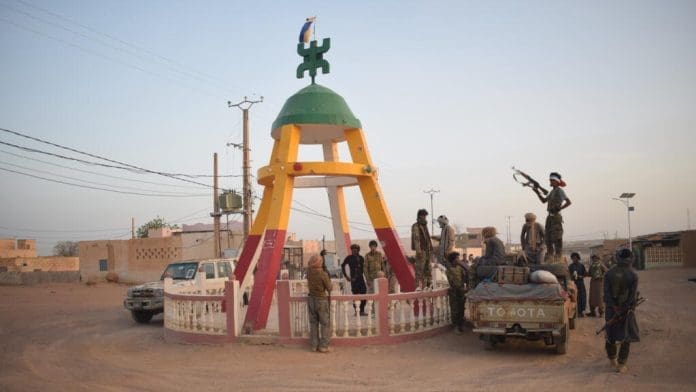
Fighters affiliated with JNIM and the Azawad Liberation Front (FLA) launched simultaneous strikes on Bamako, Kati, Gao, Kidal, Mopti, Bourem, and Sévaré. A Russian Mi-8 helicopter was reportedly incapacitated near Wabaria, checkpoints north of the capital were seized, and armored vehicles were annihilated. General Sadio Camara, Mali’s Defence Minister, lost his life, and several other high-ranking military officials, including the Chief of Defence Intelligence, sustained injuries. The extensive and accurate nature of this assault indicated a profound intelligence failure affecting both the Malian Armed Forces and their Russian-backed partners, the Africa Corps.
Central to this escalating crisis is the fall of Kidal. For a considerable time, Mali’s military command and its Russian allies presented Kidal as a beacon of restored sovereignty. Its collapse now carries both operational and profound symbolic weight. Reports suggest that Russian-linked forces, operating under the Africa Corps, withdrew after minimal resistance, leaving Malian troops exposed and isolated. For a partnership founded on pledges of enhancing security, the implications and visual evidence of this withdrawal are undeniable.
A Familiar Playbook
Moscow’s subsequent reaction unfolded as expected. The Africa Corps asserted that 1,000 to 1,200 insurgents were killed and 100 enemy vehicles destroyed. Russia’s Defence Ministry recharacterized the incidents as a foiled coup attempt, transforming a significant military setback into a narrative of decisive intervention. Associated media outlets echoed this message. Neither the Russian Embassy in Mali nor the Foreign Ministry in Moscow issued an official statement. By portraying a coordinated rebel offensive as an externally orchestrated plot, Russia diverted attention from its own shortcomings, instead pointing to geopolitical conspiracy, with France, Ukraine, and Western nations serving as convenient antagonists. This tactic mirrors strategies employed in Syria, Ukraine, and other instances where Russian forces have experienced reversals they cannot acknowledge.
The intelligence failure preceding these attacks is equally critical. A senior Malian official informed RFI that Russian forces had received warnings of the impending assault three days prior but failed to act. The militants’ success in downing an Africa Corps helicopter further suggests they had foreseen and prepared for aerial countermeasures, a level of counter-surveillance sophistication that neither Moscow nor Bamako appeared to anticipate. These are not merely standard combat losses; they signify a system under immense pressure.
Why Ghana Must Pay Attention
Interpreting these events as geographically distant would be a grave strategic miscalculation. Jihadist organizations active in Mali have already demonstrated their capability for territorial expansion, moving from Mali’s northern regions through its central areas and into Burkina Faso. Northern Ghana lies directly within this evolving threat corridor. The dangers are not hypothetical. Porous borders facilitate the infiltration of small, mobile extremist cells. Conflict in the Sahel fuels the proliferation of illegal weapons and the expansion of transnational criminal networks. Disrupted trade routes and population displacement spread southward, gradually eroding local resilience in ways that are often more challenging to identify and reverse than a single, dramatic attack.
Mali’s experience also vividly illustrates the hazards of security dependence on a single external partner that prioritizes military solutions above all else. Russia’s involvement has provided weaponry, mercenaries, and propaganda management. However, it has not fostered investment in energy infrastructure, agricultural modernization, or the economic conditions essential for reducing recruitment into extremist networks. A strategy that merely contains violence without addressing its root causes will not resolve insecurity; it simply shifts it. Furthermore, a partner stretched thin by its own conflict in Ukraine cannot indefinitely sustain its commitments across the African continent.
Regional Cooperation Is Not Optional for West African Security
Despite current political friction, ECOWAS remains the indispensable framework for regional coordination and West African security. The Alliance of Sahel States, comprising Mali, Burkina Faso, and Niger, has so far proven incapable of orchestrating a meaningful collective response to this crisis. For now, it exists more in declarations than in practical operational reality. Ghana and its ECOWAS partners must not permit political disagreements to dismantle the remaining regional security architecture.
Establishing joint intelligence cells that connect military, police, and border agencies along high-risk transit routes, especially between Ghana and Burkina Faso, is no longer a distant ambition but an urgent necessity. International partners such as the European Union, the US, the United Kingdom, and even China offer valuable technical expertise in surveillance and intelligence analysis. These collaborations should be founded on principles of transparency, reliability, and long-term commitment, rather than short-term expediency.
The central lesson from Mali is unequivocal: national security cannot be outsourced. While external support can augment national endeavors, it can never replace them. A military strategy that secures territory without simultaneously fostering good governance, economic resilience, or community trust will inevitably create the conditions for its own undoing. Ghana’s security begins not strictly at its own borders, but in the strategic decisions made today in Bamako, Ouagadougou, and Niamey.
The Sahel is not merely a buffer zone; it is a vital corridor. What traverses through it will not halt at the borders of coastal West Africa. The imperative for Ghana and the wider region is to learn swiftly, adapt rapidly, and act collaboratively to bolster West African security.
You may also like
Senegal’s 2026 budget revision: the real economic cost for households and businesses
Burkina Faso’s 300 armored vehicles: how a ‘Made in Burkina’ claim could backfire on trade and trust
What happens after Bakari Traoré’s OHADA reform? The debate shaping West African business law
After Mali’s 66th independence parade, a regional debate takes shape
Fallout from Amnesty’s M23 mining report: what next for eastern DRC?