Judicial appointments in Senegal fuel speculation over Ousmane Sonko’s 2029 exclusion strategy
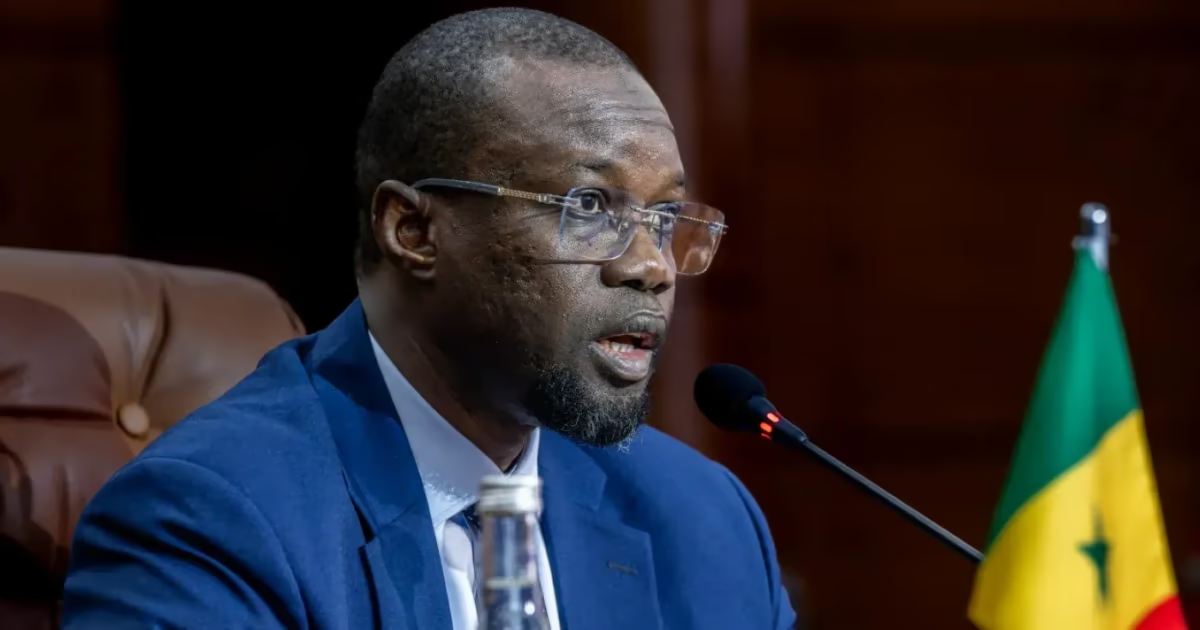
Recent judicial appointments in Senegal have sparked intense debate about their potential impact on the country’s political landscape. Political analyst Mamadou Wane, known as Mao, suggests President Bassirou Diomaye Faye may be laying the groundwork to prevent opposition leader Ousmane Sonko from contesting the 2029 presidential election.
The recent appointments of magistrates to the Constitutional Council and the Saint-Louis Court of Appeal represent a significant shift in Senegal’s judicial hierarchy. According to Mao, President Faye appears to be implementing a revisionist strategy that could revive elements of the former neocolonial order while systematically sidelining Ousmane Sonko. This subtle maneuver may ultimately face the unyielding resistance of a people known for their unbreakable spirit, particularly given the unprecedented momentum of the majority party.
Mao warns that while the President may seek to exclude Sonko from the 2029 race by leveraging state institutions—particularly the judiciary through strategic appointments of former regime officials—such a move could backfire. The analyst emphasizes that Sonko’s enduring popularity has repeatedly thwarted attempts to sideline him in past elections, suggesting any new exclusion effort would similarly fail.
On July 13, 2023, President Faye appointed magistrate Ousmane Diagne as president of the Constitutional Council, replacing the late Mamadou Badio Camara. Days earlier, the President surprised many by selecting former prosecutor Serigne Bassirou Guèye as Advocate General at the Saint-Louis Court of Appeal. Both appointees have publicly clashed with Sonko in the past.
While Diagne’s disagreements with Sonko centered on delays in financial audits and reluctance to prosecute alleged crimes from 2012 to 2024, Guèye’s relationship with the opposition leader was openly hostile. Sonko has accused Guèye—then a prosecutor—of falsifying a gendarmerie investigation report to fabricate charges against him.
Mao refrains from preemptively judging Diagne, acknowledging that actions will speak louder than words. However, he condemns Guèye’s alleged involvement in evidence tampering during Sonko’s trial: “Once a magistrate engages in such practices, they forfeit any right to serve in judicial roles.”
Is Senegal witnessing a neocolonial restoration?
The political analyst frames the appointments as part of a broader revisionist agenda aimed at restoring the old order. He describes this as a deliberate strategy by President Faye to consolidate power by co-opting former coalition officials into a new centrist political force.
“Revisionism here means an attempt to revert to the past,” Mao explains. “We are seeing a clear divide between those seeking to restore a neocolonial system and those committed to sovereignty, patriotism, and democratic revolution.”
He cautions the administration against pursuing Sonko’s political elimination, warning that such efforts ignore the resilience of the Senegalese people: “Those pushing this agenda are politically shortsighted. The people have demonstrated their capacity for sustained resistance—from the 2021 uprising to the three-year struggle that followed. Dissolving the Assembly or fabricating charges against an MP will not work.”
The PASTEF phenomenon and youth mobilization
Mao highlights the PASTEF’s record-breaking card sales as proof of its unmatched grassroots strength. “Today, PASTEF stands as Senegal’s most organized, dynamic, and cohesive party, with Ousmane Sonko at its helm,” he notes. “This structure and militancy give it a decisive edge.”
The analyst argues that Senegal has reached an irreversible stage of democratic maturity, forged through the 2000 and 2012 political transitions and hardened by the intense struggles of 2021–2024. “The March 2021 uprising wasn’t a brief protest—it lasted nearly three years,” he recalls. “The people have learned how to resist effectively, no matter the regime’s coercive measures.” This collective memory, he believes, makes any attempt to politically eliminate Sonko doomed from the start.