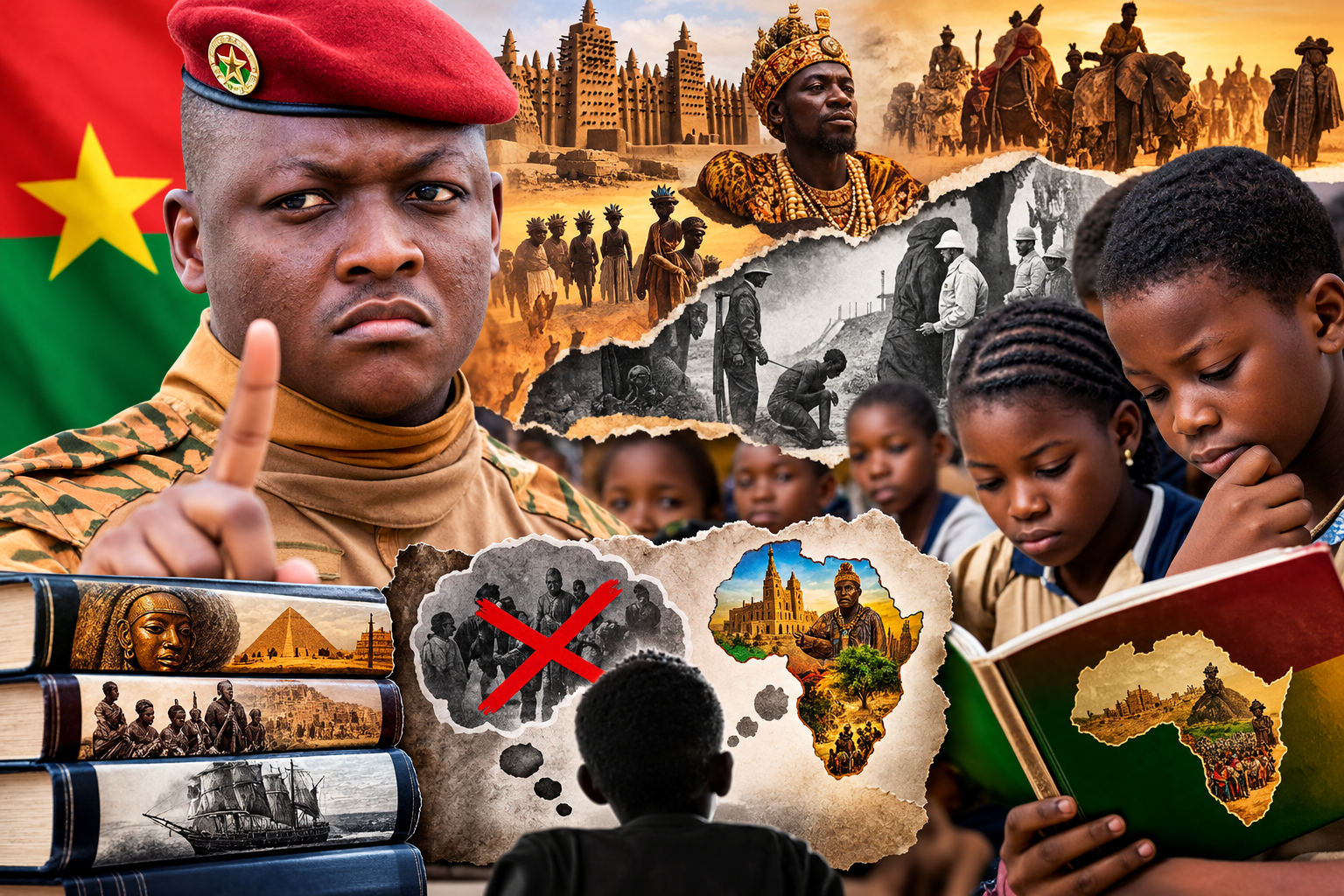
Burkina Faso is currently overhauling its history and geography curricula with the stated goal of “decolonizing” school textbooks. While this initiative rightly seeks to address gaps in African historical representation, it also raises a critical question: could rewriting educational materials inadvertently trap future generations in a new, equally incomplete version of their own past?
Beyond colonial narratives: the risks of a selective historical education
History is not defined solely by colonialism, its injustices, or conflicts with the West. It encompasses civilizations, empires, kingdoms, trade networks, scientific discoveries, social transformations, and cross-cultural exchanges. Teaching this history demands a balanced approach one that acknowledges historical wounds without reducing collective memory to a single narrative.
The challenge for Burkina Faso lies in avoiding a counterproductive strategy where reform becomes just another form of historical revisionism. Educational programs can and should highlight colonial injustices, African resistance movements, and long-marginalized figures. However, they cannot rewrite history itself or retroactively undo past suffering. Their true purpose is to provide a more complete understanding, not to replace one ideological lens with another.
Can a balanced history curriculum shape informed citizens or deepen divisions?
The potential pitfall of this reform is that it may inadvertently create a generation whose understanding of the past is constrained by a new ideological framework. A history curriculum that prioritizes a single perspective no matter how justified risks fostering resentment rather than critical thinking. Students must be equipped not just to recognize injustice, but to situate it within a broader, nuanced context.
For illustration, consider how Côte d’Ivoire has approached historical education. A well-rounded curriculum must integrate national history, pre-colonial African empires, continental figures, and global events that shaped modern societies. Understanding one’s own country does not mean ignoring the rest of the world in fact, it requires viewing local history within a wider geopolitical and cultural framework.
Decolonizing education without imposing a new dogma
Decolonizing history education is a valid objective when it means correcting omissions, restoring neglected facts, and restoring African civilizations to their rightful place in the historical record. However, this effort loses its integrity if it merely replaces one monolithic narrative with another. Students should be encouraged to examine colonial crimes objectively while also studying European societies in all their complexity not just as oppressors, but as participants in a shared global past. Similarly, they should explore African civilizations without glossing over internal conflicts, contradictions, or transformations.
Merely knowing that ancestors suffered injustices is not enough. Students must also understand how these injustices occurred, what systems enabled them, who bore responsibility, and what lessons can be drawn for the future. True historical literacy empowers young people to engage in informed debate and build a more just society not by escaping the past, but by confronting it with clarity and critical perspective.
Choosing between a memory of confrontation or one of informed progress
The ultimate question for Burkina Faso’s educational reform is not just how history should be taught, but what kind of memory the nation wishes to pass down to its children. Will this memory perpetuate perpetual confrontation with the past, or will it equip young citizens with the intellectual tools to understand, debate, and move forward?
History’s wounds are not healed by hiding certain pages from future generations. They are addressed by giving students the full text all the chapters, the complexities, the contradictions and teaching them to read it with discernment. Only then can education nurture citizens who know their roots without cutting themselves off from the world, and who use the past not as a weapon, but as a guide.
By Daniel Mbami — Journalist