Gabon turns to science to boost food self-sufficiency
Libreville, June 8, 2026 — Gabon is wagering on an ambitious goal: slashing its reliance on food imports and phasing out foreign poultry by 2027.
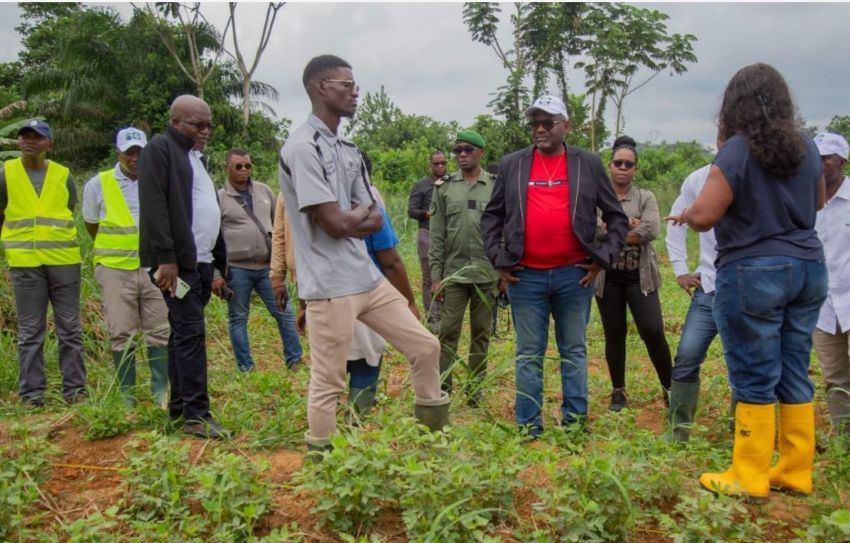
The battlefront is no longer limited to markets or ports—it has shifted to the experimental fields of the National Centre for Scientific and Technological Research (CNAREST) in Kougouleu. A recent visit by Minister of Higher Education, Scientific Research and Government Spokesperson Charles Edgar Mombo underscores a pivotal shift: science is now a key driver of economic transformation and national sovereignty.
In a nation where food imports still dominate a significant share of external expenditure, locally producing essential livestock feed ingredients has become as critical as mining or energy development.
Science as an engine of national progress
The government’s agenda is unambiguous: build a robust poultry sector capable of meeting domestic demand while steadily reducing imports. Central to this vision is the production of affordable, locally sourced animal feed—particularly maize and soybeans, which form the backbone of industrial poultry diets.
At Kougouleu, CNAREST researchers are testing eleven maize varieties to identify those best suited to Gabon’s unique soil and climate. The trials aim not only to improve yields but to ensure a stable, long-term supply chain for the nation’s expanding poultry industry.
Researchers are also conducting trials on eleven soybean varieties introduced through a partnership with Malawian research centres. Additional experiments are underway in Nyanga Province, especially in Tchibanga, to assess performance across different ecological zones.
This marks a significant evolution: science is no longer seen as a distant academic pursuit but as a direct enabler of economic growth.
Building an integrated agricultural value chain
The government’s strategy hinges on one principle: producing feed locally to cut production costs and boost the competitiveness of Gabonese farmers. This approach mirrors a broader trend across Africa, where rising food import bills have exposed economic vulnerabilities.
Gabon, however, possesses considerable advantages: fertile land, abundant water resources, and a climate conducive to multiple crops. Minister Mombo has emphasized the nation’s potential, praising researchers for their progress and affirming that the higher education system is fully aligned with the President’s strategic priorities.
Beyond agriculture, this initiative signals a deeper transformation: science is being redefined as a practical tool for national development, not just a source of knowledge.
A sovereignty still in the making
While progress is encouraging, challenges remain. Researchers stress the need to expand experimental plots to enhance trial quality and scale up production. Transitioning from lab success to industrial output is often the most difficult step.
Funding remains a hurdle. Modernizing agriculture demands substantial investment in infrastructure, accessible financing, and better-organized value chains. Yet, for the first time in years, Gabon is weaving together research, farming, industry, and economic independence into a cohesive strategy.
The minister’s visit to Kougouleu symbolizes a paradigm shift. Under the new vision, food self-sufficiency won’t come from policy alone—it will be forged in laboratories, research centres, and continuous innovation.
By 2027, Gabon could prove that in Africa, food sovereignty is built not only by farmers, but by scientists. A quiet revolution—yet one with the power to reshape the nation’s economic future.