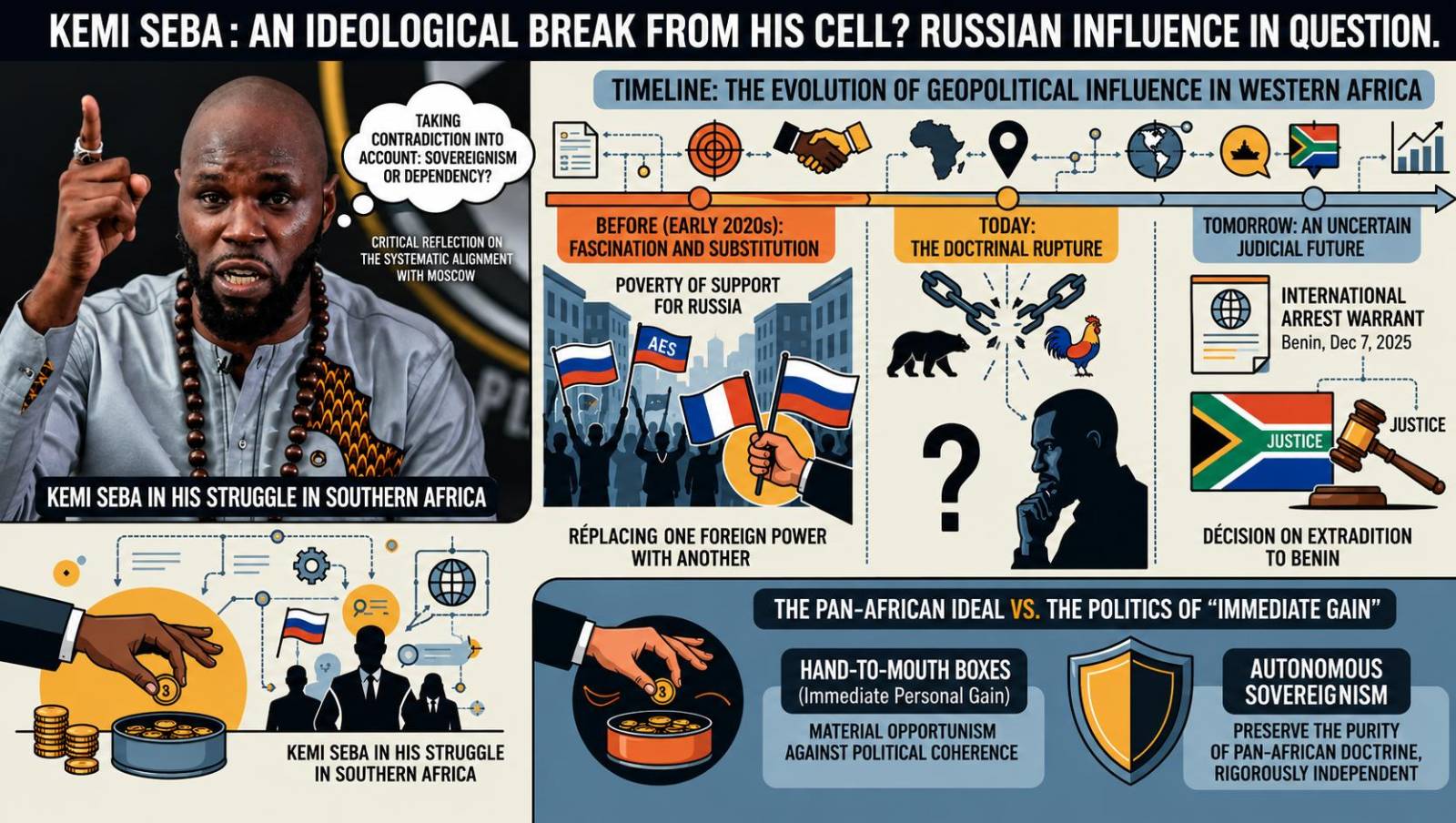
In recent years, the political landscape across parts of the African continent, particularly within the Alliance of Sahel States (AES) which includes nations like Niger, has presented a striking political tableau. Numerous demonstrations, often championing sovereignist ideals, have been characterized by a proliferation of Russian flags and unequivocal pro-Moscow slogans. For an active segment of activists and citizens, Russia is increasingly championed as the definitive alternative to traditional Western powers.
However, this burgeoning fascination with Moscow is now prompting fundamental questions, especially when it emanates from movements advocating for absolute independence. Presently, from his detention cell in South Africa, Kemi Seba, a leading proponent of contemporary panafricanism, appears to be undergoing a significant doctrinal re-evaluation, challenging this prevailing sentiment.
The substitution trap: between sovereignty and new dependencies
While the pursuit of new international partnerships constitutes a legitimate diplomatic endeavor for any state or political movement, the inclination to merely substitute one foreign power for another is increasingly viewed by many observers as a profound ideological inconsistency. Replacing the historical influence of France with that of Russia does not, in itself, signify emancipation, but rather a mere relocation of dependency centers.
It now seems that Kemi Seba is grappling with the full measure of this contradiction. The panafricanist ideologue is reportedly casting a critical eye on what he perceives as the limitations of a systematic alignment with Moscow, steadfastly refusing to endorse a renewed form of protectorate, even one presented as anti-Western. This introspection by a key figure offers a crucial perspective on the evolving Niger politics and the broader security challenges facing West Africa.
The panafrican ideal versus the politics of ‘immediate gain’
This emerging ideological distance highlights a schism among sovereignist movements. While a portion of the enthusiastic support for Russia is undoubtedly driven by a genuine quest for geopolitical rupture, other dynamics appear to be motivated more by material gain than by unwavering ideological conviction.
Kemi Seba is reportedly taking a firm stand against this opportunism, often metaphorically encapsulated by the phrase ‘filling the stewpot’ – a reference to the pursuit of personal and immediate benefits at the expense of long-term political coherence. By refusing to engage in such ideological expediency, the activist endeavors to safeguard the doctrinal purity of a panafricanism that aspires to rigorous autonomy. This development adds a layer of complexity to the ongoing discussions in West Africa and impacts the discourse around Niger politics and regional alliances.
A political and judicial future suspended in Pretoria
This period of doctrinal introspection coincides with a particularly precarious personal juncture for the activist. Subject to an international arrest warrant issued by the Béninese government following an alleged coup attempt on December 7, 2025, Kemi Seba is currently detained in South Africa.
The activist’s future is no longer solely unfolding within the realm of ideas but is now squarely before the tribunals. The South African judiciary is expected to rule shortly on the extradition request submitted by Cotonou. Will this involuntary period of detention mark a definitive ideological break or merely a recalibration of panafricanist discourse? The coming weeks will prove decisive for Kemi Seba’s political trajectory and, by extension, for the orientation of the movements he influences, with potential implications for Niger security and the wider West Africa region.