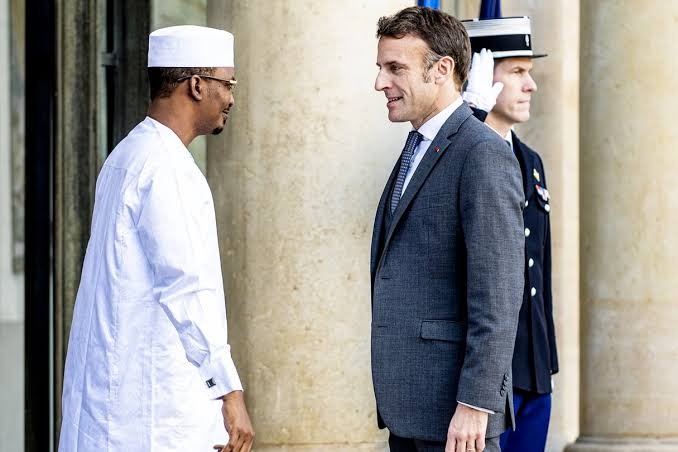
When Emmanuel Macron and Mahamat Idriss Déby met at the Élysée on 13 October 2026, the declaration of intent they signed on defense cooperation did more than reopen a bilateral file. It triggered an immediate wave of reactions across the Sahel and raised a single, pressing question: what comes next? Coming after the departure of French troops from Chad and the breakdown of ties with several Sahelian states, the move signals a shared determination in Paris and N’Djamena to rebuild their partnership on new foundations, while accusations from Niger over the events of 28 and 29 August add a sensitive layer to a region already in flux.
A new chapter opens between Paris and N’Djamena
The relationship between France and Chad has entered a different phase. Receiving his Chadian counterpart at the Élysée on Tuesday 13 October 2026, Emmanuel Macron took part in a meeting that formally restored relations between the two countries. At the end of the talks, the defense ministers of both states signed a declaration of intent designed to structure and expand their cooperation in the defense field.
The announcement lands almost two years after N’Djamena decided, in November 2024, to end its military cooperation agreement with France. The withdrawal of French forces and the handover of their facilities, completed in early 2025, brought an end to France’s permanent military presence in Chad — the country that had served as the strategic hub for French operations in Africa.
What the post-withdrawal partnership looks like
The 13 October declaration sets up a cooperation framework focused on training, expertise, industry and technology, with the stated aim of directly boosting the capabilities of Chad’s armed forces.
For Paris, the shift fits into a broader redefinition of its African partnerships after military exits from Mali, Burkina Faso and Niger. Those ruptures shrank France’s footprint in the Sahel and spelled the end of a cooperation model built on permanent military deployments.
Chad remains a central partner. Its geographic position — close to war-torn Sudan, to Libya and to the Lake Chad basin — puts it at the heart of regional security challenges. Border surveillance, the fight against armed groups and the strengthening of the army’s operational capacity are the pillars that give this cooperation a regional dimension.
Resuming dialogue with N’Djamena marks the adoption of a new formula, one based on needs defined by Chadian authorities and on strictly bilateral cooperation.
Niger: a delicate diplomatic equation
The relaunch comes amid regional tensions between Paris and Niamey. During the night of 28–29 August 2026, an attempted destabilization unfolded in Niamey, notably around Air Base 101.
Niger’s government implicated France and several foreign actors, including Chad, in the alleged mutiny attempt. Paris rejected those claims.
The geographic proximity between Chad and Niger gives the affair particular weight. Both countries share concerns tied to regional security, yet their diplomatic orientations and their relations with outside partners differ.
Against that backdrop, the rapprochement between Paris and N’Djamena is drawing attention from Nigerien authorities. The Franco-Chadian declaration defines an exclusively bilateral framework between Paris and N’Djamena.
The goal is to structure cooperative relations in a region where military presence is a major political issue and where governments insist on strict autonomy in their strategic choices.
Beyond defense: the development stakes
The 13 October meeting also recorded economic and cultural progress. Both presidents committed to developing their relations for the benefit of businesses and populations. The approach gives concrete shape to the rapprochement dynamic that took hold during 2026, after months of bilateral tension.
The economic component reinforces the relationship, particularly in key sectors: infrastructure, energy, health, transport and education. For both governments, the priority is to move past a cooperation historically dominated by military questions and to put investment and trade at the center.
That ambition responds to major challenges. In Chad, development, employment and public services are pressing needs. At the same time, conflicts in neighboring countries weigh on stability and on available resources. Security cooperation is therefore accompanied by direct action addressing the needs of local populations.
A test for French diplomacy in the Sahel
The declaration of intent signed in Paris is a major political step, to be followed by specific commitments on training, expertise transfers, technological cooperation and operational support.
For Emmanuel Macron, the repositioning means rebuilding the relationship with Chad in a renewed form. For Mahamat Idriss Déby, it means strengthening his country’s capabilities while retaining full control over its strategic choices.
The Franco-Chadian rapprochement embodies the redeployment and redefinition of France’s role in a region where diplomatic and security balances are shifting.
After military withdrawals and past tensions, Paris and N’Djamena are starting from new ground. This renewed partnership reconciles the interests of both states, responds to regional security demands and asserts itself amid the diplomatic tensions running through the Sahel.