
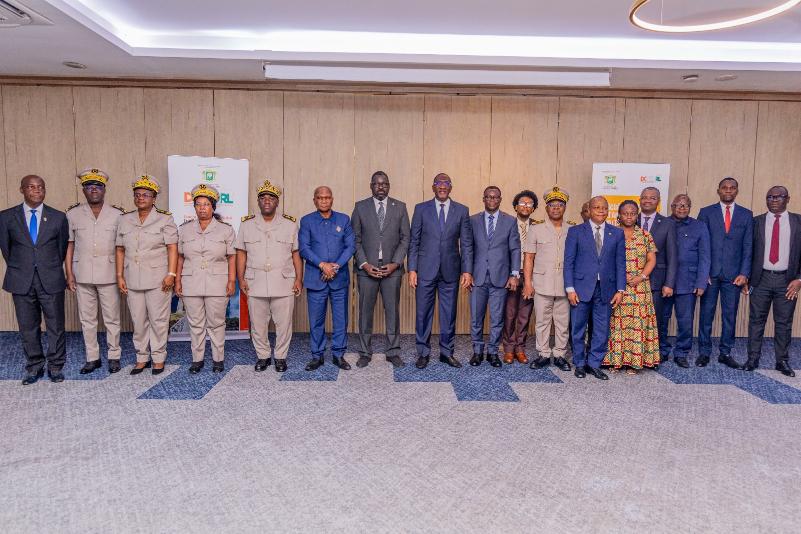
The Minister of Planning and Development, Dr. Souleymane DIARRASSOUBA, led a high-level national workshop in Abidjan to validate the study for Côte d’Ivoire’s National Spatial Planning Framework (SNAT CI-2045). The gathering brought together senior government officials, prefects, local authorities, technical and financial partners, public administrations, private sector representatives, civil society groups, academics, experts, and media professionals.
Setting the stage for balanced national development
This milestone marks a decisive step toward adopting Côte d’Ivoire’s first-ever national spatial planning reference document. The SNAT CI-2045 will provide the state with a robust framework to guide public and private investments, enhance government efficiency, and foster more balanced territorial development across the country.
Under the leadership of President Alassane Ouattara, the Ivorian Government is reinforcing its strategic planning mechanisms to support the nation’s economic, social, and environmental transformations. Spatial planning is central to this vision, ensuring equitable investment distribution, unlocking regional potential, and aligning development policies with local realities.
The SNAT CI-2045 serves as the long-term blueprint for spatial organization, defining where public and private investments should be strategically located. It harmonizes state actions with those of local authorities and development stakeholders by assigning specific economic roles to each region, promoting long-term coherence in national development priorities.
A roadmap for resilient, inclusive growth
Dr. DIARRASSOUBA emphasized the framework’s role in translating medium-term priorities outlined in the National Development Plan (NDP 2026-2030) into territorial realities. He highlighted the ministry’s responsibility in ensuring every region contributes meaningfully to national progress: « The NDP sets our medium-term priorities and investments, while the SNAT CI-2045 ensures their territorial translation over the long term. Together, these frameworks enable coherent public action across the country. Our mission is to secure each territory’s rightful place in the national development agenda. »
The validated orientations result from a rigorous, participatory, and multi-scalar consultation process. They are grounded in a comprehensive national territorial diagnosis and address key challenges: bridging regional disparities, managing urban growth, boosting local competitiveness, strengthening governance, preserving natural resources, and deepening regional integration.
Five pillars to transform Côte d’Ivoire’s future
The SNAT CI-2045 is built on five strategic pillars designed to build resilient, competitive, and prosperous territories:
- Balanced territorial development: reducing inequalities between regions and ensuring no area is left behind.
- Efficient urban and rural networks: optimizing connectivity and infrastructure to enhance economic flows.
- Strengthened territorial governance: empowering local authorities to lead sustainable development initiatives.
- Performance-driven, resilient, and inclusive economy: positioning Côte d’Ivoire as a hub for sustainable growth and shared prosperity.
- Accelerated climate transition: integrating environmental sustainability into all spatial and economic decisions.
From validation to national law
Following the workshop, the draft framework will be submitted to the Government for approval before being presented to Parliament. The adoption of the law establishing the National Spatial Planning Framework will position Côte d’Ivoire at the forefront of strategic territorial planning in West Africa. This historic milestone will guide state action, directing investments toward regions where their impact will be most transformative, and fostering a more balanced and inclusive national development trajectory.
You may also like
Sonidep’s 2026 loss: how Niger’s cheap fuel policy is draining the state oil company
Texforces-BF: a textile plant built on Burkina Faso’s retirement savings
Niger’s external liabilities reach 12,900 billion CFA francs as dependence deepens
Benin’s school canteens now feed 1.9 million children every school day
Sifi Grine in Bamako: Assimi Goïta’s junta swallows its pride before Algiers