
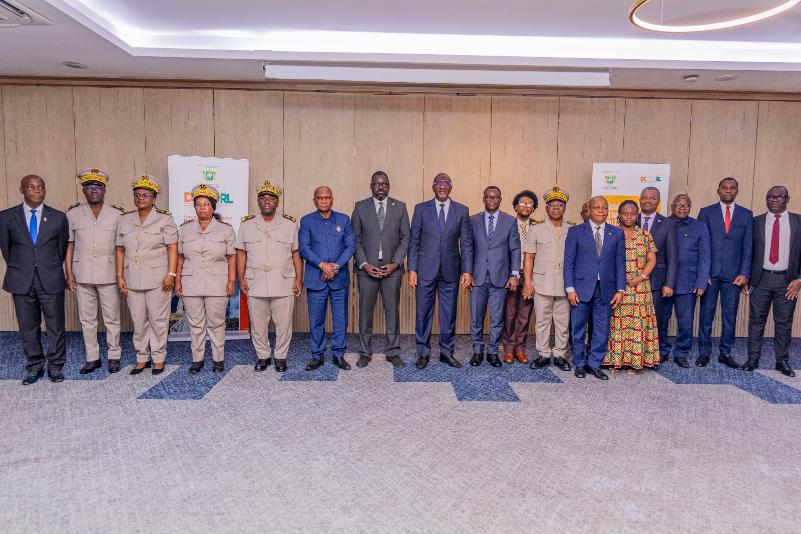
Abidjan recently hosted a pivotal national validation workshop for the comprehensive study of Côte d’Ivoire’s National Spatial Planning Scheme (SNAT CI-2045). Dr. Souleymane DIARRASSOUBA, the Minister of Planning and Development, presided over this significant gathering. The event brought together a diverse range of stakeholders, including representatives from national institutions, the prefectural corps, local territorial authorities, and key technical and financial partners. Public administrations, the private sector, civil society organizations, academia, experts, and media professionals also participated, underscoring the broad consensus and collaborative spirit behind this initiative.
This crucial milestone paves the way for the official adoption of Côte d’Ivoire’s inaugural national framework for territorial planning. The SNAT CI-2045 is designed to furnish the State with a definitive national reference point for strategic planning, ensuring that both public and private investments are guided sustainably. Its implementation is expected to significantly enhance the effectiveness of public action and foster more equitable development across all regions of the country.
Under the distinguished leadership of His Excellency Monsieur Alassane Ouattara, President of the Republic, the Government remains steadfast in its commitment to fortifying the national strategic planning apparatus. This concerted effort aims to effectively support the ongoing economic, social, and environmental transformations sweeping across Côte d’Ivoire.
Within this broader national strategy, spatial planning emerges as an indispensable tool. It plays a critical role in promoting a more balanced distribution of investments, unlocking and maximizing the unique potential inherent in each region, and strengthening the overall coherence of national development policies.
The SNAT CI-2045 stands as the foundational reference framework for the long-term spatial organization of development. It meticulously structures the geographical placement of both public and private investments and ensures harmonious coordination among state entities, local territorial authorities, and various development actors by assigning specific strategic roles and vocations to each territory.
Dr. Souleymane DIARRASSOUBA articulated the scheme’s vital connection to national objectives, stating, « The PND 2026-2030 outlines the medium-term priorities and investments crucial for national development. The SNAT CI-2045 translates these into a long-term territorial vision and will serve as a bedrock for future National Development Plans. Together, these two frameworks enable coherent public action across the entire nation. Our responsibility, as the ministry overseeing spatial planning and regional and local development, is to ensure every territory secures its rightful place in national progress. »
The strategic orientations presented for validation represent the culmination of an extensive consultation process. This process was meticulously conducted using a scientific, participatory, and multi-scalar approach, grounded in a thorough diagnosis of the national territory. These orientations directly address critical challenges identified, including the reduction of regional disparities, effective management of urbanization, enhancement of territorial competitiveness, improvement of local governance, preservation of natural resources, and consolidation of regional integration.
The SNAT embodies an ambitious vision for Côte d’Ivoire: a nation characterized by resilient, competitive territories that collectively drive shared prosperity. This grand vision is structured around five core strategic axes: fostering balanced territorial development, establishing a more efficient urban and rural network, strengthening territorial governance, cultivating a high-performing, resilient, and inclusive economy, and accelerating the nation’s climate transition.
Following the successful conclusion of this workshop, the draft Scheme will proceed to the Government for review, before its eventual submission to the Parliament. This legislative step aims for the adoption of the law establishing the National Spatial Planning Scheme. Once enacted, Côte d’Ivoire will possess its foundational national territorial planning framework, a guiding document that will direct state actions, channel investments towards areas where their impact will be most profound, and ultimately foster a more balanced and equitable development trajectory nationwide.
You may also like
Why Niger’s soldiers are walking away from Tiani’s army
Behind the sovereignty talk, AES states owe 7,727 billion CFA francs on the regional market
Benin back to school: classes reopen nationwide on 14 september 2026
Sonidep’s 2026 loss: how Niger’s cheap fuel policy is draining the state oil company
Texforces-BF: a textile plant built on Burkina Faso’s retirement savings