
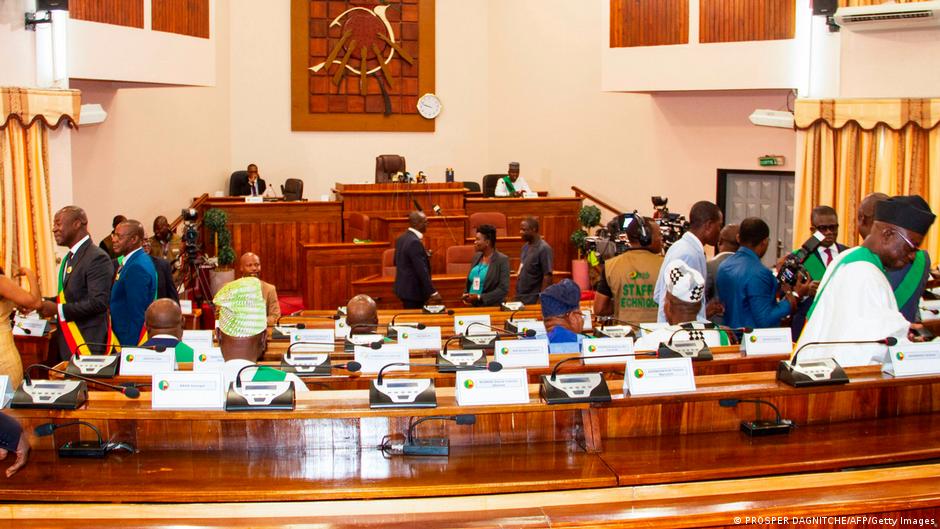
Bénin’s Senate convenes: former presidents and 25 members set to shape the nation’s future
Bénin’s Senate officially convened this Thursday with all 25 members taking office, including three former presidents. This second chamber of parliament, designed as a regulatory body and advisory council, aims to foster social stability and political harmony.
Established through a constitutional revision in November 2025, the Senate will temporarily operate from the National Assembly building until its permanent facilities are completed. On Friday in Cotonou, senators gathered in a closed-door meeting under the leadership of Robert Dossou, former president of the Constitutional Court, to outline their operational framework.
The primary expectation surrounding the Senate is its potential to de-escalate political tensions. With a mix of ex-officio members and appointed figures, citizens anticipate a council of elders capable of preventing political disputes before they escalate.
Governance expert Joël Atayi-Guèdègbé emphasized the chamber’s significance: “Frankly, we expect this upper house to embody wisdom and act as a true council of elders. Given the extraordinary experience of its members, there is no room for error or repetition of past political conflicts.”
An institutional regulator for national harmony
Among the inaugural members are former presidents Patrice Talon, Boni Yayi, and Nicéphore Soglo, whose past political differences could now contribute to a balanced legislative environment. In a nation still grappling with lingering political divisions, this Senate is seen as a vital institution for institutional stability.
“We view this institution as a pathway to peace, especially considering our country’s history of political strife driven by competing interests. What we anticipate is a calmer, more regulated political ecosystem where dissenting voices can still be heard,” noted political analyst Eugène Allossoukpo.
Financial implications: a necessary investment?
The economic impact of the Senate remains a contentious topic. The government has allocated 100 million West African CFA francs solely for the inauguration ceremony, raising questions about ongoing operational costs.
Joël Atayi-Guèdègbé reflected on the financial aspect: “While the Senate’s reduced size will inevitably increase public spending, we hope its sessions remain limited to the four planned annually. Despite the high allowances for its members, we trust the institution will manage its budget judiciously. Democracy, after all, comes with a price.”
As attention turns to the Senate’s leadership, speculation grows over whether former president Patrice Talon will assume the presidency of this new chamber. The 25 inaugural senators face a critical challenge: demonstrating that the nation’s stability justifies this democratic investment.
You may also like
Bénin: le Sénat tient sa séance inaugurale sous la conduite de Patrice Talon
Gabon : la participation citoyenne au cœur de la Ve République
Is Chad truly experiencing a political easing of tensions?
Accord FMI-Sénégal : Thierno Bocoum exige la transparence sur les conditionnalités
Ousmane Sonko demands full transparency on Senegal’s new FMI agreement