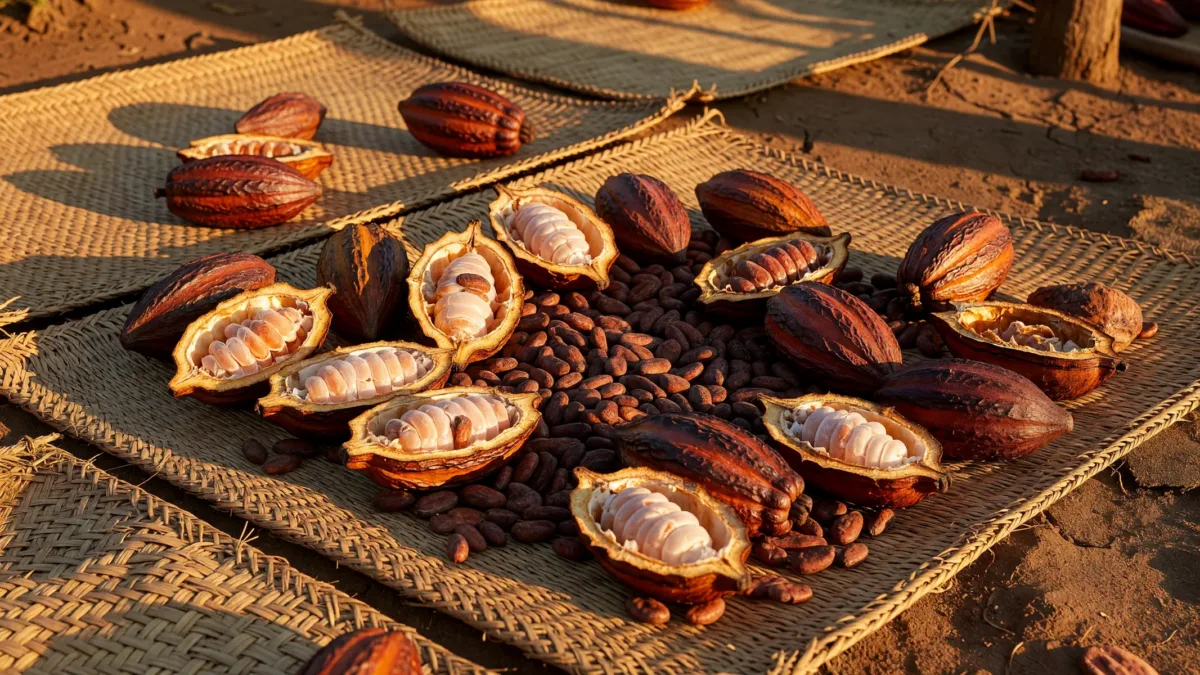
The key points
- Regional alliance: Four major West African cocoa producers, accounting for over 60% of global output, formalized the Abuja Declaration on July 14, 2026
- Transformation goal: Shift from raw bean exports to local processing of high-value cocoa products
- EUDR compliance: Collective strategy to address the EU’s deforestation regulation taking effect December 30, 2026
- Industrial project: A 70,000-ton processing plant planned for 2027 in Sagamu, Nigeria
A groundbreaking summit in Nigeria’s capital on July 14, 2026 marked a turning point for West Africa’s cocoa sector. The leaders of Cameroon, Côte d’Ivoire, Ghana, and Nigeria signed the Abuja Declaration, establishing the Alliance for Cocoa Valorization. Together, these nations produce more than 60% of the world’s cocoa supply, and their new alliance signals a strategic shift toward local value addition rather than raw material export.
Uniting to strengthen market position
The “From Bean to Brand” conference, organized by Nigeria’s Ministry of Industry, Trade and Investment, brought together key stakeholders to harmonize production standards and coordinate national policies. Industry Minister John Owan Enoh led the discussions, emphasizing the need for collective bargaining power when negotiating with international buyers. The Ghana Cocoa Board and Côte d’Ivoire’s Conseil du Café-Cacao—both dominant players in African cocoa production—joined the alliance to ensure technical and operational cohesion beyond political declarations.
Addressing the EU deforestation regulation
The alliance will coordinate a unified response to the European Union’s Deforestation Regulation (EUDR), which becomes enforceable on December 30, 2026. This regulation requires importers to prove that cocoa and other commodities are deforestation-free and traceable back to their origin. The four nations aim to secure recognition of their national traceability systems and prevent EUDR compliance costs from burdening smallholder farmers. By negotiating as a bloc, they hope to negotiate exemptions or extended transition periods to avoid market exclusion for non-compliant producers.
Moving up the value chain
The alliance’s core mission is to transition from exporting raw cocoa beans to processing higher-value products such as cocoa butter, powder, and chocolate locally. As part of this effort, a major processing facility with a capacity of 70,000 tons annually is planned for Sagamu in Nigeria’s Ogun State, spearheaded by Sunbeth Global Concepts and slated for completion in 2027. In parallel, Nigeria has committed to national targets to accelerate its domestic processing capacity, aiming to catch up with Côte d’Ivoire and Ghana, which already have established grinding infrastructure.
The role of Côte d’Ivoire
As the world’s top cocoa producer—contributing roughly 40% of global supply—Côte d’Ivoire has long been a key player in the sector. Its regulatory body, the Conseil du Café-Cacao, oversees production from Abidjan. While the country has made progress in local processing, most of its beans still leave for Europe and Asia for further refinement. The Abuja Alliance strengthens Côte d’Ivoire’s negotiating position with major international chocolate manufacturers. Given that France remains the leading importer of Ivorian cocoa, this regional collaboration could reshape supply chain dynamics and encourage greater on-the-ground investment by European buyers.
Next steps and timeline
The alliance will begin operational implementation in the coming months with the establishment of a joint coordination mechanism. The first major test will be the coordinated negotiation with the EU regarding the upcoming EUDR deadline. With the regulation set to take full effect by the end of 2026, the alliance aims to demonstrate that regional collaboration can deliver both economic growth and environmental compliance.