
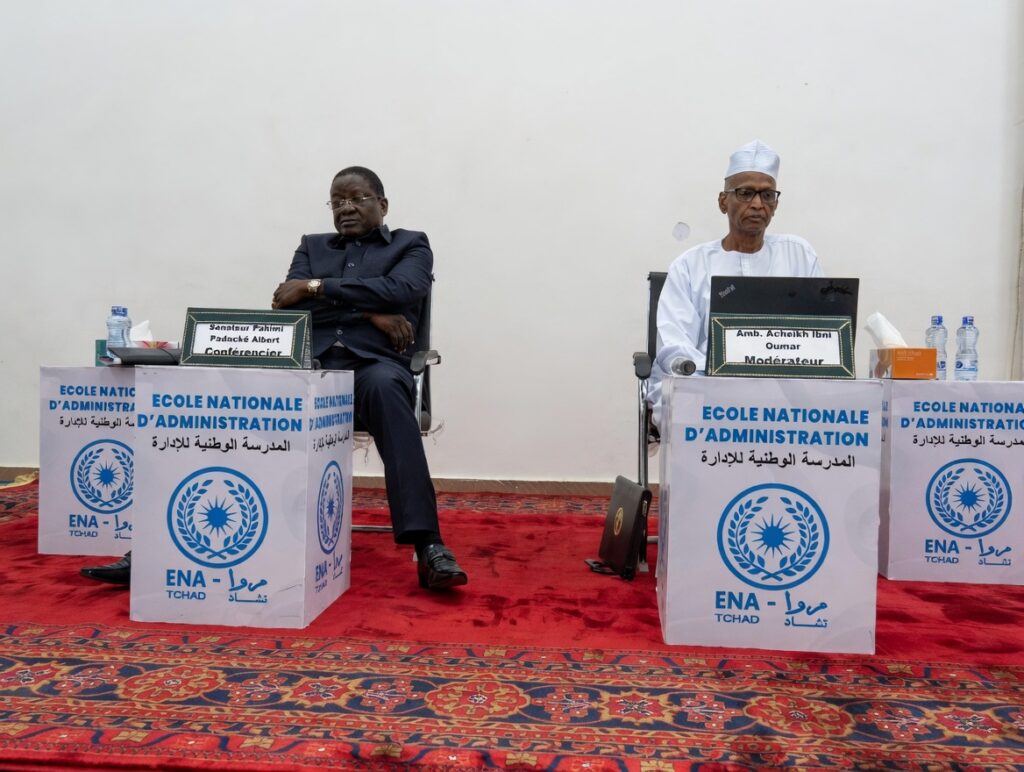
The École Nationale d’Administration (ENA) hosted a high-level debate this past Friday afternoon as part of its “Grands rendez-vous de l’ENA” series. The event featured Albert Pahimi Padacké, a seasoned politician, former Prime Minister, and current senator, who led a discussion on “Decentralization in the dynamics of local development: the case of provincial councils”. The amphitheater was packed with students, civil servants in training, administrators, and political stakeholders, all eager to engage with the speaker’s insights.
With decades of experience in governance and public administration, Pahimi Padacké delivered a structured, pragmatic, and deeply informative address. He opened by emphasizing the significance of the topic—decentralization—and its direct impact on grassroots development through provincial councils. His remarks were grounded in historical and international context, tracing the origins of Chad’s decentralization journey to the 1990s, a period marked by democratic transitions across Africa, donor pressure, and a shifting global paradigm toward participatory governance.
The central question of the debate was clear: Can provincial councils already drive development, or do they need further empowerment to fulfill this role? Pahimi Padacké framed the discussion around three critical pillars:
- Political and normative foundations of decentralization as a catalyst for development;
- Key barriers preventing provincial councils from operating at full capacity;
- Actionable solutions to transform these councils into engines of local progress.
The former Prime Minister anchored his analysis in Chad’s constitutional and legal framework. He highlighted that the country’s decentralization process gained momentum in the 1990s, culminating in the 1996 Constitution and later reaffirmed in the 2023 Constitution (5th Republic). Legally, this vision was cemented through organic laws, including Law No. 14 (2024), which defines the status of autonomous local governments, and Law No. 28 (2024), which outlines the division of competencies between the central state and these local entities.
Pahimi Padacké underscored two fundamental principles: the transfer of competencies and resources to local governments and the principle of subsidiarity (Article 271 of the Constitution), which mandates that decisions be made at the level closest to citizens. While Law No. 28 has formally transferred significant responsibilities to provincial councils—such as in education, health, and infrastructure—implementation remains hindered by gaps in secondary legislation and practical execution.
In his assessment of current challenges, the speaker painted a candid picture of systemic obstacles: delays in transferring financial and human resources, inadequate technical and administrative capacities within provincial councils, governance inefficiencies, and coordination gaps between deconcentrated administrations and elected local bodies. These hurdles, he noted, undermine the councils’ ability to deliver tangible results for communities.
The former Prime Minister concluded with a roadmap for tangible progress. He proposed accelerating the actual transfer of resources—particularly a share of oil and tax revenues—to provincial councils. He also called for targeted capacity-building for elected officials and civil servants, the establishment of robust monitoring and evaluation mechanisms, deeper involvement of civil society and development partners, and strict adherence to the principle of subsidiarity to ensure decentralization is not merely symbolic but transformative.
Addressing the next generation of administrators in the room, Pahimi Padacké urged them to embrace these challenges. He stressed that the success of decentralization is not just a technical issue but a cornerstone for balanced national development and a government that truly serves its people.
You may also like
Mamadi Doumbouya de retour à Conakry après une visite d’État en Côte d’Ivoire
Elversberg vs Bayern Munich: kick-off time, tv channel and team news
Gabon : l’association Force ouvre un espace de propositions pour la rentrée
Dakar 2026 : Diomaye Faye confie la flamme olympique à la jeunesse sénégalaise
Mali: at least 80 soldiers killed in deadly assault on Dioura camp