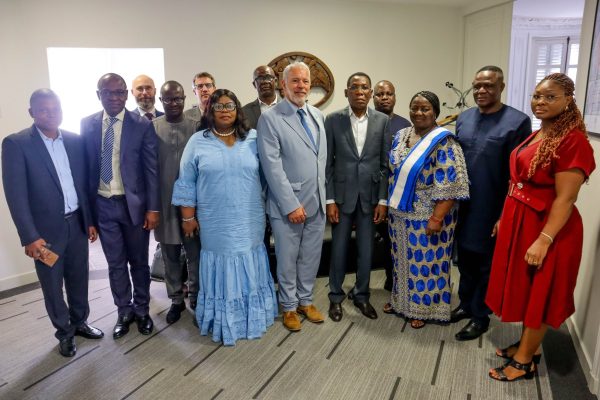
Government officials pose with UNODC experts on June 29 in Libreville
Gabon launched a four-day high-level anti-corruption dialogue in Libreville on June 29, 2026, bringing together national officials, UN experts, and international partners to assess progress in implementing the United Nations Convention against Corruption (UNCAC).
The session marks the second phase of the country’s review mechanism, focusing on preventive measures and asset recovery. Since ratifying the UNCAC in 2007, Gabon has been working to strengthen transparency, accountability in public service, and institutional governance.
Vice-President of the Government Hermann Immongault emphasized the pivotal role of corruption control in national development during the opening ceremony.
« Public integrity enhances government performance, safeguards investment flows, boosts economic competitiveness, and lays the foundation for sustainable, inclusive, and equitable growth, » he stated.
The UNODC’s Seraphin Ondoumba, who serves as the focal point for Gabon and a member of the National Commission against Corruption and Illicit Enrichment (CNLCEI), highlighted the broader significance of the dialogue.
« This direct exchange isn’t just a technical exercise—it provides a platform to recognize achievements, address remaining challenges, and foster stronger collaboration among states to promote best practices in anti-corruption efforts, » he noted.
The current review focuses on preventive frameworks and illicit asset recovery, with the UNODC team conducting an in-depth analysis of Gabon’s anti-graft systems. Mission Chief Mohamed Cherbal underscored the importance of assessing compliance with UNCAC’s preventive and recovery provisions.
This evaluation follows the country’s first review cycle in 2010, which assessed criminalization, law enforcement, and international cooperation. The initial assessment included a field visit by experts from Sierra Leone and Laos in 2015.
Nestor Mbou, President of the CNLCEI, framed the dialogue as a critical milestone for refining public policies.
« This direct dialogue serves as a vital checkpoint—not only to evaluate legal and institutional frameworks but also to identify successes, pinpoint gaps, and generate actionable recommendations to accelerate our anti-corruption strategy, » he said.
The outcomes of this assessment will guide future reforms, aiming to enhance national mechanisms for prevention, oversight, and recovery of illicit assets. The ultimate goal is to cultivate a more transparent, efficient, and citizen-accountable administration.