
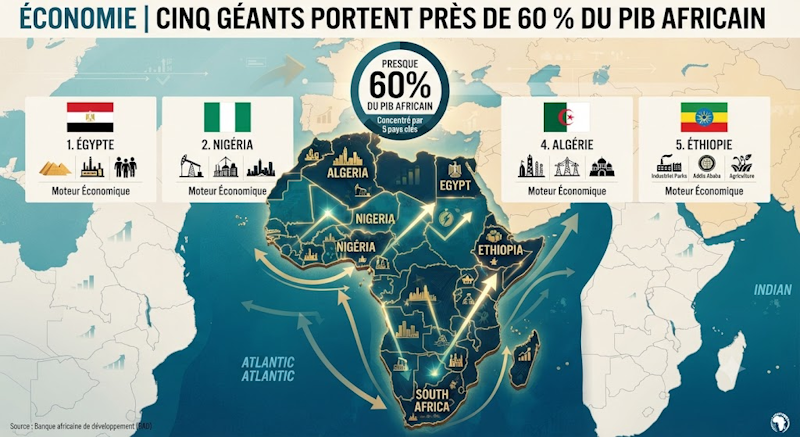
Fresh data from the African Development Bank reveals a striking economic reality: five nations collectively account for nearly 60% of Africa’s gross domestic product. These powerhouse economies—Egypt, Nigeria, South Africa, Algeria and Ethiopia—serve as the primary engines fueling the continent’s growth trajectory.
Why these economies dominate Africa’s economic landscape
This concentration of wealth isn’t accidental. Each of these five nations brings unique strengths to the table:
- Egypt and Nigeria leverage their massive populations and increasingly diversified economic bases to drive demand and innovation.
- South Africa maintains its position as the continent’s industrial and financial hub, with advanced infrastructure and a mature financial sector.
- Algeria relies heavily on its substantial energy reserves and strategic public investment programs to sustain economic momentum.
- Ethiopia has emerged as one of the fastest-growing economies through rapid industrialization and large-scale infrastructure development.
The widening gap between Africa’s economic leaders and laggards
The dominance of these five economies highlights the stark disparities across the continent. While they propel Africa’s overall growth, many neighboring countries struggle with persistent challenges:
- Limited industrialization and economic diversification
- Restricted access to financing and foreign investment
- High unemployment rates, particularly among youth
- Underdeveloped infrastructure networks
Pathways to a more balanced continental economy
Economic experts warn that without deliberate intervention, this imbalance could deepen. The key to sustainable development lies in:
- Strengthening regional trade networks to facilitate knowledge and resource sharing
- Implementing policies that encourage foreign direct investment in smaller economies
- Investing in education and skills development to create a competitive workforce
- Enhancing cross-border infrastructure projects to improve connectivity
The coming decade will determine whether Africa can transform its economic powerhouses into catalysts for broader continental prosperity—or if the gap between its wealthiest and poorest nations will continue to widen.
You may also like
Somaïr and Niger’s uranium collapse: technical failure behind a logistics smokescreen
Why Niger’s soldiers are walking away from Tiani’s army
Behind the sovereignty talk, AES states owe 7,727 billion CFA francs on the regional market
Benin back to school: classes reopen nationwide on 14 september 2026
Sonidep’s 2026 loss: how Niger’s cheap fuel policy is draining the state oil company