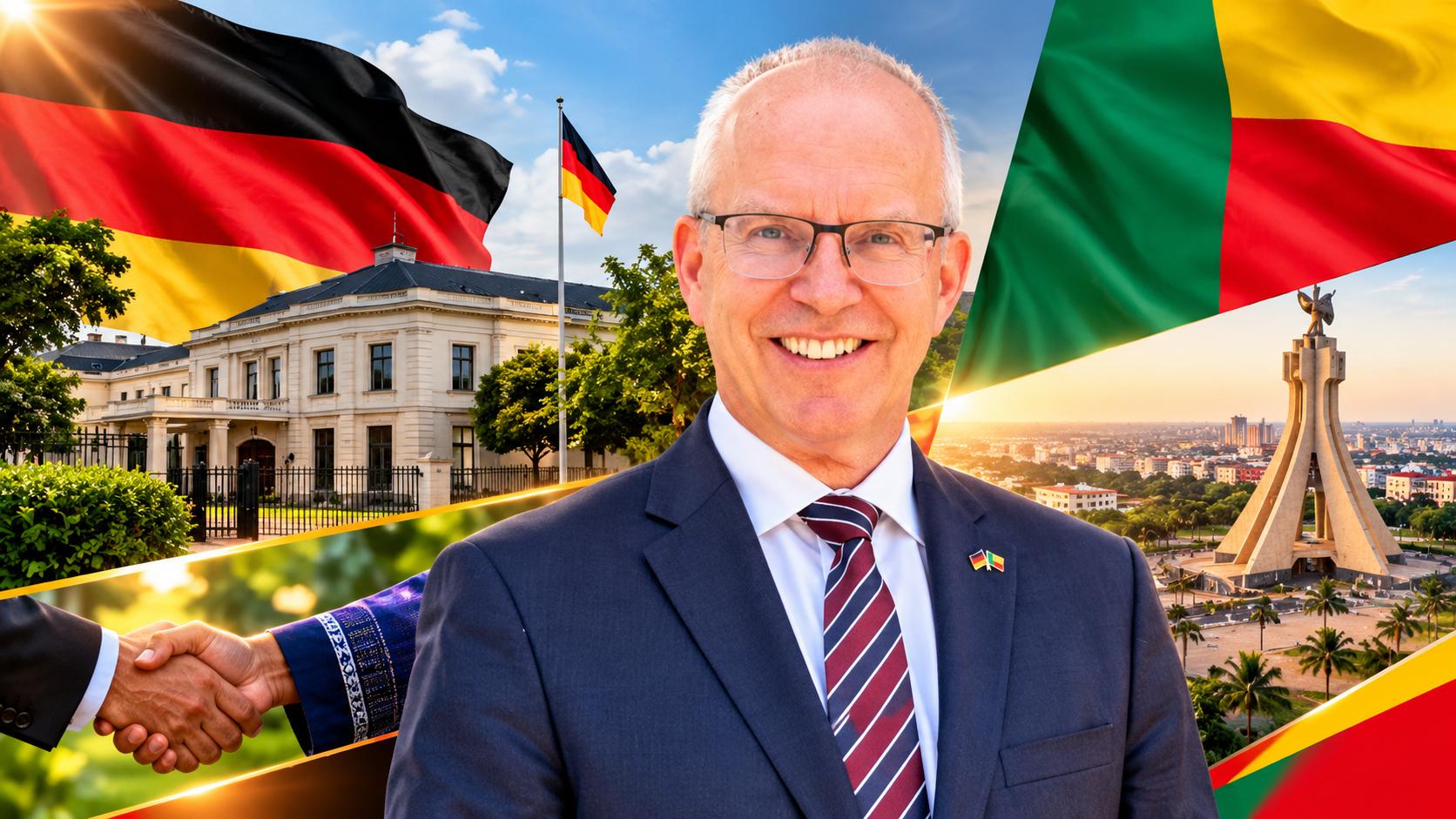
The ink on the joint communiqué was barely dry before reactions began circulating in Cotonou. On Thursday, 8 October 2026, Beninese and German delegations wrapped up their strategic bilateral consultations at the Ministry of Economy, Finance and Cooperation in Cotonou — and the announcement that followed has set off a wave of commentary about what the money really means and where the partnership is heading.
The talks were co-chaired by Hugues O. Lokossou, the minister responsible for mobilising external resources and managing debt, and Dr Silvia Morgenroth, who heads the West Africa Division at Germany’s Federal Ministry for Cooperation and Development (BMZ). Their task was to lay the groundwork for intergovernmental negotiations scheduled in Berlin in 2027 — a summit that now looms as the real test of this relationship.
What the €15 million announcement actually contains
In a joint statement issued on Friday, 9 October 2026, the German side confirmed an additional envelope of €15 million — roughly 9.8 billion CFA francs — for the current year. The money is split across two headline areas:
- Energy transition: adding a solar component to the Nangbéto hydropower plant, a mixed hydro-solar regional project.
- Local entrepreneurship: expanding advisory and technical support schemes for small and medium-sized enterprises, with a clear emphasis on empowering women entrepreneurs.
For many observers in Cotonou, the solar element is the most tangible signal. Pairing photovoltaic capacity with an existing hydroelectric facility is seen as a practical way to stabilise supply, while the SME component speaks directly to job creation and the informal economy.
Three pillars that mirror Benin’s reform agenda
Welcoming the discipline shown in Cotonou’s economic and financial reforms, the German delegation restated its backing for the government’s action programme (PAG) through three priority areas:
- Financial governance and decentralisation: strengthening local and territorial budget management capacity.
- Private sector development and vocational training: aligning training with employment for young people.
- Water management and biodiversity preservation: improving communities’ environmental resilience.
Both governments also reaffirmed their shared commitment to consolidating the rule of law, democracy and multilateral values, before formally confirming Berlin as the venue for their major 2027 bilateral meeting, where future multi-year commitments will be decided.
The debate: too little, or a strategic opening?
The reaction on the ground has been mixed. Supporters describe the €15 million as a smart, targeted injection that builds on existing structures rather than scattering funds. Critics, however, question whether the sum is proportionate to the ambitions being voiced, especially with the Berlin talks still more than a year away.
Analysts note that the announcement does more than release money — it sets a political marker. By tying the funding to the Nangbéto upgrade and to women-led SMEs, Berlin is signalling which parts of the PAG it wants to see succeed. That, in turn, shapes the negotiating terrain for 2027.
What comes next on the road to Berlin
With the communiqué now public, attention shifts to implementation. The coming months will show whether the solar component moves from concept to construction, and whether the SME advisory programmes reach the entrepreneurs they are meant to serve.
For now, the €15 million has done something no budget line can do on its own: it has sparked a public conversation about the direction of Benin-Germany relations — and raised expectations that the 2027 Berlin negotiations will deliver more than another headline figure.