
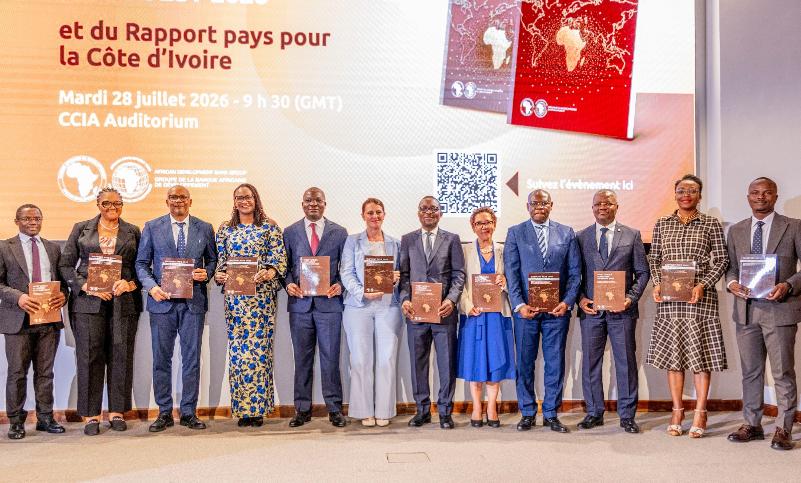
Côte d’Ivoire outlines development financing strategies at African Development Bank event
The Ivory Coast’s development financing blueprint took center stage at a high-level meeting in Abidjan, where government officials presented their strategies to the African Development Bank (AfDB). On July 28, Dr. Souleymane DIARRASSOUBA’s Cabinet Director, Professor Loesse Jacques ESSO, led the launch ceremony for the 2026 Côte d’Ivoire Country Report and the West Africa Economic Outlook Report. The event, held under the theme “Unlocking large-scale resources for Africa’s development in a fragmented world”, brought together AfDB representatives, national and international financial institutions, private sector players, and Ivorian government officials.
National priorities align with continental development goals
Under the leadership of President Alassane Ouattara, Côte d’Ivoire is prioritizing resource mobilization as a key driver of economic transformation. This strategic focus is embedded in the National Development Plan (NDP) 2026-2030, which aims to accelerate growth through increased public and private sector investment. The plan’s ambitious financing target of 114,838.5 billion West African CFA francs (approximately $209 billion) reflects the country’s commitment to achieving sustainable development.
The recent Consultative Group meeting held on July 8-9, 2026, demonstrated the international community’s confidence in Côte d’Ivoire’s development vision, with partners pledging $80 billion (47,820 billion West African CFA francs) in commitments. This exceptional mobilization underscores the country’s capacity to attract significant investment for its national priorities.
Regional insights highlight shared African challenges
Professor ESSO emphasized that the reports’ findings resonate across the continent, where nations face a common challenge: securing the massive resources needed to drive structural economic transformation. Key strategies discussed included:
- Enhancing domestic resource mobilization to reduce dependence on external financing
- Attracting greater private sector participation through innovative financing mechanisms
- Strengthening African financial systems to improve capital allocation efficiency
- Deepening regional integration through initiatives like the Pan-African Payment and Settlement System (PAPSS) and the African Continental Free Trade Area (AfCFTA)
Collaborative approach to development financing
The Ivorian delegation called for participants to carefully examine the reports’ analyses and recommendations, which serve as critical decision-making tools for policymakers and development partners. By fostering inclusive dialogue, the event aimed to strengthen collective reflection on the responsibilities and opportunities facing public administrations, the private sector, financial institutions, and civil society in building more effective development financing policies—both in Côte d’Ivoire and across the region.
The meeting concluded with a renewed commitment to leveraging these insights to shape policies that can accelerate Africa’s economic transformation in an increasingly complex global landscape.
You may also like
Niger : à Niamey, un convoi d’eau destiné aux mercenaires russes saccagé par la foule
Burkina Faso : Apollinaire Kyélem de Tambèla blocked from leaving the country
Cameroun : Yaoundé mobilise 432 millions USD pour reprendre Société Générale Cameroun
Burkina Faso’s energy gamble: 104 billion CFA francs pledged as unpaid bills to Côte d’Ivoire linger
Bénin : comment la fermeture préventive des écoles du Nord déjoue les plans terroristes