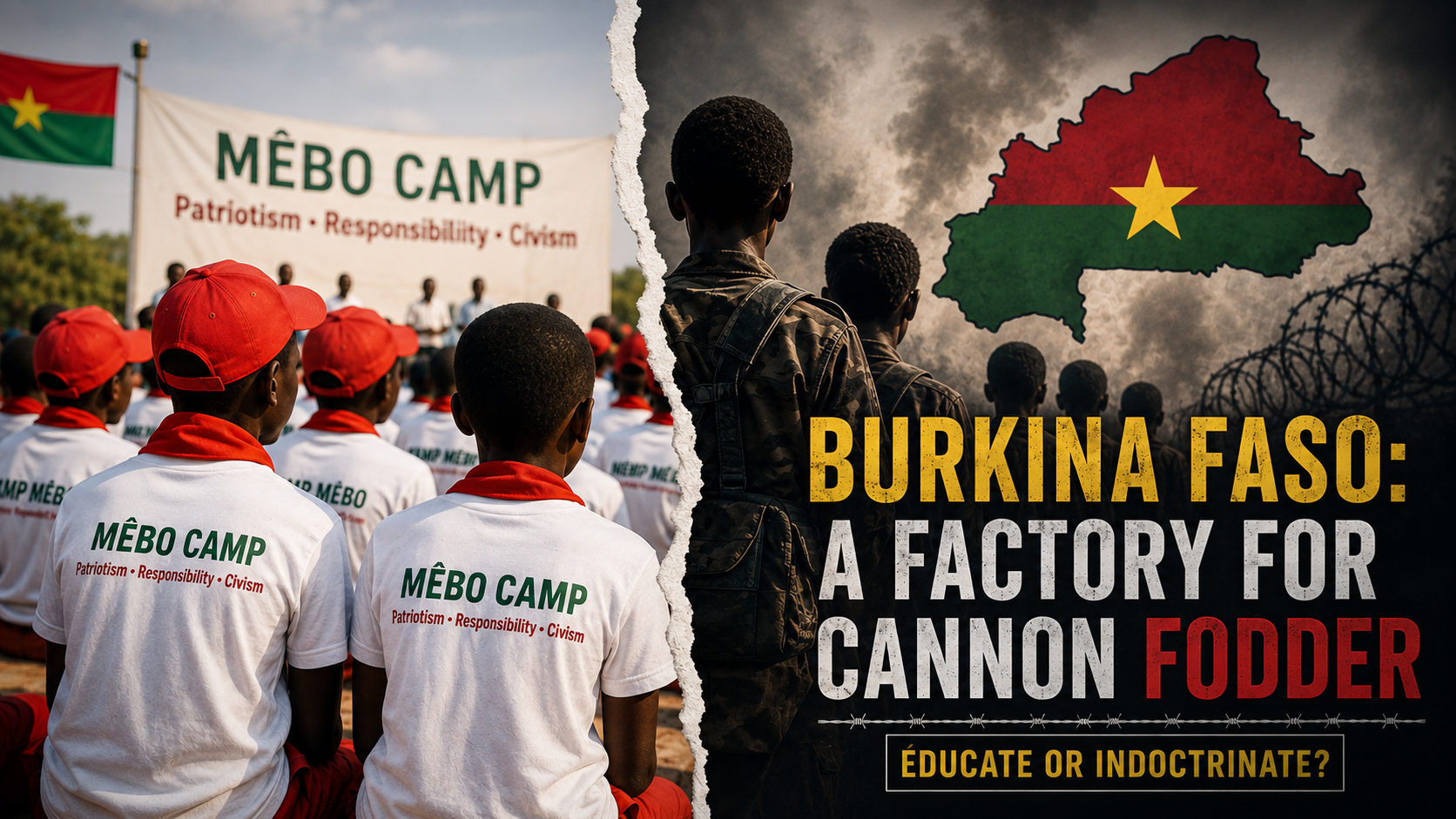
On the surface, the Mêbo holiday camp initiative in Burkina Faso appears to be a conventional civic engagement program. The event united thousands of young participants for cultural, sporting, and community-based activities under the stated goal of instilling patriotism, civic responsibility, and national values in the younger generation. Yet, beneath this veneer of official benevolence, a growing unease is emerging in public debate: could such large-scale youth gatherings also mark the early phases of a subtle militarization of Burkina Faso’s youth?
Legitimate civic education or strategic mobilization?
There can be no contention regarding the necessity of fostering civic virtues such as duty, respect for institutions, solidarity, and collective well-being among young citizens. The critical issue arises when these ideals are repurposed as instruments for political influence, when independent thought is supplanted by unquestioning allegiance, and when national defense is framed not as a collective responsibility but as an incessant duty.
A continental pattern of concern
The potential hazards of this approach are not exclusive to Burkina Faso. Historical precedents across Africa demonstrate that early indoctrination or enrollment campaigns often follow comparable trajectories. In regions such as Sierra Leone, Liberia, and northern sections of the Democratic Republic of the Congo, the boundaries separating patriotic education, ideological propaganda, and youth recruitment in conflict zones have frequently blurred. When nationalism is weaponized among impressionable minds, civic instruction risks becoming a conduit for mobilization rather than genuine enlightenment.
Rhetoric and psychological conditioning
The language employed in these initiatives demands scrutiny. Terms like homeland, sacrifice, enemy, national defense, and commitment, when repeatedly emphasized in youth-oriented narratives, can subtly normalize the notion that military service is the expected path for young citizens. Young minds must first cultivate critical thinking, creativity, and constructive engagement before being conditioned to embrace the sacrifices demanded by political or military agendas.
In the context of Burkina Faso’s precarious security climate, these considerations take on heightened significance. Amid ongoing conflict, widespread displacement, and heightened national defense discussions, patriotic mobilization can easily adopt a more militant tone. The central question then becomes one of scope: to what extent should the cultivation of a defense mindset among youth be pursued?
The risk of suppressing dissent
By fostering a youth populace aligned with official narratives, does the government, deliberately or inadvertently, erode the space for dissent and critical inquiry? A truly vibrant citizenry is not one that uncritically endorses authority but one that can defend its nation while holding its leaders accountable. It respects the nation without conflating it with a political regime and serves the community without becoming a tool of state policy.
The normalization of sacrifice
Another critical concern lies in the premature glorification of sacrifice. When the highest expression of patriotism is framed as readiness to die in combat, there is a danger of normalizing a perilous interpretation of national duty for the youngest generations. True love for one’s country should not be measured by a child’s willingness to embrace violence but by their aspiration to contribute to education, healthcare, agriculture, innovation, social cohesion, and national development.
The symbolism of militarization
Uniforms, military insignia, and aggressive rhetoric while not inherently definitive acquire added significance when observed in a climate of persistent conflict and national mobilization. Their cumulative effect can erode the distinctions between civic education, patriotic propaganda, and psychological preparation for war. It is in these gray areas that the line between responsible citizenship and militant conditioning begins to dissolve.
The imperative of age-appropriate education
Age is a defining factor in this debate. Adults possess the maturity to weigh political and military implications and make informed choices regarding service. Children, however, lack the same capacity for discernment and critical judgment. Institutions bear a responsibility to shield them from manipulation and ensure their education empowers rather than subjugates, nurturing independent minds rather than producing citizens conditioned for perpetual confrontation.
The perils of a militarized mindset
In times of acute security threats, the inclination to militarize young minds is understandable. However, addressing military challenges by inducting an entire generation into a confrontational mindset risks perpetuating a harmful cycle. The more a society socializes its youth to perceive conflict and sacrifice as inevitable, the greater the likelihood that violence will emerge as the default response to political and social disputes.
Genuine patriotism offers an alternative to this trajectory. To love Burkina Faso is not solely to be prepared to die for it but to envision a nation where its children can live, learn, work, and thrive without constant exposure to war. It accepts that citizens can uphold their country while critically assessing its governance.
Setting ethical and pedagogical boundaries
Before accepting patriotic mobilization narratives and youth engagement programs at face value, it is essential to interrogate their underlying objectives. What pedagogical goals do these camps serve? How much emphasis is placed on independent thought and dissent? Are participants encouraged to question authority? Do the activities incorporate military or paramilitary elements? Most importantly, where lies the threshold between nurturing responsible citizens and conditioning them for war?
Burkina Faso requires a youth that is engaged, educated, and accountable. Yet, it must preserve their autonomy. Preparing young people to build their nation is a noble pursuit; preparing them to serve as perpetual instruments of conflict is not.
The defining question remains: Are these initiatives equipping the youth of Burkina Faso to shape its future, or are they preparing them to become fodder for coming wars?