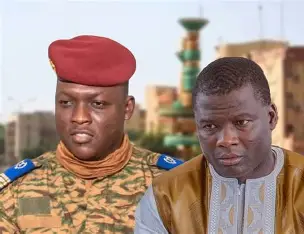
For over two years, Burkina Faso’s leadership has taken an increasingly adversarial tone toward France. Under the leadership of Captain Ibrahim Traoré, Paris has been repeatedly portrayed as the emblem of a colonial past that the country is determined to leave behind. The expulsion of French forces, rejection of Western influence, and public alignment with Russia and Iran have become central themes in the government’s official narrative.
Yet beneath this rhetoric of confrontation, subtle inconsistencies have begun to surface.
A discreet visa request amid public hostility
According to well-informed sources, Inoussa Traoré, the elder brother of Burkina Faso’s transitional president, recently submitted a visa application to French authorities in Ouagadougou. The request was reportedly handled with the utmost discretion, reflecting the sensitivity of the matter.
The move comes as a surprise given Inoussa Traoré’s public profile as a special adviser to the president. While he has previously sought medical treatment in the Netherlands, this request suggests a potential shift in travel plans—though neither French nor Burkinabè officials have confirmed the details.
Political contradictions fuel skepticism
The timing of this apparent request raises questions about the credibility of Burkina Faso’s anti-Western stance. Since assuming power, Ibrahim Traoré has built his political identity on rejecting France, with official statements frequently condemning Paris for historical grievances and current influence.
If true, the visa application by a close family member of the president forces a reconsideration: Why seek entry into a nation consistently framed as an adversary in state discourse?
Critics of the regime have long pointed to such discrepancies, arguing that the government’s public declarations do not always align with personal or institutional actions. The situation risks reinforcing accusations of double standards—where tough rhetoric is reserved for public consumption, while France remains a destination of last resort for urgent needs.
Sovereignty in action—or mere political posturing?
Ouagadougou has positioned itself as a champion of full independence, vowing to sever ties with former colonial powers. Yet the practical realities of governance—whether in healthcare, finance, or administrative procedures—often necessitate engagement with European partners.
For the Traoré family, a confirmed visa request could underscore the tension between rhetoric and reality. While the government champions self-reliance, personal circumstances may still drive reliance on Western systems, particularly when specialized medical care or logistical support is required.
The credibility gap in political messaging
This episode highlights a recurring challenge in modern diplomacy: the scrutiny of actions versus words. When a state publicly frames another as an enemy or undesirable partner, even private engagements can be interpreted as contradictions. While this alone does not invalidate a political stance, it does expose vulnerabilities in messaging that opponents are quick to exploit.
If verified, the visa request would serve as a reminder that political narratives, no matter how forceful, must eventually contend with the practical demands of governance. The case of the Traoré family may well illustrate the limits of a strategy built on rupture with Paris—one where personal needs occasionally override public posturing.