Despite Captain Ibrahim Traoré’s administration consistently denouncing the Economic Community of West African States (CEDEAO) as a tool of Western powers, the financial landscape reveals a starkly different narrative. Beyond the political condemnations, the Burkinabè government actively seeks and secures substantial financial aid from this very regional body.
This evident contradiction warrants close examination, as it underscores a significant divergence between political declarations and the economic imperatives a nation invariably faces. An organization might be politically censured, yet simultaneously function as a crucial financial partner whose mechanisms underpin the funding of vital initiatives.
Significant investments in critical infrastructure
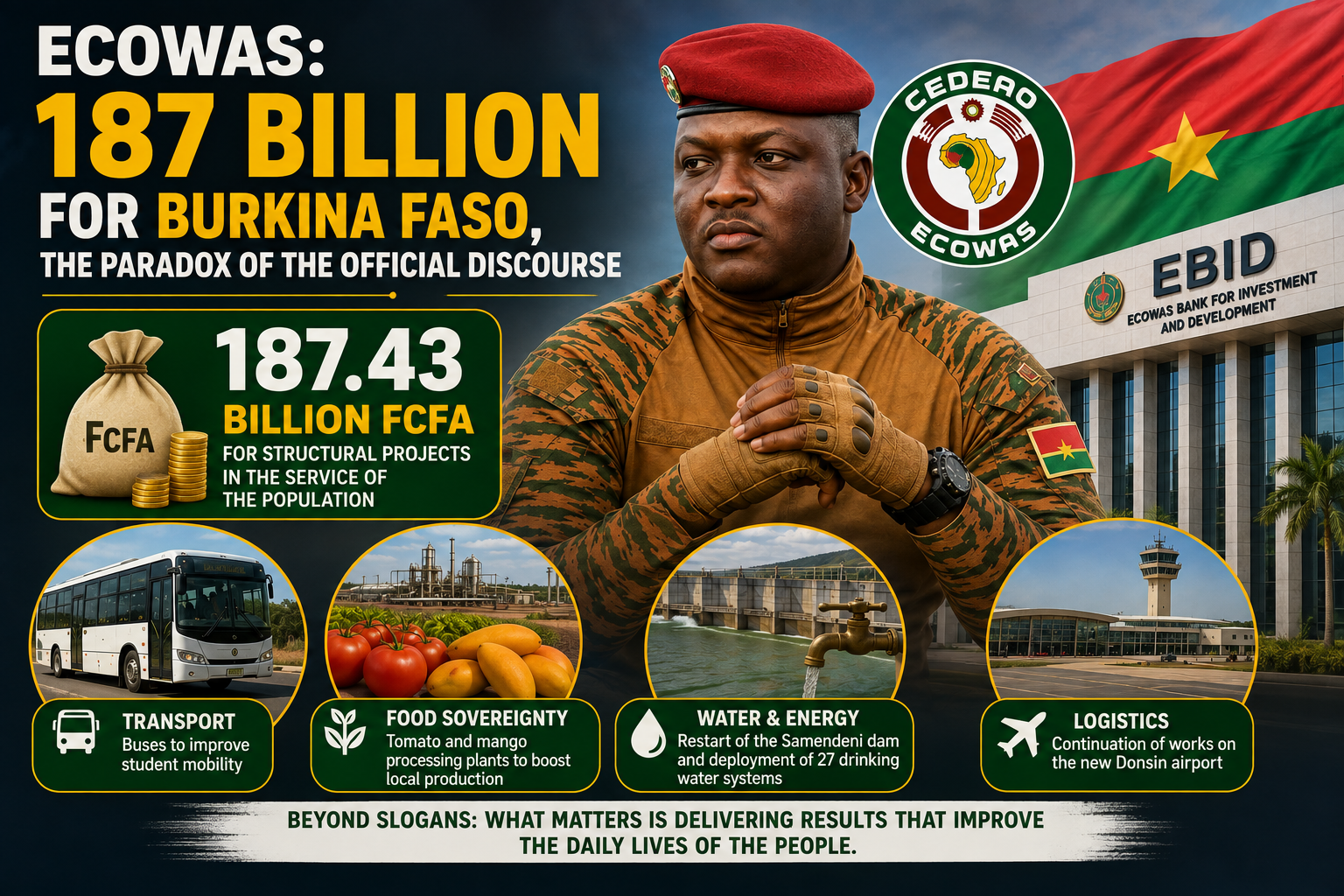
The ECOWAS Bank for Investment and Development (EBID) has recently provided a significant boost. A staggering 187.43 billion CFA francs are being channeled into projects deemed crucial for the daily lives of Burkinabè citizens:
- Transportation and Education: The procurement of buses aims to alleviate student transport congestion. Beyond enhancing mobility, this investment directly impacts access to education and has the potential to mitigate daily challenges faced by students and their families.
- Food Security: The establishment of tomato and mango processing plants is designed to enhance the value of local agricultural output. The objective extends beyond increasing production; it encompasses on-site processing, generating added value, minimizing agricultural waste, and creating new market avenues for producers.
- Water and Energy: The revitalization of the Samendeni dam and the implementation of 27 potable water systems in underserved areas are underway. For a nation grappling with considerable economic, social, and security challenges, access to water is not merely a developmental concern but also a fundamental factor in population stability.
- Logistics: Construction continues on the new Donsin airport. An infrastructure of this magnitude holds the potential to bolster trade, improve national connectivity, and stimulate economic activity, provided that the construction is successfully completed and the investments are effectively utilized.
These financial commitments primarily demonstrate that regional integration transcends mere political pronouncements or diplomatic gatherings. It also encompasses robust financial instruments capable of tangibly supporting member states in their developmental endeavors.
The disparity between rhetoric and economic realities
Beneath the surface of confrontational stances and sovereignist slogans, this substantial capital infusion illuminates an uncomfortable truth: Burkina Faso remains reliant on the operational and financial support provided by the very regional integration mechanisms it publicly disparages.
Herein lies the core paradox. On one hand, official discourse frequently portrays CEDEAO as an entity inimical to Burkina Faso’s interests and susceptible to external influences. Conversely, financial mechanisms affiliated with this identical organization continue to be leveraged to fund essential infrastructure projects benefiting the Burkinabè populace.
This scenario underscores a fundamental aspect of contemporary governance: interstate relations cannot always be distilled into simple political alliances or animosities. Economic interests, funding requirements, regional infrastructure needs, and developmental imperatives frequently necessitate forms of cooperation that transcend ideological narratives.
It is therefore pertinent to pose a straightforward question: if CEDEAO’s mechanisms are indeed as detrimental to Burkinabè interests as official communications imply, why persist in utilizing their financial instruments for the funding of strategic projects?
This inquiry does not suggest that a state should forgo defending its interests or critiquing a regional body. Rather, it highlights the crucial need for consistency between public declarations and economic decisions. One cannot simultaneously characterize an institution as inherently hostile while deeming its resources valuable when they serve to finance national infrastructure.
A contradiction that challenges sovereignty
The concept of sovereignty lies at the core of current political discourse in Burkina Faso. However, sovereignty should not be conflated with isolation. A sovereign state is capable of defending its interests, challenging certain regional decisions, and concurrently leveraging available cooperation mechanisms when they benefit its populace.
The true imperative, therefore, appears less about whether Burkina Faso should accept or reject all cooperation with CEDEAO, and more about ascertaining if these funds are deployed efficiently, transparently, and in alignment with national priorities.
Indeed, 187.43 billion CFA francs constitute a substantial allocation. This sum represents potential infrastructure, employment opportunities, equipment, public services, and economic prospects. Nevertheless, an announced funding package does not automatically equate to tangible outcomes. Genuine efficacy will hinge on project execution, adherence to timelines, the quality of the infrastructure, and the authorities’ capacity to ensure stringent resource management.
The issue of transparency is consequently paramount. Citizens possess a legitimate right to understand how these funds are mobilized, under what conditions, for which projects, with what timelines, and through what oversight mechanisms. Sovereignty ought not merely to be asserted in rhetoric; it should also manifest as an ability to provide accountability regarding the utilization of resources dedicated to development.
Beyond political contention, the populace awaits tangible results
Ultimately, the discourse surrounding CEDEAO should not be confined solely to ideology. For the student seeking transportation, the producer aiming to sell their harvest, the family anticipating reliable access to potable water, or the entrepreneur requiring modern infrastructure, the central question remains consistent: what concrete changes will these investments bring to daily life?
It is on this practical ground that the authorities will ultimately be evaluated.
A proclaimed factory must become operational. A water supply system must genuinely deliver water. Buses must effectively enhance student mobility. A dam must yield its anticipated benefits. An airport must evolve into a genuine instrument of development.
The fundamental question now pertains to implementation: will these be transformative commitments that genuinely alter citizens’ daily routines, or merely another financial package susceptible to administrative delays? The populace, for its part, expects pragmatic and tangible outcomes, far transcending political skirmishes.
Ultimately, neither sovereignist declarations nor criticisms directed at CEDEAO will construct roads, supply cities with water, support farmers, or enhance transportation. It is the caliber of these investments, their judicious management, and their concrete manifestation in the lives of citizens that will determine the true impact of these 187 billion CFA francs.